


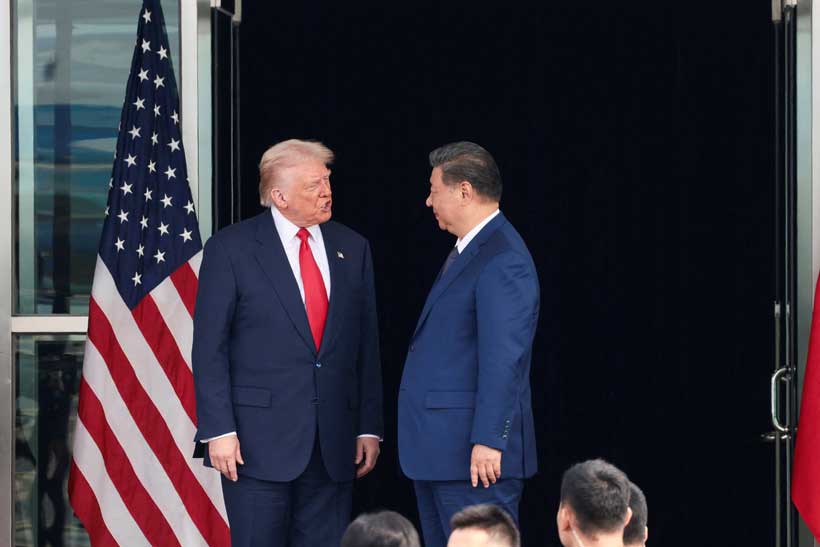
The U.S.-led military campaign against Iran has altered the diplomatic landscape ahead of a planned summit between U.S. President Donald Trump and Chinese President Xi Jinping in Beijing later this month.
The strikes, which reportedly killed Iran’s Supreme Leader Ali Khamenei, follow an earlier U.S. operation in Venezuela that led to the capture of President Nicolas Maduro two leaders of countries that have served as key oil suppliers to China. The twin actions underscore Washington’s willingness to use military force against governments aligned with or economically significant to Beijing.
While the summit was initially expected to focus on trade disputes and tariffs, the Iran campaign has reshaped the strategic context. Beijing has condemned the strikes as “unacceptable” but has avoided escalating rhetoric or signaling material support for Tehran.
Energy and Economic Exposure
Stay ahead of the geopolitical week.
MD Briefing delivers expert analysis across five global fronts — the Indo-Pacific, energy, geoeconomics, European security, and the Middle East — every Monday morning. Free.
China is uniquely exposed to disruption in Iranian oil supplies. As the world’s largest buyer of Iranian crude, it relies heavily on shipments that transit the Strait of Hormuz, a chokepoint now threatened by the conflict. Any sustained closure or instability could increase input costs for China’s manufacturing-driven economy and intensify inflationary pressures.
Although China can diversify suppliers, replacing Iranian volumes quickly would prove costly. The broader risk lies in energy market volatility, which could weaken Beijing’s economic footing just as it enters sensitive trade negotiations with Washington.
Symbolic and Strategic Implications
Beyond energy, the strikes serve as a demonstration of U.S. global military reach. For Beijing, they are a reminder that Washington retains the capability and political willingness to project force far beyond the Indo-Pacific.
Analysts suggest China’s restrained response reflects both limited leverage over U.S. military decisions and the transactional nature of its relationships with partners such as Iran. Beijing appears unwilling to be drawn directly into confrontation, preferring instead to let Washington bear the risks of Middle Eastern entanglement.
Implications for the Summit
The Iran operation may strengthen Trump’s hand going into talks, projecting decisiveness at a moment when domestic legal challenges to his tariff regime had threatened to weaken his negotiating position. By contrast, Xi faces the awkward optics of hosting Trump amid U.S. strikes against a Chinese energy partner.
Yet the advantage may be temporary. If the conflict drags on or destabilizes energy markets, the economic fallout could erode U.S. leverage as well. Prolonged Middle East engagement could also strain U.S. military resources, potentially affecting deterrence calculations elsewhere.
Analysis
In the short term, the Iran campaign shifts psychological momentum toward Washington, reinforcing an image of strategic boldness. However, leverage in U.S.-China relations depends less on symbolism than on durability. If the Middle East conflict remains limited and energy flows stabilize, Trump may enter Beijing with enhanced bargaining power.
If, however, the war expands or disrupts oil markets significantly, both economies will feel the strain and Xi may calculate that time is on China’s side. Beijing’s strategy appears to be patience: avoid direct involvement, secure alternative energy channels, and allow Washington to absorb the long-term costs of intervention.
With information from Reuters.
