


The international legal framework regulating the use of nuclear weapons is primarily shaped by the Treaty on the Non-Proliferation of Nuclear Weapons (NPT). The preamble of the NPT reflects its core objectives: the non-proliferation of nuclear weapons, nuclear disarmament, and the promotion of the peaceful use of nuclear energy. According to NPT Art. IV(1), the use of nuclear energy for peaceful purposes is recognized as an ‘inalienable right’ of all the parties. Nuclear energy can be applied as a material and technology, both in military operations and in civilian contexts. This right can only be exercised on the condition of full compliance with the non-proliferation obligations set forth in NPT Art. III, and the conclusion of safeguard agreements with the International Atomic Energy Agency (IAEA). The IAEA has been a significant international organization and contributor to the verification of the compliance with obligations arising from the NPT. Under Art. III. Parties are required to conclude agreements with the IAEA, accepting the imposition of safeguarding measures on all nuclear material in the territory of jurisdiction or control of the State, for the purpose of verifying that the materials are not intended for nuclear weapons or nuclear explosive devices.
The NPT does not establish a centralized enforcement mechanism. In cases of noncompliance with the treaty provisions, the IAEA Board of Governors, serving as the primary institutional body, may refer the issue to the UN Security Council (Art. XII, IAEA Statute, 1989). The absence of an enforcement mechanism within the NPT framework indicates that compliance is ensured through state compliance and verification measures. According to Art. VI of the NPT, state parties undertake to pursue negotiations in good faith toward nuclear disarmament, leading ultimately to the cessation of the nuclear arms race. (Nuclear weapons, A. O., 1996, para. 98). Thus, the development of a disarmament framework and the cooperation of the international community are required, affirming that the NPT constitutes a significant step leading to complete nuclear disarmament. (Nuclear weapons, A. O., 1996, para. 99).
The International Court of Justice (ICJ) emphasized that any deployment of nuclear weapons must comply with jus ad bellum, the law regulating the right to resort to armed force, as well as jus in bello, the law of armed conflict. The use of nuclear weapons under IHL is not per se prohibited either by the Geneva Conventions or by the Additional Protocol I. Thus, the legality of nuclear weapons depends on whether their use, as methods and means of war, complies with the core principles of International Humanitarian Law.
The case of Iran
Stay ahead of the geopolitical week.
MD Briefing delivers expert analysis across five global fronts — the Indo-Pacific, energy, geoeconomics, European security, and the Middle East — every Monday morning. Free.
Iran was a signatory to the NPT. In the early 1950s, the US provided the “know-how” to Iran in order to develop a nuclear program. In particular, they signed a nuclear agreement for the peaceful and civilian use of nuclear energy as part of the Atoms for Peace program. The key turning point in Iran-US relations occurred in 1979, when the Iranian Revolution overthrew the pro-Western Mohammad Reza Pahlavi dynasty, undermining the foundational idea of ‘Westernization.’
Since 1970, Iran has developed a nuclear program, claiming that it serves only peaceful purposes. However, Iran faced opposition from many states in developing its nuclear program. It was believed that the program could be diverted toward developing nuclear weapons; issues arose relating to limited transparency with the IAEA inspections and the uranium and plutonium enrichment activities.
In 2015, the UN Security Council imposed sanctions on Iran, including restrictions on its nuclear program activities, enhanced verification measures, and inspections on its uranium and plutonium enrichment, imposed limitations on the development of its weapons and ballistic missiles, as well as economic sanctions. The Resolution S/2015/544 endorsed the JCPOA; the Joint Comprehensive Plan of Action (JCPOA) was a diplomatic accord agreed upon between Iran and the European Union. The JCPOA does not serve as a source of international law, nor is it provided with a legally binding character. It is a detailed framework for verification, transparency, activity monitoring, and safeguarding that Iran’s nuclear program would serve only for peaceful and civilian purposes.
The Preemptive Strike
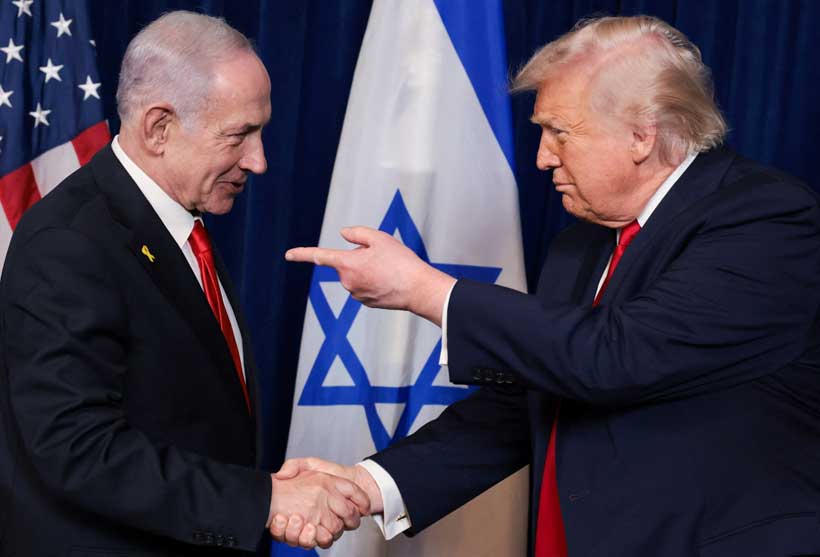
On 28 February 2026, the United States, along with Israel, conducted a preemptive strike on Iranian territory. The strikes targeted Iranian nuclear sites and military sites. The Iranian supreme leader, Khamenei, has been killed, along with several other high-ranking officials and key persons in the Iranian regime.
This action raises significant questions. Under international law, the prohibition of the threat of the use of force, set forth in Article 2(4) of the UN Charter, has crystallized as a jus cogens norm, where no derogation is permitted. According to Article 51 of the UN Charter, states have the inherent right to resort to individual or collective self-defense if an armed attack occurs against a member of the UN. The right to self-defense shall fulfill certain prerequisites, such as the principle of necessity and of proportionality. As it was expressed in the 1837 Caroline Incident, the use of force is justified only in cases where the threat is imminent and overwhelming, leaving no choice of means and no moment for deliberation.
A preemptive strike does not require the actual occurrence of an armed attack. The preemptive self-defense is an asserted legal right to use military force against a target that does not pose a threat yet but may in the future and aims to protect the security of the State or of the International Community against future threats. Such an action has precedent: In 1981 Israel carried out a preemptive strike on Iraq’s nuclear reactor, aiming to prevent the development of nuclear weapons, claiming that the strike was intended to protect the geographical region and the international community. However, the UN Security Council condemned this action, highlighting the inalienable sovereign right of every state and the threat posed by such a premeditated Israeli attack (SC Res. 487, 1981).
The U.S. and Israel justified their 2026 strikes, claiming that Iran poses an imminent threat as it has been developing a nuclear program for nonpeaceful purposes. In particular, the operation targeted nuclear sites, believed to be critical to Iran’s capability to produce enriched uranium and plutonium, ultimately leading to the development and deployment of nuclear weapons. However, the absence of a direct or an imminent attack, the negotiations that have been taking place between the two states, and the targeting of civilians and of facilities used for civilian purposes create legal ambiguity. Furthermore, the operation directly affected the right of Iran to develop a nuclear program for peaceful purposes. Notably, the operation has also another dimension; the strike was of a preventive and not preemptive nature. It was intended to establish a new order of things, a new regime in the area, by targeting Iran’s supreme leader, as well as a new structure in the power of the global economy.
