


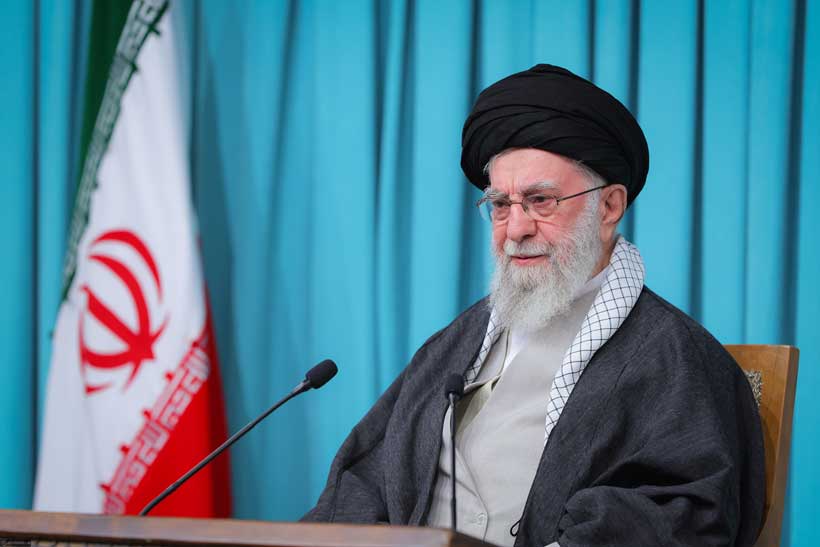
Ayatollah Ali Khamenei has ruled Iran since 1989, exercising ultimate authority over all branches of government, the military, and the judiciary. With decades of experience navigating internal unrest, regional conflicts, and foreign pressure, Khamenei now faces arguably the gravest crisis of his 36-year tenure: a sanctions-hit economy, massive domestic protests, and the threat of U.S. airstrikes over Iran’s missile and nuclear programs.
Despite an embittered population and weakened regional influence, Khamenei remains fiercely devoted to preserving the Islamic Republic and maintaining his control, drawing on a mix of ideological rigidity, tactical flexibility, and a loyal security apparatus.
Preserving the Islamic Republic
Khamenei’s January 2026 crackdown on nationwide protests was the deadliest since the 1979 revolution, with security forces opening fire on demonstrators chanting “Death to the dictator!”. These actions underscore his zero-tolerance approach to dissent and his use of force to preserve the Islamic Republic at all costs.
The Supreme Leader’s resistance to U.S. demands to limit Iran’s ballistic missile program highlights his intransigence on core strategic issues, even as negotiations attempt to avert military strikes. Iran views its missile arsenal as essential deterrence against Israel and other regional threats.
Stay ahead of the geopolitical week.
MD Briefing delivers expert analysis across five global fronts — the Indo-Pacific, energy, geoeconomics, European security, and the Middle East — every Monday morning. Free.
Political and Strategic Calculations
Khamenei’s leadership style blends ideological steadfastness with calculated pragmatism. The concept of “heroic flexibility,” first articulated in 2013, allows tactical compromises to preserve regime survival, a strategy mirrored in his guarded support for the 2015 nuclear deal. While he resisted concessions on missiles, Khamenei has previously accepted negotiated agreements when sanctions relief or stabilization of domestic power required it.
He operates through a carefully structured security network, relying heavily on the Islamic Revolutionary Guard Corps (IRGC) and the paramilitary Basij, who enforce internal discipline and quell protests. These forces were instrumental in suppressing unrest following the disputed 2009 presidential election, the death of Mahsa Amini in 2022, and the latest January protests.
Consolidation of Power
Khamenei rose from relative weakness to dominance by building a loyal security and administrative apparatus. Early in his rule, he lacked the religious credentials to assert authority, but he consolidated power through the IRGC, Basij, and a vast financial empire known as Setad, worth tens of billions of dollars. These assets have strengthened both his political influence and his capacity to fund strategic and military initiatives.
His personal history surviving assassination attempts, imprisonment under the Shah, and severe torture has shaped a leader deeply distrustful of betrayal and committed to maintaining a tight grip on power. His early experience as deputy defense minister and later as president during the Iran-Iraq war further cemented his strategic instincts and ties to Iran’s security apparatus.
Regional and International Challenges
Khamenei’s influence in the Middle East has been eroded. Key allies and proxies, including Hezbollah and Syrian President Bashar al-Assad, have weakened or fallen. Israeli and U.S. strikes last year destroyed critical nuclear and missile infrastructure, while Iran’s economy remains crippled by sanctions.
U.S. President Donald Trump’s renewed threats of military action increase the stakes, challenging Khamenei to balance domestic repression, international negotiation, and military deterrence. The Supreme Leader’s decisions now carry profound implications not just for Iran but for the stability of the broader Middle East.
Analysis
Khamenei exemplifies a combination of ideological rigidity and pragmatic adaptability. His survival and consolidation of power reflect mastery over Iran’s unique political system, blending limited democracy with clerical authority and a powerful security state. His strategic patience and tactical flexibility have historically allowed him to outlast crises and maintain control.
Yet, the convergence of domestic unrest, regional military setbacks, and looming U.S. pressure may constitute a historical stress test even for a leader of his experience. Khamenei’s refusal to compromise on missiles and core security levers suggests he is prepared to risk confrontation rather than surrender strategic autonomy, potentially escalating tensions in the Middle East.
Iran’s Supreme Leader faces a pivotal moment in his 36-year rule, balancing regime survival, regional influence, and international pressures, with consequences that could reshape the future of Iran and its neighborhood.
With information from Reuters.
