


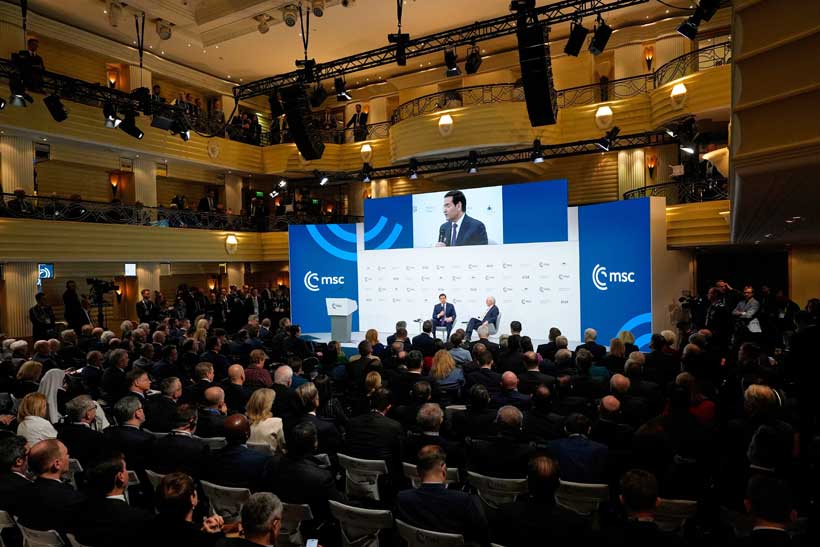
The 62nd Munich Security Conference took place in a turbulent environment. Europe remains the theater of a protracted war between Russia and Ukraine. On NATO’s eastern flank, the fighting extends well beyond territorial claims; it is embedded in a broader reconfiguration of power relations, where spheres of influence, civilizational narratives, and shifting strategic centers of gravity intersect. At the same time, technological acceleration and industrial competition are reshaping the criteria of power. Therefore, power is now measured not only by the capacity to project force but also by the ability to secure industrial flows and supply chains that underpin future technological and military advantage. The Alliance itself is undergoing a period of introspection. Between American demands for greater burden sharing and Europe’s pursuit of strategic autonomy, the transatlantic architecture is under strain. These frictions are compounded by sensitive dossiers, including Greenland—now more explicitly integrated into Arctic strategic calculations—as well as more directive approaches to defense procurement and interoperability within the Alliance.
Within this framework, rivalry with China—and, in the background, with Russia—shapes repositioning strategies on both sides of the Atlantic. Sino-American competition is no longer confined to military or technological domains; it extends to the control of critical and strategic materials. In this long-term contest, Beijing holds a structural advantage: China dominates several key segments of the value chain—extraction, refining, and processing—particularly in rare earths and other minerals essential to defense industries, semiconductors, batteries, and green technologies. This configuration creates a durable vulnerability for Washington. Excessive dependence on a strategic competitor exposes American industrial supply chains to risks of economic coercion, export restrictions, and geopolitical disruption.
Against this backdrop, Marco Rubio’s intervention at the Munich Security Conference can be interpreted as reflecting an adjustment in how Washington conceives its international role. As the pivot power of the international system, the United States exerts a structuring influence on the global balance: any shift in its posture reverberates through the prioritization of interests, alliance management, and the handling of major theaters of tension.
When Rubio declared that “the old world is gone,” he echoed a reading already present in several recent U.S. strategic documents—namely, that the international environment has undergone a structural transformation. For Washington, the post–Cold War framework no longer serves as the dominant reference point. The system is evolving toward a configuration marked by fragmentation, enduring rivalries, and heightened exposure to technological, industrial, and energy vulnerabilities. In this context, the modalities of American engagement are being reassessed, with implications for alliance conduct and crisis management.
Stay ahead of the geopolitical week.
MD Briefing delivers expert analysis across five global fronts — the Indo-Pacific, energy, geoeconomics, European security, and the Middle East — every Monday morning. Free.
This evolution is consistent with the orientations set out in the National Security Strategy 2025 (NSS 2025) and the National Defense Strategy 2026. The emphasis shifts away from extending a universal liberal order toward consolidating a strategic space capable of sustaining systemic competition. Analytically, this doctrinal repositioning may be described as Pax Americana 2.0—an evolution in the exercise of American leadership within a durably competitive environment.
From Liberal Integration to Structured Competition
The Pax Americana established after 1945 rested on a relatively coherent architecture: trade openness, normative diffusion, multilateral institutions, and military superiority. The implicit assumption was convergence—that economic integration would eventually generate political stabilization. Today, that paradigm appears weakened.
Supply chains have become instruments of strategic leverage. Technological interdependencies expose critical vulnerabilities. Multilateral mechanisms reveal their limits when great-power rivalries paralyze collective decision-making. The war in Ukraine highlighted the inability of the UN Security Council to produce a coercive response in a crisis involving a permanent member. Tensions surrounding Iran’s nuclear program illustrate the erosion of multilateral negotiation frameworks, while the Gaza crisis underscores how strategic divisions among major powers impede durable stabilization.
In each of these cases, multilateralism functions more as a diplomatic arena of confrontation than as an effective mechanism of regulation. Ultimately, the international order is structured less by normative integration than by the pragmatic management of power balances and by the capacity of coalitions to impose a minimum equilibrium. In this logic, Pax 2.0 no longer pursues universalization; it organizes stability through deterrence, industrial resilience, and the securing of strategic flows. Methodologically, this approach resonates with the Preventive Priorities Survey (PPS 2025), which ranks crises not in pursuit of a universal order to impose, but through selective risk management within a structurally conflictual system.
Economic Security and the Doctrine of Strategic Burden
The new American strategic doctrine, as expressed notably in the NSS 2025, elevates economic security to a central pillar of national power. Supply chains, critical materials, and technological infrastructures are treated as parameters of power. Within this framework, the Vault Project—an initiative bringing together more than fifty countries—aims to secure access to critical minerals and essential technological components for defense industries and strategic sectors. The supply chain becomes a domain of geopolitical competition.
For its part, the NDS 2026 introduces a sharper prioritization of U.S. commitments. Resources are directed toward theaters deemed vital, and allies are invited to strengthen their contributions—both in capabilities and financial terms. This prioritization reflects a logic of strategic concentration and improved allocation of means in response to the multiplication of challenges.
From the European perspective, this evolution prompts a nuanced assessment. Some view it as an incentive to reinforce continental defense capabilities and consolidate European industrial autonomy. Others perceive the risk of gradual U.S. disengagement, particularly in regional crisis management. For European capitals, the recalibration of American leadership raises a structural question: how to strengthen strategic autonomy without weakening the transatlantic bond that underpins deterrence credibility. For several European capitals, the reaffirmation of NATO’s eastern flank and the credibility of deterrence vis-à-vis Russia remain existential priorities.
The dynamic introduced by the NDS 2026 thus places the Alliance in a phase of adjustment: on one side, Washington seeks to rationalize its global engagement; on the other, Europe attempts to reconcile capability enhancement with the preservation of the American security guarantee. This fragile balance constitutes one of the structuring issues of the current transatlantic configuration.
Two concepts frame this evolution. The first, Burden Sharing, denotes increased allied participation in collective defense, both in capabilities and financing. The issue extends beyond budgets to force modernization, enhanced interoperability, strengthened defense industrial bases, and the capacity to sustain high-intensity operations. For Europeans, this requirement may be perceived as a short-term constraint but also as a medium-term lever for strategic consolidation.
The second, burden shifting, refers to a partial transfer of regional responsibilities to allies, who are expected to manage their immediate strategic environment more directly. This approach aligns with U.S. prioritization of theaters of interest—particularly the Indo-Pacific—without abandoning Europe. It represents a redistribution of roles rather than disengagement. For European capitals, these dynamics fuel a dual movement: strengthening indigenous capabilities while gradually asserting strategic autonomy within the transatlantic framework.
Together, Burden Sharing and Burden Shifting reflects a functional adjustment of the Alliance’s responsibility architecture. The hierarchy of power persists, but its operation evolves toward a more distributed model grounded in co-responsibility and capability complementarity. In this context, NATO remains the primary operational framework: its centrality endures, yet its effectiveness depends on the concrete contributions of its members and the coherence of capability investments. This evolution may be illuminated by classical strategic thought. André Beaufre emphasized the organization of power in contexts of indirect rivalry, while Antoine-Henri Jomini stressed the importance of lines of communication and strategic nodes. Pax Americana 2.0 embodies this dual logic: structuring power relations while securing critical flows within an environment defined by systemic competition.
A Conditional Pax in a Fragmented System
Marco Rubio’s Munich address fits squarely within this trajectory. The transatlantic link is reaffirmed, but with an explicit expectation: European partners must increase their contributions in defense, industrial capacity, and strategic resilience. The United States retains a central position in the Western architecture, yet frames this centrality within shared responsibility.
This orientation extends beyond Europe. Persistent tensions in the Middle East, destabilizing dynamics driven by regional actors, and the structural limits of multilateralism reflect an environment where stability depends less on normative diffusion than on coalition solidity and vulnerability management. Simultaneously, the message directed at rival powers—China and Russia—is clear: fragmentation of the international system does not imply American retreat, but rather leadership recalibrated for prolonged competition.
In this perspective, Pax Americana 2.0 may be understood as a structured organization of strategic competition. It recognizes the permanence of great-power rivalry and places deterrence, balance of forces, and the security of energy, technological, and industrial flows at its core. Whereas the universalist phase of the post–Cold War era was driven by normative expansion and economic integration, the current sequence is organized—according to American logic—around supply-chain resilience, strategic prioritization, and a more explicit distribution of responsibilities among allies.
Rubio’s intervention, viewed in conjunction with the NSS 2025 and NDS 2026, therefore represents more than a tactical adjustment; it highlights a shift in the equilibrium of the transatlantic relationship. The present phase compels a redefinition of collective engagement: implicit protection and delegated strategy are reaching their limits, while an assumption of co-responsibility gradually takes shape. This transition can only endure through a clarified framework in which American expectations regarding burden sharing converge with European aspirations for strategic autonomy compatible with the Alliance.
Within this space of tension, a new transatlantic strategic contract may emerge—based on explicit prioritization of shared interests, capability complementarity rather than dependency, and an articulated nexus between military security, economic security, and technological resilience. This would amount to a structured rebalancing of responsibilities rather than American withdrawal or disorderly European emancipation.
In a world marked by fragmentation, enduring great-power rivalry, and the politicization of interdependence, stability rests less on uncontested hegemony than on robust cooperative architecture. If Pax Americana 2.0 is to endure, it calls for a concerted clarification of the rules of strategic solidarity. The stakes go beyond crisis management; they concern the capacity of allies to develop a common framework of action suited to a competitive international system. The central question is no longer primacy but the structuring of a transatlantic equilibrium capable of producing stability in a durably unstable environment.
What is unfolding within the transatlantic architecture resembles, in many respects, a game of chess. A strategy, however coherent on paper, becomes fragile if it fails to account for the opponent’s moves and the reactions of partners. The solidity of a plan depends less on initial intention than on the capacity to anticipate counter-moves, adjust tempo, and preserve maneuver space. In a competitive environment, effective strategy functions as a calibrated sequence—balancing initiative with prudence and power with coordination—so that a miscalculated move does not destabilize the entire configuration. Framed by strategic competition, Pax Americana 2.0 emerges less as a fixed order than as a managed equilibrium, dependent on coordination, anticipation, and sustained collective discipline.
