



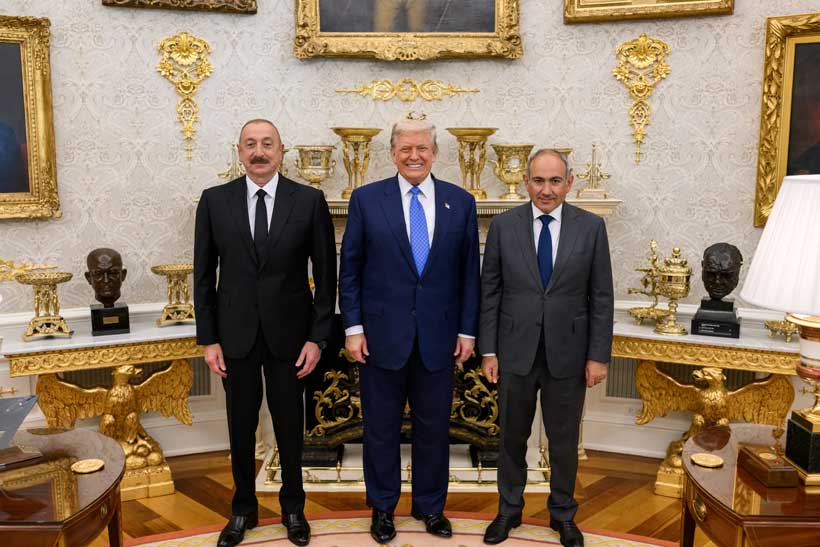
Despite the camera-ready image of Prime Minister Nikol Pashinyan and President Ilham Aliyev shaking hands at the August 2025 Washington Summit, the formal end of hostilities has not profoundly brought closure or clarity to Yerevan, as Armenia currently faces quite possibly the most opaque security landscape of any post-Soviet state. While the cessation of fighting removed the immediate risk of renewed war, the nation’s security posture is journeying down an unclear road as traditional guarantees weaken and alternative arrangements remain dangerously speculative.
The bitter pill that a non-victorious nation swallows at a peace signing still usually provides the benefit of a clearer landscape. In Armenia’s case though, this is a modest luxury that still cannot be fully counted on. The centrepiece of the U.S.-brokered peace is the Trump Route for International Peace and Prosperity (TRIPP). Codified in the January 15, 2026 Implementation Framework, this 42-kilometre multimodal transit link through the Syunik province should unblock regional trade and, on the surface, provide the economic oxygen necessary to resuscitate a stagnant Armenian economy and transform the country into a vital node of theMiddle Corridor bypass of Russia and Iran.
The catch, of course, is that the deal involves a significant trade-off in the form of a U.S.-led consortium that now manages the route, effectively placing an intentional Western commercial ‘tripwire’ on Armenian soil. Trump’s ‘peace through prosperity’ is not a bad idea in theory, but block-wide consensus on a proper response has been notoriously tricky to find for military engagements, let alone for an economic project. Yerevan has essentially traded territorial autonomy for a seat at a table where the rules are increasingly transactional. This is not inherently a bad outcome on an economic level, but the security landscape remains unresolved as the country ‘quiet quits’ the CSTO, leaving it de facto without a military protector for the first time in a century.
Around 2023, NATO was beginning to look at Armenia with increasing interest. The country seemed to offer many of the geographic benefits of Georgia but without the immediate Russia-linked territorial disputes. Emmanuel Macron, in particular, seemed poised to serve as the country’s diplomatic sherpa into the first stages of a formalised partnership. The trouble now is that the NATO of January 2026 is currently facing a crisis of self-conception that makes expansion almost unthinkable. The alliance is torn between two competing centres of gravity: the ongoing war in Ukraine and the resurfacing dispute over Greenland. As NATO Secretary GeneralMark Rutte warned at Davos (January 21), the rift over Greenland threatens to ‘drop the ball’ on Ukraine, which remains the alliance’s primary mission.
The Greenland Crisis has inadvertently now introduced a logic of ‘coercive bargaining’ into the alliance that contradicts NATO’s core principle of respect for sovereignty. For a country like Armenia, the ‘Open Door’ policy looks far more like an entrance to a legal battleground than a path to protection. If the alliance is struggling to reconcile the territorial inviolability of a founding member like Denmark with the transactional demands of its most powerful partner, it is highly unlikely to extend a meaningful security umbrella to the South Caucasus.
That is not to say NATO’s attention toward Armenia has been purely lip service. Since the August 2025 Washington Summit, the alliance has moved with uncharacteristic speed to institutionalise a ‘hardware transfusion’ designed to pull Yerevan firmly into the Western orbit. This shift was underscored by the December 18, 2025 visit of NATO’s Deputy Secretary General, Radmila Shekerinska, who hailed Armenia as a vital partner for Black Sea stability.
This diplomatic courtship is anchored by the 2026 Defence Cooperation Plan, signed in Paris on December 16, 2025, which represents a deliberate strategic exit from Russian defence dependence. This was perhaps most strikingly seen with the replacement of Soviet-era 152mm systems with 36 CAESAR 155mm self-propelled howitzers and the activation of three Thales GM200 multi-mission radars, all provided by France between late 2024 and 2025. These weapon shipments were so ominous that many Russian outlets, as well as the Russian Ambassador to Armenia, Sergey Kopyrkin, viewed this as a kind of ‘second front’ being opened against Moscow from the south, warning against the so-called ‘Ukrainisation’ of the South Caucasus.
Recently, things have not progressed nearly as continuously as many Armenians would have hoped. As of January 22, 2026, this pivot has run headlong into a NATO that is currently at odds with its own self-conception. While President Trump’s January 21 Davos reversal on Greenland tariffs provided a temporary reprieve for markets, the sudden and profoundly strange nature of the Greenland Crisis has exposed the structural fractures that had already begun surfacing. If European leaders are forced into a posture of ‘strategic supplication’ that requires balancing the necessity of keeping Washington engaged in Ukraine against the threat of territorial coercion in the Arctic, then Armenia finds itself courting a security guarantor that is fundamentally distracted. Yerevan is effectively trying to board a European life raft that is currently too battered by the transatlantic storm to decide whether it can return to the mothership or must seek its own land.
The task ahead for Yerevan over the coming years is to simply understand its hand and play the cards that it actually has versus those that it wishes it held. The country cannot seek shelter where it does not exist in a meaningful way and would be wise to pivot from a policy of ‘alignment’ to a policy of strategic multi-alignment. The country must treat the TRIPP corridor as a security asset that forces international stakeholders to maintain a vested interest in Armenian stability for commercial reasons. It is not perfect leverage, but it is leverage nonetheless.
History provides a blueprint for this survival in the ‘Siam Strategy’ of the late 19th century. Like Armenia today, the Kingdom of Siam found itself caught between two clashing gears of Britain and France but survived through its transformation into a vital, neutral trade buffer that both empires relied upon. This enabled the besieged kingdom to maintain its independence while its neighbours fell to colonisation.
Yerevan’s path forward is likewise not to be found as an unequal partner, or occasional afterthought by the West when it is politically convenient. Better is to lean into the cold logic of making itself too economically valuable to be ignored. Its geographic utility must be leveraged as well, but not in a way as to invoke new conflicts or revive dormant ones. In an era where the Western mission is turning inward and presents wildly mixed messaging from a revolving door of various administrations, Armenia will have to learn to stand on its own two feet and ensure that it can walk on whatever terrain it ultimately must traverse.
