


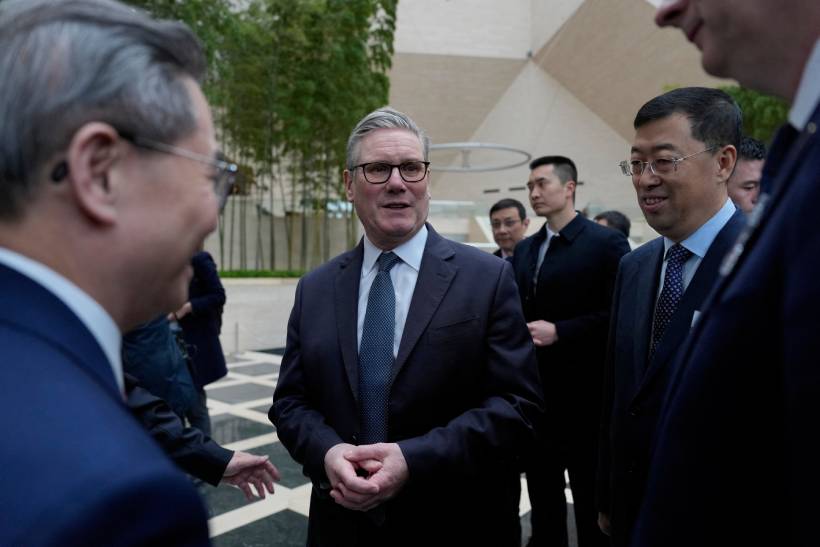
Prime Minister Keir Starmer’s visit to China marks a deliberate recalibration of British foreign economic policy at a moment of heightened systemic uncertainty in global politics. The Labour government, under pressure to deliver economic growth amid domestic stagnation, has prioritised restoring pragmatic engagement with the world’s second-largest economy. This strategy reflects a broader European trend toward selective economic engagement with China despite intensifying U.S.–China rivalry.
President Donald Trump’s warning that closer UK–China relations are “very dangerous” must be read within the context of his administration’s transactional approach to alliances. Trump has repeatedly framed international economic relations as zero-sum and has demonstrated a willingness to use tariffs and public pressure to discipline both rivals and allies. His remarks signal concern not only over economic competition but also over alliance cohesion in a multipolar order.
Britain’s Strategy: Economic Pragmatism without Strategic Realignment
Starmer’s insistence that Britain is not choosing between the United States and China reflects a strategy of issue-based alignment, rather than bloc loyalty. The UK seeks to maintain its foundational security relationship with Washington anchored in defence, intelligence sharing, and NATO while simultaneously pursuing economic diversification.
Agreements on visa-free travel and tariff reductions on whisky, though limited in macroeconomic scale, are symbolically significant. They indicate Britain’s willingness to engage China on functional economic issues while avoiding overt political convergence. Starmer’s emphasis on trust-building and “sophisticated” engagement suggests an attempt to normalise relations without endorsing China’s broader geopolitical ambitions.
Stay ahead of the geopolitical week.
MD Briefing delivers expert analysis across five global fronts — the Indo-Pacific, energy, geoeconomics, European security, and the Middle East — every Monday morning. Free.
U.S. Perspective: Alliance Discipline and Containment Logic
From Washington’s viewpoint, Britain’s outreach to China risks weakening a coordinated Western strategy aimed at constraining Beijing’s economic and technological rise. Trump’s warning, coupled with Commerce Secretary Howard Lutnick’s scepticism, reflects a containment-adjacent logic in which allied economic engagement with China is perceived as indirectly strengthening a strategic competitor.
Unlike Canada, which faced explicit tariff threats, Britain benefits from its historical “special relationship” with the United States. However, Trump’s comments indicate that this status does not guarantee immunity. Alliance loyalty, under Trump, appears conditional on alignment with U.S. strategic priorities rather than institutional trust or shared values.
Europe’s Hedging Behaviour
Starmer’s visit aligns with similar moves by France and Germany, illustrating a European effort to hedge against U.S. unpredictability. As Trump questions NATO commitments, threatens territorial changes (such as Greenland), and oscillates on trade policy, European leaders increasingly seek strategic autonomy particularly in economic relations.
This hedging does not amount to balancing against the United States, but rather to risk diversification in an unstable international system. China’s appeal, despite its restrictive market practices, lies in its scale and its willingness to offer selective economic concessions to politically significant partners.
Structural Constraints: The Limits of Engagement
Despite political symbolism, structural barriers remain significant. China’s tightly managed economy, state subsidies, and export dominance limit reciprocal access for foreign firms. U.S. scepticism is grounded in empirical reality: European and British exporters have historically struggled to gain sustained market penetration in China.
Thus, Starmer’s engagement strategy faces an inherent contradiction seeking economic gains from a system that resists liberalisation, while also avoiding strategic dependence that could trigger U.S. retaliation.
Analysis: Power Politics beneath Economic Diplomacy
From a neorealist perspective, this episode illustrates how economic diplomacy is increasingly subsumed under great-power competition. Trump’s warning is less about trade and more about relative gains and alliance discipline. Britain’s outreach to China, even if economically modest, is interpreted in Washington as a signal that could erode U.S. leverage.
Starmer’s response reflects the constraints of middle-power behaviour in a transitioning international order: Britain lacks the capacity to shape systemic outcomes but seeks autonomy within narrow margins. The tension between economic necessity and security dependence highlights the fragility of Western unity in an era where U.S. leadership is no longer predictable.
Ultimately, this case demonstrates that as the international system shifts toward multipolarity, allies are increasingly forced into complex balancing acts not between war and peace, but between markets, security guarantees, and strategic loyalty.
With information from Reuters.
