



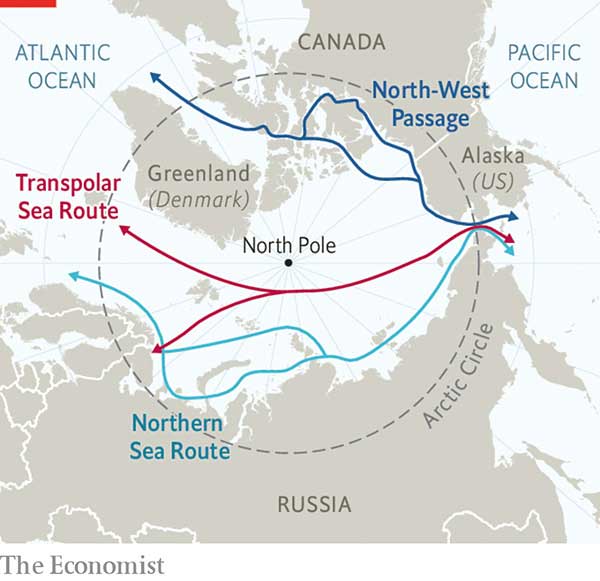
The Arctic, long seen as a remote and frozen frontier, has emerged as a critical zone for energy, shipping, and strategic minerals. Rapid warming nearly four times faster than the global average is opening new shipping routes and unlocking vast resource deposits. As ice recedes, geopolitical competition is intensifying, with Russia and China moving decisively to secure influence, while the U.S. and Europe remain behind in strategy and infrastructure.
Russia’s Arctic Dominance
Russia controls a vast majority of Arctic oil and gas production, with Arctic fields accounting for roughly 20% of its total oil output. Its Arctic territories hold 35.7 trillion cubic metres of natural gas nearly 75% of Russia’s proven reserves and significant shares of rare earths, nickel, cobalt, and platinum-group metals. Russia’s concentration of energy and mineral assets provides both economic leverage and strategic control over northern trade routes.
Western Arctic Assets
Western Arctic holdings are fragmented. Alaska contributes about 3.5% of U.S. crude output, while Sweden’s Kiruna mine provides a large share of EU rare earths. Finland is preparing to become the EU’s first integrated lithium producer, and Greenland’s mineral wealth remains largely untapped due to logistical challenges. While these resources are valuable, Western infrastructure and investment in the Arctic lag behind Russia’s concentrated presence.
Northern Sea Route and Trade Rerouting
Since Russia’s invasion of Ukraine, European sanctions have forced Arctic energy exports to be rerouted eastwards via the Northern Sea Route (NSR). The NSR nearly halves travel time between northern Europe and Asia compared to the Suez Canal, giving Moscow leverage over global shipping corridors. Russian LNG exports continue to reach Asian and European markets, though the EU plans to ban all Russian LNG imports from January 2027, further emphasizing the Arctic’s strategic importance.
China’s Arctic Strategy
China has strategically invested in Arctic energy and minerals, including a nearly 30% stake in the $27 billion Yamal LNG project. Its involvement secures long-term LNG supplies, access to polar energy technology, and potential influence over Arctic shipping lanes. Chinese firms are also pursuing rare earths in Greenland and nickel and iron ore elsewhere in the High North, tying Arctic resources to global clean-energy supply chains. The Arctic is increasingly part of China’s “Polar Silk Road,” providing resilience against disruptions in traditional shipping routes.
Implications and Analysis
The Arctic is evolving into a central theater of geoeconomic rivalry with long-term consequences for global markets. Russia’s control over shipping routes and concentrated resource deposits allows it to bypass Western chokepoints and weaken the impact of sanctions, especially in LNG markets. China’s strategic investments secure critical energy and mineral supplies while increasing its bargaining power in global trade.
For the U.S. and EU, lagging infrastructure and fragmented Arctic holdings present a strategic disadvantage. As the High North becomes a separate corridor with its own rules, costs, and risks, disruptions whether from sanctions evasion, cyberattacks, or regulatory controls could ripple through global supply chains, energy markets, and shipping networks.
The opening of Arctic routes is not just an opportunity but also a structural fault line in the global economy. Concentrated control of resources and trade corridors by Russia and China may redefine trade patterns, resource pricing, and geopolitical leverage for decades.
With information from Reuters.
