



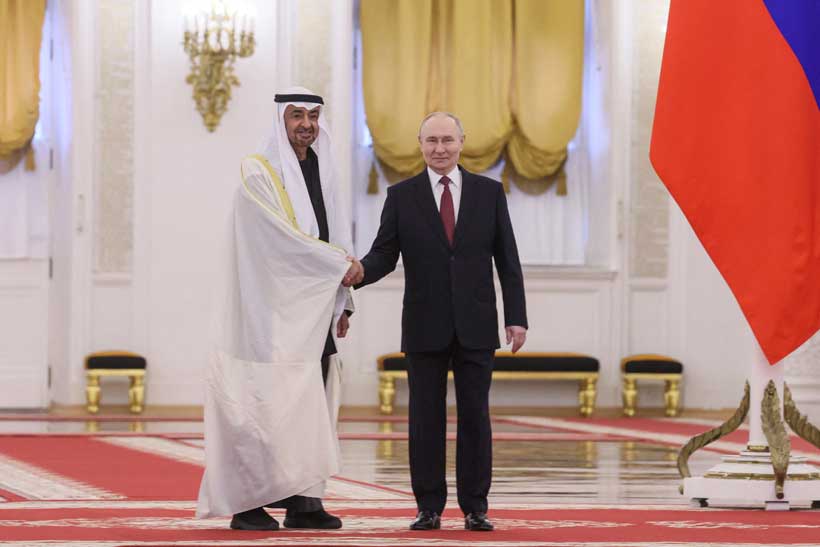
Russian President Vladimir Putin has held diplomatic talks, aimed at strengthening strategic relations with countries in the Arab world, in the Kremlin in the final week of January 2026. The discussions also focused on broadening economic cooperation and, particularly, on Russia’s security presence in the region, as well as the current situation in the Middle East and other international issues.
Who were the guests of Vladimir Putin?
Leaders from the United Arab Emirates, the Syrian Arab Republic, and the State of Palestine. In addition to these, Putin interacted with a group of Israelis in the Kremlin. He also held phone conversations with President of the Islamic Republic of Iran Masoud Pezeshkian and with Prime Minister of Israel Benjamin Netanyahu. So also with Malaysia’s Sultan Ibrahim and Vietnam.
Significance of Regional Arab Matters
United Arab Emirates: Putin talks in the Kremlin with President of the United Arab Emirates, Mohamed bin Zayed Al Nahyan, who was on an official visit, centered on key areas of multifaceted Russia-UAE cooperation, as both marked their 55th-year of the establishment of diplomatic relations. In an assessment, Putin noted: “We attach great value to your significant personal contribution to all spheres of the Russia-UAE strategic partnership, which is multifaceted, mutually beneficial and growing dynamically. We have developed political dialogue at the level of our governments, parliaments, ministries, and agencies, as well as between our business communities.”
The United Arab Emirates is an important trade partner in the Arab world. Russia’s bilateral trade has been growing consistently. This is due to the efficiency of the intergovernmental commission’s work in the previous years in Moscow and in Dubai. The Russian Direct Investment Fund and the Mubadala Foundation have implemented over 60 projects. In fact, cooperation in technology and industry has advanced significantly. Russia’s high-tech company Yandex is promoting its services in the UAE market. A number of significant initiatives have been formulated in the sphere of energy.
Traditionally, special attention has been devoted to humanitarian contacts. In November 2025, the United Arab Emirates hosted the Days of Russian Culture. Each year, the number of tourists from Russia visiting the country continues to grow: in the first nine months of 2025 alone, it reached 1.5 million people, an increase of 18 percent.
Cooperation in the fields of education and science is also developing productively. A Russia-UAE cooperation center operates at the Primakov Gymnasium in the Moscow Region. Branches of this gymnasium, as well as of Plekhanov Russian University of Economics, are operating in the UAE. Plans are also in place to open a Russian university, along with a youth science park under the auspices of the Sirius Centre.
President of the United Arab Emirates, Mohamed bin Zayed Al Nahyan, also noted that relations between the United Arab Emirates and Russia are built upon a strong legacy of fruitful cooperation spanning more than five decades. Both countries are united by a partnership focused on sustainable development across a wide range of sectors, including the economy, energy, investment, trade, and technology. Dubai is, therefore, firmly committed to deepening these ties and to achieving the shared goals of development and partnership for the benefit of both nations.
Zayed Al Nahyan underlined the Services and Trade Agreement (Trade in Services and Investment Agreement) that was signed last August, 2025, that will significantly enhance and expand mutual investment and trade between two nations. The same holds for the Cooperation (Comprehensive Economic Partnership) Agreement between the UAE and the Eurasian Economic Union. It was emphasized that this serves to strengthen economic cooperation between two countries.
Syrian leader’s visit to the Kremlin
On January 28, Vladimir Putin also set aside time to meet with the President of the Syrian Arab Republic, Ahmed al-Sharaa, in the Kremlin, who arrived in the Russian Federation for a working visit. The agenda of the talks encompasses the current state and prospects for the development of bilateral relations in various spheres, alongside discussions on the current situation in the Middle East.
Russian-Syrian relations have deep historical roots. Diplomatic ties were formally established as far back as 1944, with the signing of an agreement even as the Second World War was raging. Throughout all the following decades, Russian-Syrian bilateral relations have remained consistently strong, without a single dark chapter. Today, in this new reality—and thanks in no small measure, above all, to your personal efforts—the relations between Syria and Russia continue to progress.
A large interdepartmental delegation from the Russian government traveled to Syria and worked intensively with their colleagues. Consequently, there are a number of promising initiatives planned, spanning both industry and humanitarian affairs—including sports, medicine, and construction.
Concretely, Russia is looking ahead to establishing a military base in Syria, and particularly, in the construction sector, Russians are ready to engage in this joint work. Rebuilding the needs in Syria. Russia has always championed the goal of restoring Syria’s territorial integrity.
Ahmed al-Sharaa, however, pointed out that one of the greatest challenges is the unification of Syrian territory. Russia, of course, plays a major role in Syria, contributing to the stabilisation not only in country but in the entire region. Ahmed al-Sharaa acknowledged, with gratitude, further contributions to security and infrastructure development in Syria and finally concluded that the entire region is in great need of stability.
Putin’s meeting with Chief Rabbi of Russia
Meeting with Chief Rabbi of Russia, Berel Lazar, and President of the Federation of Jewish Communities of Russia, Alexander Boroda, on January 28, Vladimir Putin stressed, in particular, the importance of the International Holocaust Remembrance Day, which is observed throughout the world to commemorate the victims of the Holocaust. It is, generally, observed as a memorial day in Russia, because Russians remember the woes that Nazism brought to the land. Over a million Soviet and Russian Jews fell victim to those crimes.
It is no coincidence that, in accordance with the well-known resolution adopted by the United Nations General Assembly, this memorial day coincides with the anniversary of the complete liberation of Leningrad from the Nazi siege.
In his response, Chief Rabbi of Russia, Berel Lazar, pointed to the fact that traditional religions and people of various ethnic backgrounds in Russia today truly experience not just dialogue, but mutual respect for everyone. It is important to find a way to live in friendship.
President of the Federation of Jewish Communities of Russia, Alexander Boroda, talked about the idea of patriotism, the idea of love for one’s country, which all confessions promote and demonstrate by example, is what underpins Russia’s unity today. It is what brings all together: the Russian Orthodox Church, Muslims, Jews, and Buddhists—all confessions present in Russia are united by this shared substance and common meaning. The fact that the state places emphasis on traditional religious values as the foundation of spiritual and moral education is tremendous support for the society and, in fact, a stronghold and basis of the country’s shared values.
And with Vietnam
Putin had a telephone conversation with General Secretary of the Communist Party of Vietnam Central Committee, To Lam, with a focus on his reelection to the top party post during the 14th National Congress of the Communist Party of Vietnam and wished him continued success in his efforts for the good of the Vietnamese people.
To Lam thanked the Russian leader for his kind words and briefed him on the ambitious goals set by the National Congress of the Communist Party of Vietnam. The leaders discussed prospects for cooperation between Russia and Vietnam in politics, trade and economy, and energy, confirming their mutual commitment to developing the entire range of bilateral relations at a rapid pace and in the spirit of the comprehensive strategic partnership. They also agreed to maintain contacts at various levels.
Supreme Ruler of Malaysia Sultan Ibrahim
Supreme Ruler of Malaysia Sultan Ibrahim was in Russia on a private visit. Accompanied by Hermitage General Director Mikhail Piotrovsky, Putin and Sultan Ibrahim viewed the museum’s permanent exhibition. Later, the two heads of state continued their dialogue in a working breakfast format.
With Iran and with PM of Israel Netanyahu
During the call, the President of the Islamic Republic of Iran briefed Putin on the Iranian government’s sustained efforts to normalize the situation in the country. It was noted that Russia and Iran unanimously and consistently support deescalating the tensions—both surrounding Iran and in the region as a whole—as soon as possible and resolving any emerging issues via exclusively political and diplomatic means. The leaders confirmed their mutual commitment to further strengthening the strategic partnership between Russia and Iran and implementing joint economic projects in various fields.
Vladimir Putin, in a telephone conversation with Israeli Prime Minister Benjamin Netanyahu, discussed the state of affairs in the Middle East and the situation surrounding Iran. In addition, Putin laid out his fundamental stance in favor of stepping up political and diplomatic efforts aimed at ensuring the region’s stability and security. The Russian side confirmed its commitment to continuing to make mediation efforts and promoting a constructive dialogue involving all concerned parties. The leaders also agreed to maintain contacts at various levels.
