


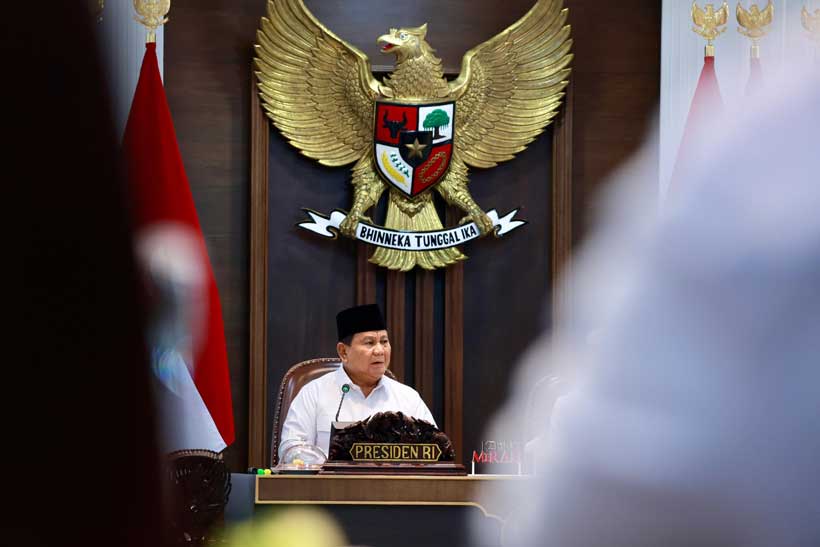
A thousand friends are still too few, one enemy is too many.
This is the diplomatic rhetoric often used by Prabowo Subianto for international geopolitical strategy. Now, in Davos, Switzerland, on January 22, 2026, that philosophy was put to the test when he signed Board of Peace charter with Donald Trump.
Peace of World in the Hands of a Tough Man
The signing of the Board of Peace (BoP) charter was no ordinary ceremony. The presence of Prabowo (President of the Republic of Indonesia) alongside Donald Trump (President of the United States) and Viktor Orban (Prime Minister of Hungary) sent a message far beyond symbolic diplomacy.
Board of Peace (BoP) is an alternative power platform, built outside the traditional international order. Trump appears to dislike institutions. He favors personal relationships. He values symbolic loyalty. And Prabowo understands this logic.
Stay ahead of the geopolitical week.
MD Briefing delivers expert analysis across five global fronts — the Indo-Pacific, energy, geoeconomics, European security, and the Middle East — every Monday morning. Free.
Trump, known for his anti-traditional multilateral institutions, is instead building a parallel institution with himself as chairman for life with absolute veto power, as detailed in the 11-page draft charter.
Indonesia’s decision to join cannot be read as submission. It is more accurately read as a geopolitical tactical awareness, stemming from the reality that multilateralism is weakening. The world is moving toward a rigid and transactional multipolarity.
Most Western allies refused to join. Britain, France, Germany, and Norway were absent from the signing ceremony. They feared Board of Peace (BoP) would erode the legitimacy of the UN. French President Emmanuel Macron even harshly criticized the charter’s structure, which goes beyond the Gaza framework and raises serious questions about the principles and structure of the UN. Trump responded with threats of 200% tariffs on French wine and champagne. This pattern is clear: loyalty is rewarded, criticism is punished.
From Free Active to Free Maneuver
The Free Active Policy was born in the bipolar era of the Cold War. Its essence was that Indonesia maintains its sovereignty by not being permanently tied to any bloc. In today’s multipolar world, where traditional multilateralism is weakening and power is dispersed, Prabowo seems to be reading the map differently. The enemy is no longer just two giant blocs, but uncertainty and pressure from various directions.
Prabowo has not abandoned The Free Active Policy, but reinterpreted it for the post-multilateral era. The Free Manuever Policy means moving between all powers. Joining without committing. Approaching without bowing, and being present without being drawn in.
Joining the Board of Peace (BoP) is Prabowo’s maneuver in reading the geopolitical map. Within this framework, the Board of Peace (BoP) is not an end in itself; it is a tool. Indonesia wants to be recognized as a partner, not an object of future pressure. This is a kind of initial political insurance. Prabowo is sending a signal to the West that Indonesia can be spoken to in “their language.”
Indonesia is no longer simply taking sides, but actively shifting from one point of power to another in pursuit of national interests. Indonesia’s joining the Board of Peace (BoP) is concrete evidence of this agility.
National Interests Behind Strategic Decisions
There are strategic national security calculations behind Prabowo’s decision. Through the Board of Peace (BoP), Indonesia likely aims to secure stability in the North Natuna Sea by securing US commitment through Trump’s preferred personal diplomacy channels. Geopolitical speculation suggests the US goal is to implicitly push Indonesia to reject China’s claims in the South China Sea, a goal that aligns with Indonesia’s interests without having to explicitly state it.
Prabowo also calculated that the world was rapidly becoming multipolar. The post-1945 global security architecture was being challenged from multiple directions. In this situation, mid-sized countries like Indonesia could no longer rely on a single institution or a single bilateral relationship. They must build safety nets across multiple platforms simultaneously. The Board of Peace (BoP) is one such net; not the only one, but important enough not to be overlooked.
This decision also bolstered Prabowo’s image as a tough guy rational global. Prabowo positioned himself as a pragmatic geopolitical realist. He befriended everyone West, East, North, and South as long as it served Indonesia’s national interests. In his speech at Davos, he emphasized that Indonesia chooses peace over chaos. “We want to be a friend to all, an enemy to none.”
Rowing between Two Orders
The Free Manuever Policy that Indonesia currently employs places our country in a very challenging position. Indonesia is now rowing between two competing orders: the Old Order: the UN, ASEAN Centrality, and rules-based international law. And the Parallel Order: the Board of Peace (BoP), a US-led minilateral alliance, and a power structure based on personal relationships.
When these two orders collide, for example in the disputes in the South China Sea, which forum will Indonesia stand in? If we choose the UN and ASEAN mechanisms, we will still be accepted and respected by the wider international community, including China. If we choose the Board of Peace (BoP), we will be well-received by Trump and his inner circle.
Either choice can benefit Indonesia, which Prabowo is cleverly playing. This is the essence of the Free Manuever Policy: not being tied to a single platform, but utilizing all platforms for the national interest. However, this also means Indonesia must constantly balance, negotiate, and navigate contradictions, a diplomatic dance that is both energy-consuming and high-stakes.
I understand the strategic logic behind President Prabowo’s decision, but I also warn of the long-term risks. Indonesia must remain a leader in the Global South and a major democracy with a strong social base. We must not be absorbed into the orbit of personal power; be it Trump, Putin, or Xi Jinping. The Free Maneuver Policy must be carried out with clear principles: national interests, democratic values, and solidarity with developing countries.
A thousand friends are indeed too few. One enemy is indeed too many. But among friends and enemies, there are principles that must not be compromised: sovereignty, justice, and humanity. This is the true test of The Free Active Policy under Prabowo’s leadership.
