

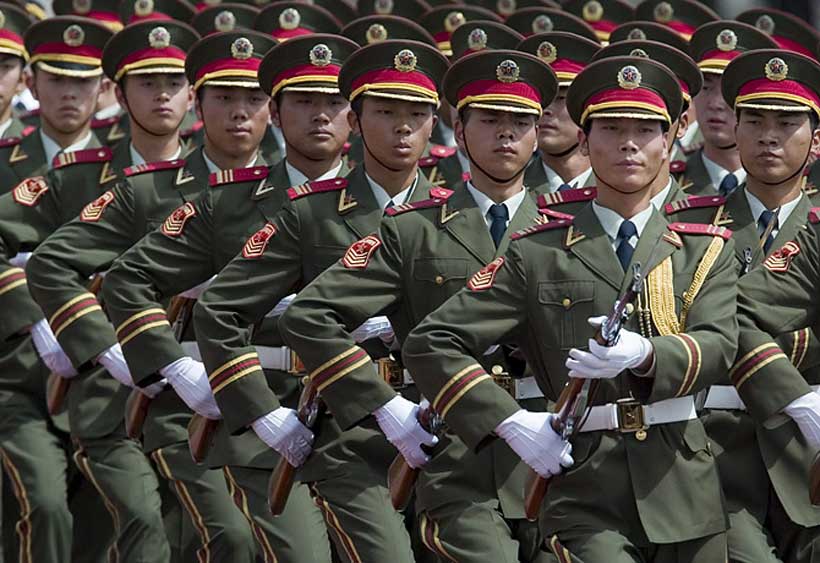
Since the Fifth Plenary Session of the 20th Central Commission for Discipline Inspection earlier this month, rumours about the fate of two of China’s most powerful figures, Zhang Youxia and Liu Zhenli, have circulated across social media. Their absence at the session prompted speculation that ranged from ill-health to a special overseas visit. The most sensational rumour claimed that these two senior officials, along with the other members, had been arrested for organising a military coup. While an official statement by China’s Ministry of National Defence has attempted to quell these rumours, the political implications of the investigations remain unresolved — whether the episode is about discipline at all, or about Xi Jinping securing the military for the long game.
The official statement only states that Zhang Youxia and Liu Zhenli are under investigation for ‘suspected serious violations of discipline and law.’ No additional details have been disclosed except this careful formulation of words. Such an opaque nature of the Chinese political system and its symbolism, in conjunction with the lack of explanation, invites scrutiny rather than closure.
Xi Redefines Loyalty in the PLA
Since the beginning of Xi Jinping’s second term, the CMC has been at the centre of his anti-corruption campaign. Though it is presented as a disciplinary campaign, it has also been used to reorganise loyalty within the military. In 2024, Wei Fenghe and Li Shangfu, members of the CMC and Ministers of National Defence, were expelled from the Party in the name of disciplinary violations and corruption charges. In a similar manner, He Weidong, Vice Chairman of the CMC, and Miao Hua, another CMC member, were removed at the Fourth Plenum of the 20th National Congress in October 2025. He Weidong was the highest-ranking military official to be purged in the period after the Cultural Revolution.
If Zhang Youxia and Liu Zhenli were to meet a similar fate, the political implications would be unprecedented. The CMC would be limited to just two figures, that is, Xi Jinping himself and Zhang Shengmin, Vice Chairman of the CMC, until the National People’s Congress reconvenes in March 2026. This degree of authority is exceptional even within the context of Chinese politics.
Xi’s break from the norm of appointing his close aides to senior positions renders this investigation exceptional. The historical pattern of Chinese leadership states that leaders often represent certain geographic regions. It is natural for leaders to appoint or promote individuals with whom they share work experience that demands loyalty, trust, and competence. Xi has both appointed and promoted individuals who served as his close associates during his provincial career. Most of the senior military officials purged in recent years have worked in the same provinces where Xi spent the formative years of his political career. For instance, He Weidong and Miao Hua both served in the 31st Group Army in Fujian Province, where Xi was building his political experience in the 1980s and 1990s. They were considered part of the so-called ‘Fujian clique,’ a network of PLA leaders whose careers overlapped with Xi’s.
In contrast, Zhang Youxia is the son of Zhang Zongxun, a revolutionary PLA veteran associated with Xi’s father and has thus inherited political trust. Although provincial associations are limited within the CMC, Xi’s retention of Zhang as Vice-Chairman of the CMC indicates the extent of that trust. The investigation of Zhang, therefore, states that even proximity to Xi and revolutionary pedigree can no longer guarantee political security.
The Myth of a Military Coup
The most sensational part of the Zhang–Liu investigation has been speculation about an organised military coup. The high stakes encourage the advancement of such claims. The military has been influential in Chinese politics since the establishment of the People’s Republic of China. History reveals that the relations between the Party and the PLA show that a leader who cannot command the majority of the top leadership of the military is destined to be defeated. However, the Leninist structure of the Chinese political system makes a coup complicated, but not impossible.
Xi’s anti-corruption campaign has targeted some of the most powerful officials whom he perceived as a threat. This might lead to widespread resentment and trigger internal resistance. But for all that, Chinese politics is structured around the centralisation of power in the leader. It leaves lieutenants with minimal scope to contest authority. In the end, the Party constitutes more than the sum of its leaders, and cannot be reduced to those who might seize power through a coup. Moreover, the ideological framework of the Chinese system, with its elaborated ideology, adds to the complexity of the matter. The PLA is not a national army in the Western sense; it is a Party army. Therefore, any attempt to depoliticise the military and replace Party control with a national army amounts to the most serious crime in the Chinese political system, equivalent to treason.
Though a leader who cannot command the loyalty of the military is destined to be defeated, the reverse is also true: those who want to expel a leader require military support. Hua Guofeng was successful in carrying out a coup against the Gang of Four with decisive backing from Marshal Ye Jianying. It allowed Hua to move against Jiang Qing, Mao’s wife and her associates and subsequently put them on trial. The lack of military support can put the challengers in a precarious situation. In this case, the only option would be the physical elimination of the leader, though it entails a substantial risk. It also demands a rapid yet total control of the national security apparatus. In light of Xi Jinping’s power consolidation, such an outcome appears implausible.
The Military Question in Xi’s Succession Calculus
Xi pursued a dual purpose through the recent investigations – showcasing discipline and asserting dominance. The investigations reinforce the message that loyalty to Xi and the Party supersedes personal relationships, revolutionary lineage, and competence. Trust is conditional, not permanent. At the same time, they raise two important questions: What circumstances led to such drastic action, and who will Xi appoint to fill the leadership vacuum within the CMC? These questions cannot be separated from succession. Xi’s accumulation of power reflects a concern for long-term political continuity. Hence, control over the military concerns not only presents stability but also the management of future power transitions.
Xi articulated the idea of the ‘Chinese Dream’ in 2012 – a political vision that aims to revive China as a strong, modern, and respected global power. The concept of the Chinese Dream can also be understood from the perspective of the fùguó qiángbīng (富国强兵), the doctrine that helped the progressives of the beleaguered Qing dynasty to survive the Hundred Days’ Reform in 1898. It focuses on the material capabilities of the state, that is, economic prosperity and military strength. Xi has pledged to achieve modernisation by 2035 and to realise the great rejuvenation of the Chinese nation by 2049, which marks the centenary of the founding of the PRC. For Xi and China, the most important matter that calls for immediate attention is the reunification of Taiwan with the mainland. Xi frequently consults with military-affiliated or hawkish intellectuals to shape strategies that will help to realise the Chinese Dream of a strong China and narrow the disparity with the U.S., the superpower. Thus, the unquestioned loyalty of the PLA is indispensable.
The Zhang-Liu investigations can also be interpreted as part of efforts to align ‘the gun’ with Xi’s long-term vision rather than independent disciplinary actions. The real lesson lies not in the fate of these two generals, but in what their investigation uncovers – as long as Xi Jinping remains in power, ‘the gun’ will be under his control.