


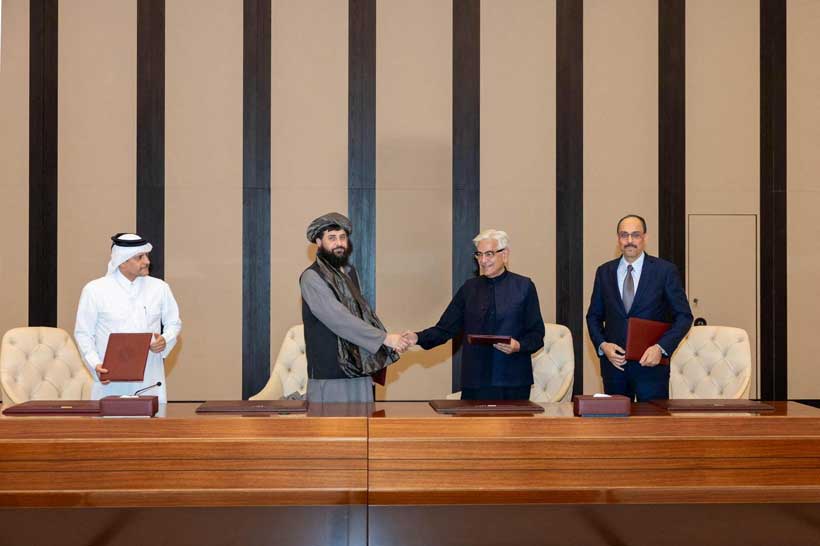
The suggestion of Zalmay Khalilzad to make Pakistan pursue an agreement of the Doha format with Kabul is pegged on a retrocedent vision of the region. It assumes that Pakistan still needs a tremendous bargain to prove its goodwill, and it incorporates the Afghan Taliban as one of its partners with promises to be reined and delivered. These two assumptions are no longer valid. The security outlook of Pakistan has hardened because of the loss over the years, and the Taliban statements about their dominance and responsibility are of lesser credibility. A template that is made to break in more favorable circumstances cannot be commercialized as a new solution in a more unfavorable event.
Pakistan has reached the phase of strategic clarity where the main divisions of fault of the last era have been abridged. The political leadership and state institutions are becoming increasingly converged along with the mass opinion on the matter of terrorism. This is significant because counterterrorism is no longer a controversial question that reinvents itself each time electoral periods or media scandals come around. It is a national necessity; it is the business of the core state, and there should exist minimum grey zones and minimum foundations of procrastination. When a society has gone so far as to no longer demand symbolic deals but desire quantifiable outcomes, then it is the latter.
The same twist also changes what Pakistan can accept of Kabul. Slogans are not signed; an agreement is signed with actors, who are able to perform. The Islamic Emirate of Afghanistan has failed to build the bare minimum confidence that serious states are supposed to possess. The sanctions by the United Nations and sanctions monitoring have all been invoked to declare that the Afghanistan terrain is free to enable free movements of the different militant groups. It is an aggregated sum of the results with time, and the trend is hard to dispute. The Taliban was to demonstrate a consistent course of action towards transnational militants, which was the easiest path in case they desired to be legitimate. They did not.
That is why the Doha Accord should be interpreted as a warning rather than an example. The diplomatic departure point that was given by Doha to the United States did not last as a long-term security balance. It was unable to eliminate local militant networks, and it could not deter spillover violence. In practice, it shifted the incentives towards takeover and left the region to deal with the consequences. When it comes to Doha as a form to be exported, it does not include its basic failure, which was to withhold its promise, but left space, momentum, and confusion, which could be exploited by militant networks.
Stay ahead of the geopolitical week.
MD Briefing delivers expert analysis across five global fronts — the Indo-Pacific, energy, geoeconomics, European security, and the Middle East — every Monday morning. Free.
The current pose of Pakistan is a pointer of what was learned in that experience. Neither is it something that is pulled in one direction, and it is stratified and combined. The approach will be accurate intelligence operations, more stringent at the border, tracking finances in the network, and a propagandistic discussion that will advance an agenda of disinformation. This multi-track posture has been declared through the public affairs leadership of the military, including the Director General of Inter Services Public Relations. It has nothing to do with complicity; reduce the space of operations, disrupt the facilitation, and deny the militants the possibility to build perceptions.
The recent performance of the operations explains why such a tactic is the better one as opposed to gambling diplomatically. The long-term intelligence work that has been successful in capturing high-value agents in Baluchistan and sabotaging a major planned attack in Karachi is indicative of all that the long-term intelligence work can achieve. It would take years of network mapping, infiltration of cells, and the formation of coordination among the agencies. They also point out one significant fact, which is that the security of Pakistan is not attained by trust but through pressure, perseverance, and internal capacity such that an untrustworthy partner can one day clean its backyard.
Another missing element is the operational picture, which is present in the calls to establish a new bilateral framework to counter the Islamic State Khorasan Province. ISKP is not a friend, but there is nothing wrong with acknowledging the fact that the world demands a new external order of affairs to be able to deal with it, as it shows a sense of helplessness that does not merit the history. The kinetic pressure, infiltration of intelligence, and disruption of recruitment and funding have aggravated the activity of the ISKP on the Pakistani territory. The case of cooperation can be instrumental, though it cannot be the foundation on which the other party cannot effectively manage its own territory or preclude cross-border facilitation.
More problematic is the fact that diplomacy is no museum. Something that was found to be workable in 2021 may not work now. It is since the threat vectors have changed, the assumptions have been unveiled, and the cost of not being involved is more visible. Pakistan has discovered that false promises and ambiguous enforcing mechanisms make it dangerous and not safe. Any heavy system in this day would require verification, accountability, and consequences. A Doha-style deal offers all that, and especially when it comes to a Taliban government that considers international pressure as a sound or a noise and not a cause to change and reform, then there is no deal at all.
Pakistan cannot calculate its national security on a regime that has long-term mixed a mixed-political economy with war. These are the rentier system, the patronage system, and the ideological policing, which are not the simplest systems to stabilize, as the stability is a danger to the systems, which the structure must be founded on to retain its power. Such a regime cannot be expected to prioritize the security issues of Pakistan before its balance of power. The solution for Pakistan is therefore clear-cut: squeeze the noose around the domestic security, keep on withholding space to militants, use diplomacy where it offers any tangible returns, and do not follow the same formula that has failed miserably. Doha is not an example but a lesson.
