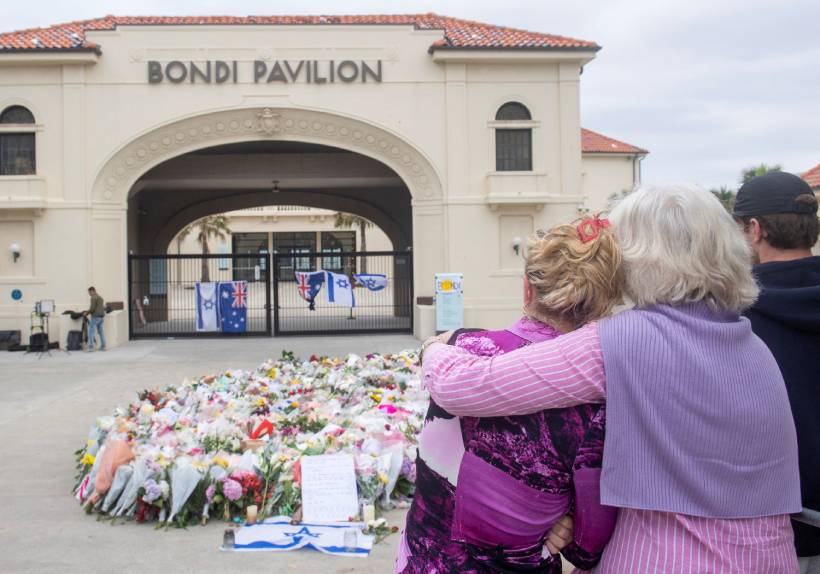
Moments of national trauma often reveal a country’s deepest divisions. More seldom, they expose its moral essence. The Bondi terror attack did the latter. Amid chaos, fear, and gunfire, one man moved not away from danger but towards it. Ahmed al-Ahmed, a Syrian-born Australian father of four, wrestled a rifle from an attacker and, in doing so, challenged a narrative extremists rely on: that societies are irreparably divided along faith and identity.
That single act of courage has travelled far beyond Bondi. It has reached global capitals, think tanks, security forums and diplomatic cables. Not because it was extraordinary in a cinematic sense, but because it was profoundly ordinary in its values. It showed what happens when moral conviction outpaces hatred.
Australian Prime Minister Anthony Albanese described Ahmed as ‘the best of our country’, a phrase that resonated because it rang true. In an era when national identity is increasingly politicised, Ahmed’s heroism highlighted something quietly powerful: Australian values are not inherited by blood or faith, but demonstrated through actions. The statement that ‘an attack on Jewish Australians is an attack on every Australian’ was not mere rhetoric. It was exemplified, physically, by a Muslim Australian risking his life for strangers.
This is not sentimentality. It is a strategic reality.
Stay ahead of the geopolitical week.
MD Briefing delivers expert analysis across five global fronts — the Indo-Pacific, energy, geoeconomics, European security, and the Middle East — every Monday morning. Free.
Extremist violence aims not only to kill but to fracture. According to the Global Terrorism Index, attacks are designed to provoke retaliation, amplify suspicion and accelerate social polarisation. The Bondi attacker failed on all counts. Muslim, Jewish and broader Australian communities responded not with fear, but with coordinated solidarity. Peak Muslim organisations condemned the antisemitic violence within hours. Jewish leaders publicly acknowledged that response. Candlelight vigils became collective statements of refusal: refusal to be divided, refusal to allow ideology to replace humanity.
Ahmed al-Ahmed’s actions were immediately framed through the language of values. Islamic ethics emphasise the sanctity of life, captured in the Qur’anic principle that saving one life is akin to saving all of humanity. These are not abstract theological claims; they form the ethical backbone of Muslim civic engagement globally. Studies of Muslim communities in Australia consistently show overwhelming alignment with democratic norms, human rights and the rule of law, with more than 90 per cent of respondents rejecting any justification of violence against civilians.
That alignment matters for foreign policy.
In international relations, identity is not ornamental. Constructivist theory has long argued that shared norms shape security outcomes more effectively than coercion alone. Ahmed’s intervention is a textbook case of normative resilience. It undermines extremist messaging that frames Western societies as hostile to Islam, while simultaneously dismantling far-right narratives portraying Muslims as threats to national security.
Comparable moments echo globally. In Christchurch, Abdul Aziz ran towards gunfire to stop a massacre, saving dozens. In London, Algerian-born rail worker Samir Zitouni shielded commuters during a stabbing. In New York, Pakistani-American first responder Mohammad Salman Hamdani died trying to rescue strangers on 9/11. Each time, public recognition followed initial suspicion. Each time, the moral clarity arrived late but unmistakably.
What differentiates the Australian response at Bondi is its speed and coherence. Within hours, political leadership, community institutions and media narratives converged on unity rather than blame. That matters. Some think-tank research has shown that social cohesion is a core pillar of national security, particularly in pluralist societies facing transnational threats.
Australia’s multicultural framework is often discussed defensively, as something to be protected. Bondi reframed it offensively, as something that protects in return. Diversity did not dilute resilience; it produced it.
There are diplomatic implications here that should not be overlooked. Australia operates in an Indo-Pacific region where Islam is not peripheral but central. Indonesia, the world’s largest Muslim-majority democracy, has invested heavily in what scholars describe as “Islamic peace diplomacy”, promoting moderation as a stabilising force. When an Australian Muslim becomes a symbol of national courage, it strengthens Australia’s credibility in engaging with Muslim-majority partners on counter-extremism, humanitarian cooperation and regional stability.
Soft power, as Joseph Nye famously argued, flows from attraction rather than coercion. Ahmed al-Ahmed has become an unintentional ambassador of Australian values abroad. Coverage in Middle Eastern, European and Israeli media framed his actions as proof that coexistence is not aspirational but operational. That narrative has strategic value at a time when Australia seeks deeper engagement across faith-diverse regions while countering radicalisation narratives online.
Domestically, the lesson is equally clear. Rising Islamophobia and antisemitism are not merely social issues; they are security vulnerabilities. Singapore’s RSIS analysis warns that unchecked identity-based hostility erodes trust between communities and institutions, weakening early-warning mechanisms against violence. The Bondi response demonstrated the opposite: trust enables rapid moral mobilisation.
Ahmed’s family described his decision as ‘a matter of conscience’. That phrase deserves attention. Conscience is not policy, but it is policy’s precondition. Laws, agencies and strategies function only when citizens believe the system is worth defending. On that beach, Australian citizenship was not a legal status; it was a moral reflex.
Foreign policy often concerns itself with distant crises, but it is anchored at home. The credibility of any international human rights position depends on domestic coherence. The events at Bondi offered that coherence in stark relief. A Muslim man defended Jewish lives in a secular democracy, applauded by a nation that refused to fracture along expected lines.
This is not a story of assimilation or exception. It is a story of alignment. Islamic ethics and Australian civic values did not meet halfway; they stood on the same ground.
In a global environment increasingly shaped by grievance politics, the image of Ahmed al-Ahmed disarming hatred with bare hands carries more diplomatic weight than any communiqué. It signals that the centre can hold, that values can outpace violence, and that the most powerful response to terror remains stubborn, visible humanity.
History will record the Bondi attack as a tragedy. It should also record what followed: a country that, when tested, chose unity over fear, conscience over chaos, and demonstrated to the world that courage still speaks louder than hate.