


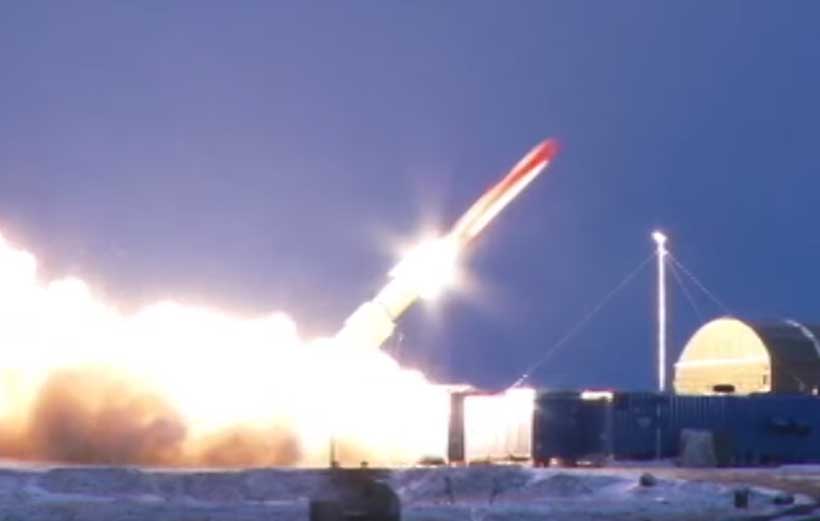
President Vladimir Putin announced on Sunday that Russia successfully tested the Burevestnik nuclear-powered cruise missile. This missile, known as the 9M730, is a ground-launched, low-flying weapon capable of carrying nuclear warheads and is powered by nuclear energy. NATO refers to it as the SSC-X-9 Skyfall. Putin claims the missile has an unlimited range and can evade U. S. missile defenses, although some Western experts doubt its strategic value, arguing it may not significantly enhance Moscow’s military capabilities and could pose radiation risks during its flight.
During the recent test on October 21, General Valery Gerasimov reported that the missile flew 14,000 km (8,700 miles) over roughly 15 hours. Its nuclear propulsion system allows it to travel longer distances compared to traditional engines, enabling it to “loiter” for extended periods before striking targets. The Nuclear Threat Initiative noted that the Burevestnik could potentially remain airborne for days, circling the globe at low altitude and dropping nuclear warheads unpredictably.
However, some experts point out that the missile’s subsonic speed makes it detectable, which could increase its vulnerability the longer it remains in the air. Russian military expert Alexei Leonkov stated that the Burevestnik would be used to target enemy command posts and military infrastructure after initial intercontinental ballistic missile attacks, helping to ensure complete destruction.
The International Institute for Strategic Studies indicated that the Burevestnik could have a range of up to 20,000 km (12,400 miles), allowing it to strike targets in the U. S. from various locations in Russia. The missile operates at a low altitude of 50 to 100 meters (164 to 328 feet), making it harder to detect with air-defense radar.
The Burevestnik’s development has faced numerous failures, including a 2019 incident that resulted in fatalities during a test. Despite these setbacks, Putin continues to promote the missile as unparalleled globally. In 2024, U. S. researchers reportedly identified a possible deployment site for the missile near a nuclear storage facility north of Moscow.
With information from Reuters
