


In the convoluted world of geopolitics, where states vie for power and prestige, the great shift is underway. The United States, which once stood as the epitome of global power and authority, today faces domestic turbulence and declining foreign credibility due to Donald Trump’s erratic leadership. China, with Xi Jinping’s firm and calculated hand, takes strides towards further global acceptance and dominance. This transformation is not merely fleeting but the result of Trump’s humiliating diplomacy, a realignment of the share of power in the globe, shifting national relations, and a change of heart by the global public. The globe watches a power realignment, as American braggadocio goes the way of Chinese serenity, with big implications for global stability, trade, and alliances.
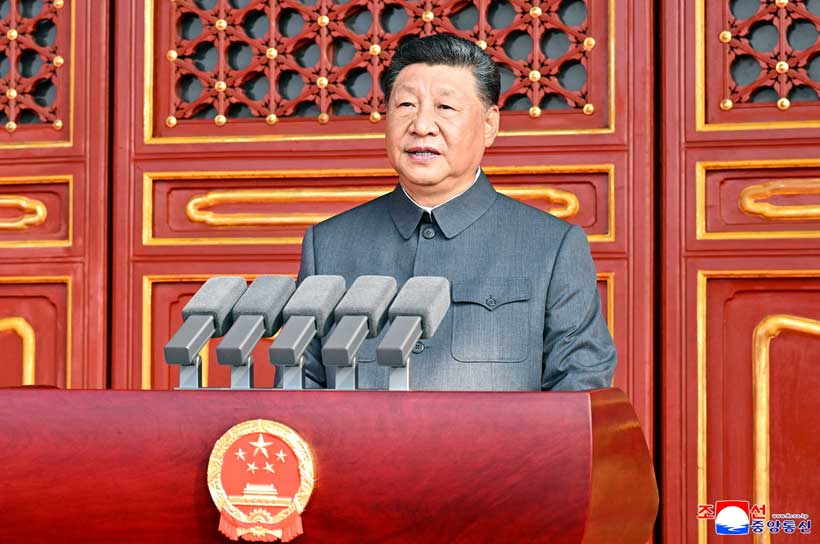
The story begins with a vivid scene: a huge military parade held by Beijing marking the 80th anniversary of the end of Japan’s surrender during the Second World War, with Xi Jinping standing beside Vladimir Putin and Kim Jong-un and conveying the military might of China. The absent figure at this ceremony was Donald Trump, the president of the superstate of the globe, not invited and not part of it, instead tweeting angrily. This omission comes with a definite message: authoritarian strongmen such as Putin, Xi, and Kim, with tight grips and geopolitical insight, regard Trump as beneath their notice. This diplomatic discourtesy forebodes a larger trend: the United States during the presidency of Trump is a rudderless ship, without the unity and political substance of the preceding period.
This impression goes well beyond the diplomatic community; public sentiment around the world confirms it. Surveys from early 2025 of 24 countries report a sudden drop by 15 countries of favorable opinion of the United States by up to a third. Double-digit drops by key allies such as Mexico, Sweden, Poland, and Canada also occurred. In 19 countries, a majority of those surveyed question Trump’s ability to manage international affairs. That contrasts sharply with the pre-Trump years when confidence in the United States stayed significantly higher by at least a third by the opinion of 13 countries. Trump’s track record on specific issues fared no better: on average, a full 72% question his approach to the environment, 67% his management of the global economy, and a majority from the NATO countries question his approach to the Russia-Ukraine crisis. Descriptors such as “arrogant” and “dangerous” dominate the characterizations by a significant margin of those asked what they think of Trump, with a full 80% calling him self-absorbed and two-thirds a danger. Even when he’s seen as a “strong leader,” this description gets swamped by accusations of ineptness and self-absorption.
Trump’s foreign policy—or rather, a lack of one—has hastened this decline. His administration includes personal scores instead of a vision for strategy: Nobel Prize-chasing summits, abrupt tariffs on trade, and tribute-like sums from allies. The glaring case in point would be his recent meeting with Putin in Alaska, during which Putin dominated the press conference, would not haggle, and bypassed a planned lunch, leaving Trump humiliated and regurgitating Russian talking points—a turn of events that upset the European allies. Likewise, his first-term love letters for Kim Jong-un led to little progress, as the arsenal of nuclear weapons of North Korea continued to grow, and predictions suggest it may eventually supplant Britain. These episodes suggest a president set upon emphasizing pomp over substance, leaving the competitors to take advantage of the US’s weaknesses. Back home, his cabinet choices—such as a defense chief with limited experience and a national intelligence director set upon personal scores—inject this turbulence further, emboldening the competitors.
Stay ahead of the geopolitical week.
MD Briefing delivers expert analysis across five global fronts — the Indo-Pacific, energy, geoeconomics, European security, and the Middle East — every Monday morning. Free.
The economic factor also accounts for this fall. China is seen as the world’s greatest economy by 12 of the 24 countries surveyed, and the United States by the rest. President Trump’s trade wars, with a 50% tax on Indian products, alienated allies, which pushed them into the open arms of alternatives. China offered itself as a protection against American “bullying,” extending agreements even to competitors like India. Chinese economic relations continue to gain popularity among the middle-income countries, as Mexico opts for them, from 15% by 2015 to 45% by 2025.
Comparatively, Xi’s trajectory for China is a gradual ascent. Perception of China in the year 2025 became more favorable in 15 of the 25 countries surveyed, a reversal since the COVID-19 era. Though the sentiment as a whole remains negative (36% positive vs. 54% negative), the reversal tells the tale of the recovery of global credibility. Belief in Xi’s leadership also rose in 16 countries, with a weighted average of believing in his global leadership standing at 25%—a modest but rising number. This shift persists, especially for the middle-income countries, wherein the likes of the Belt and Road projects became popular.
Xi’s approach, which is one of stability and responsibility, contrasts sharply with the volatility of Trump. At the recent Shanghai Summit, Xi referred to a new economic and security order with developing nations first, and he stood between the Russian and Indian leaders. Chinese investments in the Middle East and North Africa widened Beijing’s reach into the parts of the world where the West’s influence had weakened, creating economic links without the cost of military overextension. In Africa and Latin America, favorable views of Chinese investment are gaining ground. China has even gone one up over America in terms of innovation, hitting at the soft spot of American pre-eminence.
Surveys compared also highlight this gap. Global opinion now leans toward China for the most part, as 76 of 96 surveyed nations were more positively inclined toward Beijing. The Democracy Perception Index of 2025 reports the United States trailing China by net opinion. China seems the desired ally for South Africa and Indonesia but a potential danger for Argentina and Brazil. This goes beyond economic but also cultural and geopolitical. Xi’s vision of China as a “leading global force” by the year 2050, from expanded political, economic, and military outlets, takes hold amidst a multipolar world skeptical of American unipolarity.A sullied America erodes the international institutions once controlled by American leadership, including the UN and NATO. Trade skirmishes have undercut supply chains, aiding Beijing’s plans for parallel institutions like the Regional Comprehensive Economic Partnership. Security vacuums have resulted, as for the Middle East, which China filled by mediating between enemies. The conclusion of American preeminence, expedited by a leadership for which principled diplomacy takes a poor second place to great moments of stagecraft, is plain. The globe is recalibrating loyalties, putting the post-Second World War order to the test.
