


Authors: Dr. Rizwan Naseer and Wadan Ahmad Jan Khan*
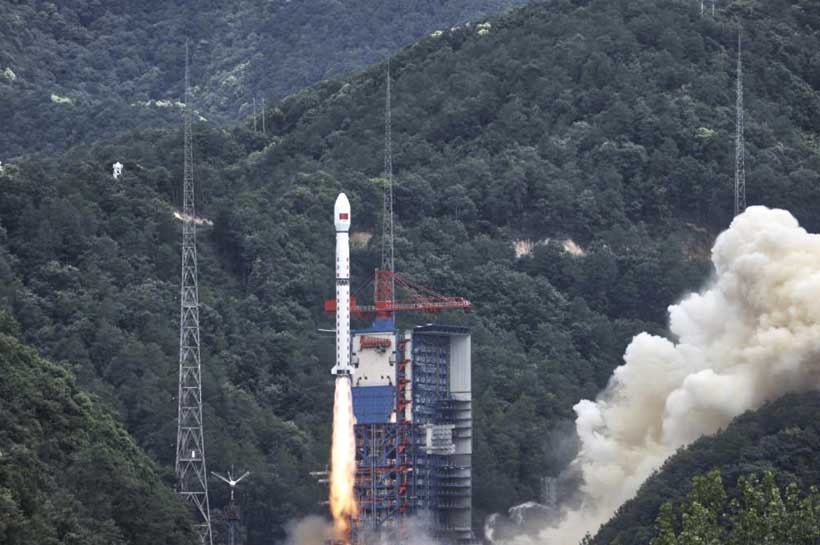
On July 3, 2025, the People’s Republic of China launched a satellite called “Shiyan-28B” aboard a launch vehicle known as a Long March 4C from Xichang into a low-inclination orbit. A low-inclination orbit refers to the path a satellite takes around the Earth that stays near the equator. Xinhua states that this launch was a mission for ‘space-environment exploration and related technology tests.’ The launch led to raised suspicions among American analysts. The Shiyan series of satellites had not attempted missions of this nature in the past. This led spectators to reassess China’s intentions in space.
Satellites that are traditionally launched into orbit by China are done so for weather, communications, or Earth-observation missions. However, the orbit along the equator taken by the Shiyan-28B suggests a pivot towards surveillance of tropical regions and narrow shipping routes such as the South China Sea or the Strait of Malacca. In addition to this matter, the satellite was placed in an unconventional orbit, which led to it being undetected. Western trackers only identified its presence only a week after its launch.
Data from satellite tracking platform N2YO states that the satellite orbits at roughly 800 km altitude, 11° inclination, and a 100‑minute period, which lends itself to regularly passing over trade routes along the equator.
Stay ahead of the geopolitical week.
MD Briefing delivers expert analysis across five global fronts — the Indo-Pacific, energy, geoeconomics, European security, and the Middle East — every Monday morning. Free.
China’s official space policy presents its space program as part of the country’s larger plan for development and security. It highlights the peaceful use of space and affirms that China is against turning space into a battlefield. Simultaneously, it emphasizes self-reliance in technology while remaining open to collaboration with other countries. Furthermore, the policy also links space progress with everyday uses such as navigation, communications, and disaster relief. However, despite this, many in Washington, D.C., remain suspicious.
Analysts continue to assess the importance of Shiyan-28B; U.S. officials continue to express their concerns over China’s unconventional maneuvers. In March 2025, Space Force Vice Chief Gen. Michaels Guetlein had publicly warned reporters during a Defense Programs Conference in Washington, D.C., of “dogfighting in space.” He was referring to five Chinese spacecraft (three Shiyan-24C satellites and two Shijan-6 crafts). He described it as synchronized, controlled maneuvers in low Earth orbit. He compared the behavior of the satellites with fighter aircraft. These were not, however, baseless claims, as the satellites appeared to be engaged in practiced choreography, rehearsing close-proximity rendezvous and potential grappling operations. According to Gen. Guetlein, these maneuvers called for caution and funding from the United States to establish “space superiority,” adding that America’s edge over its competitors has “significantly narrowed.”
U.S. observers such as Gen. Chance Saltzman, a Space Force chief general, have repeatedly warned that China’s space capabilities are advancing at a rapid pace. “Mind-boggling.” Statements such as these fuel concerns about the militarization of space.
It is not a secret that geostationary satellites Shijan-21 and Shijan-25 have previously engaged in close orbit maneuvers for docking and refueling at 22,000 miles above Earth. This is significant. If a satellite could refuel and service or extend the lifespan of another satellite, it could reduce China’s reliance on fresh satellite launches and could open the door to more flexible counterspace options.
According to Reuters, U.S. Space Command is readying itself for space-borne conflict as early as 2027 in the event of an attack on Taiwan, with satellites, AI-driven drones, and jamming systems. In fact, Reuters has also reported that China has even discussed rebuilding its Tiangong space station with robotic “drones” to intercept or grapple approaching spacecraft in the event of an attack.
For the U.S., China’s dual-use space capabilities are an increasingly growing concern. On one hand, China is advancing their intelligence with persistent surveillance along the equator and enhancing its intelligence-gathering capabilities. On another, it can potentially be used for satellite hacking or disabling capabilities. U.S. defense officials worry that this undermines orbital norms, which are unspoken rules of unilateral restraint that have so far kept space from becoming militarized.
In response to China’s growing space capabilities, the U.S. has begun developing countermeasures of their own. The Space Force has partnered with five companies to develop jam-resistant communication satellites. Furthermore, DARPA (Defense Advanced Research Projects Agency) has created DRBE (Digital Radio Frequency Battlespace Emulator), a system designed to simulate threats such as radar jamming and spoofing.
Pentagon leaders are using these developments as leverage to press Congress for additional funding to upgrade satellites, strengthen tracking systems, and further their counterspace capabilities. While at the same time experts such as Clayton Swope of CSIS warn of the need for a treaty on RPOs (rendezvous and proximity operation) or grappling arms that could lead to escalation by mistake.
These concerns are relevant as China grows more confident in deploying space assets. A recent example is the launch of low-altitude SAR satellites like the Haishao-1 into 43° inclination orbits. While officially designated for commercial or scientific purposes, such missions may support China’s development of an expanded ISR (intelligence, surveillance, and reconnaissance) network that focuses on maritime and tropical regions.
The United States now has two choices. It can continue expanding its military presence in space by investing in jamming technologies and by launching more satellites. Or it can prioritize diplomacy and create clear rules on how countries should behave in space. Arms control has worked in the past. Previous agreements, such as the 1972 ABM Treaty between the United States and the Soviet Union and the 2010 New START Treaty between the United States and Russia, showed that arms control was possible even during periods of strain. However, if China views proximity operations or satellite servicing as essential to its national strategy, establishing new agreements will remain highly challenging.
Greater transparency, such as pre-notifying RPOs or joint debris-clearing missions, could reduce misunderstandings on both sides and lower the risk of accidents.
To the U.S., Shiyan 28-B seems to be more than just an experimental satellite. It is a warning that space could become the next battlefield. Washington and its allies must take note: space security is no longer optional. It is vital for national defense and global stability.
With satellites growing more advanced and harder to track, the risk of misunderstanding increases. Although China’s space missions have peaceful goals, their dual-use potential cannot be overlooked.
The real question is whether countries will work together and create a new set of rules for space. Or will they continue to act alone and further risk turning it into the next battlefield?
*Wadan Ahmad Jan Khan is intern at the Institute of Regional Studies Islamabad.
