


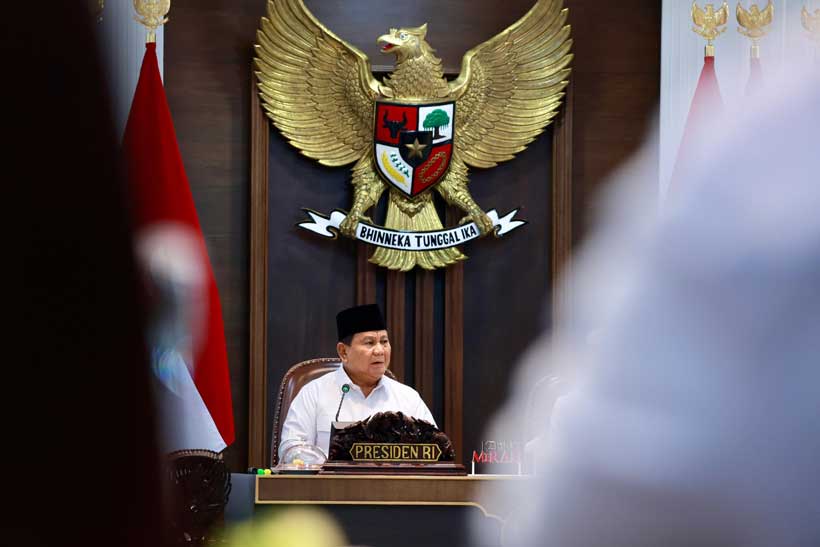
Following his election as President of the Republic of Indonesia for the 2024-2029 term, a new chapter begins for Prabowo Subianto President as he assumes the significant responsibility of navigating Indonesia’s foreign policy direction amid increasingly complex global dynamics. His military background and realist approach bring a unique perspective to the formulation of foreign policy.
As the largest democracy in Southeast Asia and an active member of the G20, Indonesia has a strategic role in global politics. Although the region that will be an important test for Prabowo’s foreign policy is the Middle East—a region fraught with strategic interests, humanitarian crises, and strong historical ties with Indonesia.
The Middle East: A Strategic Region for Indonesia’s Foreign Policy
Historically and emotionally, Indonesia has close ties with the Middle East. In a religious context, this region is the spiritual center for the majority of Indonesians. In terms of diplomatic history, the Middle East has been a key partner since the era of President Sukarno, particularly in the fight against colonialism and imperialism. Today, the Middle East is one of Indonesia’s most important partners in the fields of energy, investment, and migrant labor.
Stay ahead of the geopolitical week.
MD Briefing delivers expert analysis across five global fronts — the Indo-Pacific, energy, geoeconomics, European security, and the Middle East — every Monday morning. Free.
Indonesia’s interests in the Middle East encompass five main issues, including: 1) support for Palestinian independence; 2) protection of Indonesian citizens, particularly migrant workers; 3) energy and trade cooperation; 4) regional security and peace issues; and 5) Islamic cooperation and civilizational diplomacy.
Given these various backgrounds, Indonesia’s foreign policy toward the Middle East should not only be reactive but also proactive and strategic. This is the main challenge for President Prabowo Subianto as a leader with a military background but advocating the narrative of “prosperity and peace.”
The free-active principle inherited from Bung Karno emphasizes independence from major power blocs and active involvement in world peace—a principle that is vulnerable to being tested by the tension between constitutional idealism and political pragmatism.
Prabowo’s Track Record and Vision
During the 2024 presidential election campaign, Prabowo did not discuss in detail his foreign policy direction towards the Middle East. However, in various statements and vision-mission documents, he implied his desire to position Indonesia as a “sovereign, dignified and respected country in the international arena.” He emphasizes an “active, adaptive, and realistic” approach to foreign policy.
In the context of the Middle East, this approach is interpreted as maintaining the principles of non-intervention and active neutrality, while opening up more space for pragmatic national interests—particularly in the fields of defense and economics. Moreover, Prabowo’s track record as Minister of Defense reflects his openness to military and defense industry cooperation with Middle Eastern countries—such as the United Arab Emirates and Saudi Arabia.
On the other hand, an approach that appears technocratic and transactional could obscure Indonesia’s moral position on issues such as the Palestinian conflict, military intervention in Yemen and Syria, and diplomatic tensions between Iran and the Gulf states. Indonesia’s foreign policy is inseparable from its fundamental character as a country that upholds international justice and anti-colonialism. This is the legacy of Bung Karno, which is the spirit of Indonesia’s free and active foreign policy.
If Prabowo chooses a cautious or purely pragmatic economic approach, there are concerns that Indonesia will lose the moral legitimacy that has been the strength of its diplomacy in international forums.
The Palestinian Issue: A Test of Consistency
Palestine has become a benchmark for the consistency of Indonesia’s foreign policy in the Middle East. Throughout the history of Indonesian diplomacy, support for Palestinian independence has been not only symbolic but also ideological. Even in the constitution, rejection of colonialism is a fundamental principle that cannot be negotiated. From President Sukarno to Jokowi, Indonesia has openly condemned Israel’s occupation and supported a two-state solution based on the principle of justice.
In his statement, President Prabowo expressed his support for Palestine. However, the challenge is not merely rhetorical but lies in concrete diplomatic positions, especially in international forums. As head of state, he faces greater challenges—especially pressure from strategic partners such as the United States or Gulf countries to tone down Indonesia’s critical stance.
As the world faces Israel’s brutal aggression against Gaza—which has become an international concern—Indonesia can play an active role in mobilizing diplomatic pressure, pushing for human rights investigations, and initiating more progressive Asia-Africa or OIC forums.
If Prabowo merely follows the moderate diplomatic line without taking a clear stance against the aggressor, Indonesia’s credibility as a country that stands for justice will be called into question. This is both a moral and geopolitical test for his administration. Therefore, Indonesia must act as a global moral force—not merely a neutral mediator, but a defender of international justice.
Economic Cooperation vs Human Rights
The main dilemma in Indonesia’s foreign policy toward the Middle East is the tension between economic cooperation and the protection of human rights. Gulf countries, such as Saudi Arabia and the UAE, are major trading and investment partners of Indonesia. On the other hand, they are in the spotlight for human rights violations, including the treatment of migrant workers.
Prabowo, who tends to prioritize economic stability and efficiency, is likely to emphasize economic diplomacy and defense. During his tenure as Defense Minister, Prabowo maintained intensive communication with regional leaders on defense industry and technology transfer issues.
The National Capital City (IKN) development project presents strategic investment opportunities from the Middle East. For example, the UAE has expressed interest in developing Indonesia’s infrastructure and renewable energy sectors. In addition, the strengthening of economic diplomacy is directed towards the halal, food, and Islamic finance sectors.
However, this is where the ethical challenge lies: to what extent can the government balance economic interests with its commitment to protecting Indonesian citizens and human rights?
Some 1.5 million Indonesian citizens work in Middle Eastern countries—particularly in the domestic worker, nursing, and construction sectors. To date, cases of violence, exploitation, and inadequate legal protection for migrant workers have been critical issues.
Migrant worker issues are often resolved through bilateral channels that lack transparency. Prabowo needs to develop a protective diplomatic approach—prioritizing the rights of female migrant workers, access to justice, and strengthening diplomatic representation in the region.
The role of the Indonesian Embassy and labor attaché needs to be strengthened, not only as administrative liaisons but also as protectors of workers’ basic rights. Therefore, it is important that Indonesian diplomacy does not only serve the interests of the elite but must also reach citizens at the lowest levels.
Indonesia’s Role in Regional Peace: Hope and Caution
With Prabowo’s experience in defense, there is an opportunity for Indonesia to play a greater role in reconciling conflicts in the Middle East. This approach can be done through active involvement in multilateral forums, support for ceasefire initiatives, and even mediation between warring countries.
President Prabowo leads a country with the largest Muslim population in the world and without the burden of sectarian conflict in the region. Indonesia can only play this role if it has strong moral and political legitimacy—as well as being a mediator in the Middle East conflict. This is because Indonesia has moral legitimacy and is not considered a political threat by any party.
Mediation initiatives can be implemented—reconciling tensions between Iran and Saudi Arabia, facilitating dialogue in Syria, supporting a peaceful solution in Yemen. Although this role does not arise spontaneously—it requires political courage, consistency of principles, and serious diplomatic investment.
Active neutrality should not be interpreted as a “silent and passive” position. Rather, it is based on the principle of international justice—Indonesia can offer a strategic position as a mediator that is not aligned with the world’s major powers, but rather with peace and the sovereignty of nations.
Overall, Prabowo’s foreign policy prospects toward the Middle East are caught between principles and pragmatism. On one hand, there are opportunities to strengthen economic cooperation, defense diplomacy, and strategic investments. On the other hand, there is the risk of blurring Indonesia’s core principles as a defender of Palestine, a protector of human rights, and a guardian of global peace.
The public’s greatest hope is that the Prabowo administration will not compromise its free and active foreign policy principles solely for short-term economic interests or global power pressures. Instead, it can demonstrate that Indonesia has the potential to become a moral force on the international stage—especially in the Middle East, which is plagued by conflict and injustice.
Conclusion: Diplomacy Based on Courage and Justice
Indonesia’s foreign policy legacy is not merely history, but a moral compass. Indonesia’s foreign policy toward the Middle East during the Prabowo era serves as a mirror for future national diplomacy. Amid global power struggles, humanitarian crises, and conflicting strategic interests, Indonesia must serve as a beacon of balance between principles and interests.
In the Middle East, the world awaits a clear and firm voice for peace, justice, and freedom. Prabowo has the opportunity to continue this legacy with a strategic yet ethical approach. President Prabowo is being tested on his capacity as a national leader, not merely as head of state—but as one who upholds Indonesia’s reputation in the international community.
The choice lies with President Prabowo: whether to be a leader who uses diplomacy as a tool for transactional interests alone or as a path toward global justice. History will record his stance—and the Indonesian people will be the judges.
