


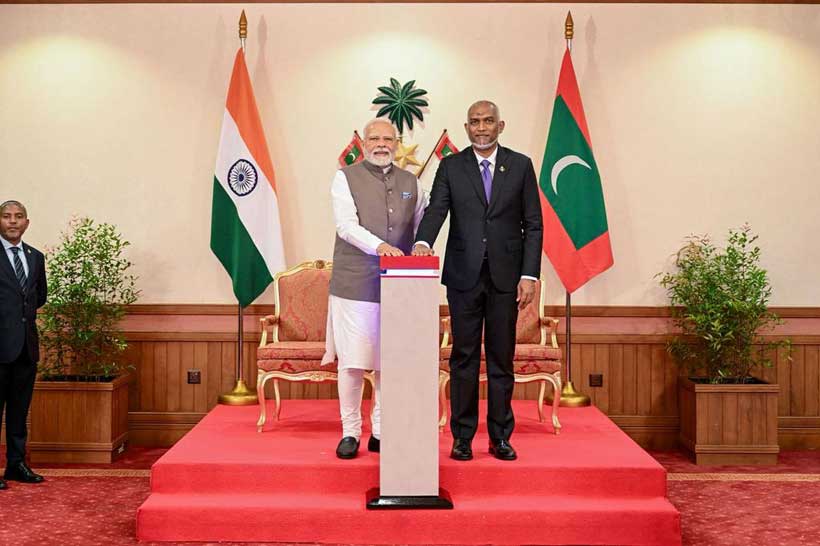
The Republic of Maldives commemorated 60 years of the nation’s independence on July 26, 2025. The President of Maldives, Dr. Mohamed Muizzu, and First Lady Sajidha Mohamed observed the independence day parade at the Republic Square, which was inclusive of a military display by the Maldivian National Defence Forces, cultural performances, and a lively procession by the other local units.
The independence day celebrations also witnessed the presence of Indian Prime Minister Narendra Modi, who was invited as the Guest of Honor at the occasion. Prime Minister Modi embarked on a state visit to the Republic of Maldives on 25-26th July, 2025, which also marked his first-ever visit to the country, following President Muizzu’s election victory in November 2023.
Prime Minister Modi’s visit and the resetting of ties
The visit of Prime Minister Modi as a guest of honour is indeed a part of a wider diplomatic manoeuvring that has been pushed from both sides, considering that President Muizzu came to power with an India-out stance that marked his presidential bid in the 2023 elections. The India-out policy aimed at reducing dependence on New Delhi, including the removal of Indian military personnel from Maldivian soil and diversification of the country’s security relations.
Stay ahead of the geopolitical week.
MD Briefing delivers expert analysis across five global fronts — the Indo-Pacific, energy, geoeconomics, European security, and the Middle East — every Monday morning. Free.
His term at the office followed a series of hostilities between the countries, beginning with his overseas visit to Turkey in December 2023 and to China in January 2024. His visit was a departure from the tradition of the new Maldivian presidents visiting India first after taking office. Subsequently, the derogatory remarks by Maldivian junior cabinet ministers (eventually suspended) hurled against PM Modi during his Lakshadweep visit in January 2024 that followed the boycott Maldives campaign on Indian social media added to the diplomatic bump between the nations. The boycott campaign significantly affected Indian tourist footfall in the Maldives, potentially affecting the tourist-reliant economy. By this time, India had started replacing its Maldivian-stationed military personnel with HAL (Hindustan Aeronautics Limited) technicians.
However, the tides turned during the middle of 2024 when Maldives Foreign Minister Mr. Moosa Zammer visited India in May 2024, signaling a willingness to reset relations and pursue economic and strategic engagement. Thus began the series of diplomatic rapprochements between the countries, marking a string of high-level visits. To begin with, President Muizzu was one of the chief guests as a part of a larger cohort of the leadership from India’s neighborhood and the Indian Oceanic Region (IOR) who graced the swearing-in ceremony of Prime Minister Modi in June 2024. The visit of the leaders was in line with India’s commitment to its Neighborhood First policy and the MAHASAGAR (Mutual and Holistic Advancement for Security and Growth Across Regions) vision. The diplomatic relationship reached its zenith when President Muizzu embarked on an official visit to India in October 2024 that officially led to reconciliation, both symbolically and substantially. The Maldivian president’s five-day visit to India culminated in the adoption of the Vision for Comprehensive Economic and Maritime Security Partnership, with President Muizzu stating that “Maldives will not do anything that would harm India’s security interests, and they value India’s role as a close neighbor and friend.” In a significant departure from his India-out campaign, Maldives shifted his diplomatic stance towards India and revitalized focus on strengthening collaboration in economics, defense, maritime security, etc.
With deft diplomacy on both sides, reciprocal visits at the level of heads of government and ministerial level are on an upswing, with the countries emphasizing the significance of their partnership. On that note, the visit of the Indian prime minister to Maldives, especially in the year 2025, which marks 60 years of diplomatic relations between the two South Asian neighbors, is indeed a step in the right direction.
PM Modi, during the visit, was accorded a ceremonial welcome, with the leaders reaffirming the deep-rooted friendship between the nations. Furthermore, the two-day visit that followed witnessed the exchange of six MoUs in the domain of fisheries and aquaculture, meteorology, digital public infrastructure, Unified Payments Interface (UPI), Indian Pharmacopoeia, and concessional line of credit, with the new line of credit offering $550 million in support for infrastructure and activities in the Maldives. Additionally, an Amendatory Agreement for the existing line of credit was also changed, reducing the annual debt repayment obligation by 40%.
PM Modi also handed over 3300 social housing units and two units of Aarogya Maitri Health Cube (BHISHM) to the government of Maldives; the medical equipment can provide aid to 2000 casualties with in-built support to sustain a crew of six medical personnel for up to 72 hrs.
In light of the commemoration of 60 years of diplomatic relations, the leaders released celebratory stamps reflecting age-old bilateral ties. The stamp depicts a large Indian boat, the Uru—handcrafted in the historic backyard of Beypore, Kerala—as well as the Vadhu Dhoni, which is a traditional Maldivian fishing boat. These boats have been a part of Indian Ocean trade for centuries, with the Vadhu Dhoni being used for reef and coastal fishing, thereby depicting its rich maritime heritage.
At the strategic level, India and Maldives share a highly interdependent relationship that, in many ways, supports their domestic and foreign policy objectives. For instance, Maldives holds a very significant position in the Indian Oceanic Region (IOR), with its geographical positioning akin to a toll gate between the western Indian Ocean choke points of the Gulf of Aden and the Strait of Hormuz and the eastern Indian Ocean choke point of the Strait of Malacca. Situated along the major sea lines of communication (SLOCs), its position is close to 50% of India’s external trade and 80% of India’s energy exports. A resilient relationship with Maldives will aid India in countering China’s string of pearls strategy in the IOR that aims to secure maritime trade routes and influence the geopolitical framework of the region. Additionally, the Indian expatriates form a large part of the Maldives, and therefore it becomes important for India to safeguard its interest with the country in totality.
On the other hand, India is Maldives’ closest neighbor, rendering it as the first organic responder in times of crisis, as in the case of the 2004 tsunami crisis when India was first to send naval and medical aid; Operation Neer, when India airlifted over 1000 tons of water owing to Male’s drinking water crisis; and during covid-19, when India sent vaccines and medical teams and equipment as a part of its Vaccine Maitri initiative. Moreover, under the Maldivian national health insurance scheme Aasandha, the citizens could seek specialized health treatment overseas, with India emerging as the most sought destination for this kind of health tourism. As per reports, hundreds of Maldivians visit Thiruvananthapuram and Kochi (cities in the Kerala state of India) to have their healthcare needs met.
Conclusion
All things considered, the visit of the Indian PM to the Maldives was indeed a momentous one, considering the bilateral relationship is highly significant in terms of securing a peaceful and secure Indo-Pacific. When it comes to regional cooperation, the outstanding issues amongst countries should be resolved with a firm intention of reconciliation and meaningful dialogue, as it immunizes the relationship from any third-country meddling.
In the present scenario, the India-Maldives recalibration is of utmost significance to India, considering its burgeoning global power ambitions and the need to strengthen maritime security frameworks and digital connectivity partnerships with key neighboring states.
