


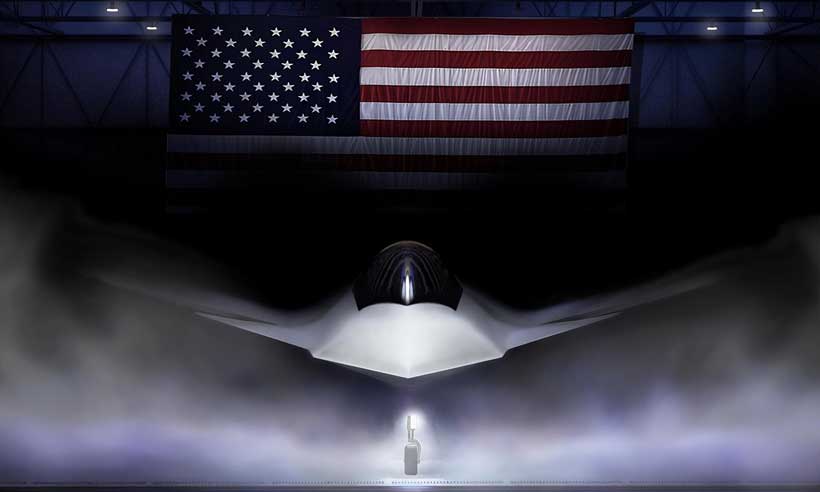
F-47 announcement:
On March 21st, 2025, President Trump declared that the US Air Force (USAF) would move on with Next Generation Air Dominance (NGAD) fighter aircraft platform production, which is expected to replace F-22 Raptors. The USAF chief said that the F-47 will be more affordable than the F-22, more capable of adjusting to new threats, and more available than their current fifth-generation fighters, with a significantly longer range, more advanced stealth, and greater sustainability and supportability. It will also have an ability to interact with drone technology. The NGAD platform is a network-connected collection of systems that work together to guarantee air superiority. These systems include drone technology, a stealth fighter jet component, and others. Boeing was chosen to develop the NGAD and it came as a surprise because the NGAD project was shelved earlier.
Understanding F-47’s design:
Compared to current F-22s, the F-47 is expected to fly about 70% farther without refueling, enabling tankers to remain farther away from action—a crucial advantage in the event of a Pacific confrontation, which means that more than 1,000 nautical miles will be the battle radius of the envisioned sixth-generation aircraft. It will fly faster than Mach 2 and have ‘stealth++’ capabilities. Unlike earlier stealth designs, renderings of the current F-47 design show a stealthy nose and bubble canopy with a chiseled chine and a flattened overall fuselage shape. It also has canards and wings with a noticeable upward inclination.
Stay ahead of the geopolitical week.
MD Briefing delivers expert analysis across five global fronts — the Indo-Pacific, energy, geoeconomics, European security, and the Middle East — every Monday morning. Free.
F-47 is expected to have a tailless design, which can lead to a decrease in maneuverability. Thrust vectoring can solve this deficiency, but that increases weight and cost, making the project more complex. Given the presence of canards, it appears that agility may have continued to be a key design factor. Canards provide extra stability and greatly improve maneuverability, especially for delta-wing aircraft, even at high angles of attack. But adding canards has the major disadvantage of historically making it difficult to achieve a very high degree of radar-evading stealth, particularly from the frontal hemisphere, which is vital for the survivability of a tactical jet. When it comes to attaining Very Low Observability (VLO), commonly known as ‘broadband’ stealth, this problem is amplified further.
In contrast to previous stealthy fighters, the F-47’s design is not solely optimized to avoid fire-control-type radars, which are typically found in and around the X-band. To meet VLO design objectives, RF emissions control and infrared signature reduction are also important factors. It is estimated that these canards might also be static devices that mainly aid in lift during specific flight envelope segments and don’t move as part of the flight control system. It is also feasible to have a completely retractable canard arrangement, which would allow for advantages of these flight control surfaces in some areas of the flight envelope while preserving optimal stealth in others. It’s clear that canards are good for agility but not great for radar signature reduction. Few believe that canards do have an impact on radar signature, but the difference doesn’t appear to be extreme.
Depending on how canards are positioned at any particular time, usage of sophisticated composites that can incorporate frequency-transparent structures with baffles underneath can aid in defeating specific bands of incoming radar radiation. Stealth treatments include more than merely coatings of radar-absorbent materials and shape. The radar reflectance of canards could be countered by even more unusual design strategies. It’s even possible for control surface structures to morph. Given that the Agile Combat Employment project that is consuming future war plans in the Pacific, short field performance—which canards and a lighter airframe would help make possible—may have also evolved into a design objective. To guard against the potential that stealth technology will lose its effectiveness against highly developed integrated air defense networks in ensuing decades, it’s also possible that a greater emphasis on traditional fighter performance rather than stealth was chosen, along with greater investments in electronic warfare capabilities.
F-47’s expected operational requirements:
The objectives of USAF’s variable-cycle engine program were clearly defined in 2018. It distinguishes between engines of 200 kilonewton (45,000 lb) thrust class (General Electric XA100 and Pratt & Whitney XA101) sized for the F-35, smaller ‘scaled core’ engines for the F-47 (now known as GE XA102 and P&W XA103), and a derivative for retrofit to F-15s and F-16s. This suggests that F-47’s engine can produce a maximum thrust of about 160 kilonewtons (35,000 lb). An aircraft with a loaded weight of roughly 45 tonnes is suggested by the need for more range and less maneuverability, much like an F-11. However, an adaptive engine is crucial since it enables a supersonic cruiser to utilize less afterburning, even for transonic acceleration, while maintaining subsonic flight efficiency.
Sixth-generation platforms depend on a reliable and safe supply of rare earth elements and critical metals for everything from high-thrust engines and sophisticated avionics to radar systems and stealth coatings. In addition to strategic metals like titanium, tungsten, and niobium for structural strength, heat resistance, and stealth coatings, rare earth elements like neodymium, praseodymium, dysprosium, and terbium are essential for high-performance magnets, actuators, and radar systems in stealth aircraft like the F-47.
The main use of strategic materials in the F-47 would be in multifunctional radars, which will be housed inside the radome. Gallium arsenide has already been used in radars and active electronically scanned arrays on aircraft of this type. By switching to gallium nitride, those arrays can release a lot more energy from the same space and have significantly higher power throughput, temperature capacity, and thermal capacity. The F-47 will have Next Generation Adaptive Propulsion program engines, which include a secondary variable bypass flow and a three-stream architecture to improve fuel efficiency in cruise mode. These engines can shut down and accelerate when required.
Supporting Refuelers:
In addition to the NGAD program, USAF has been honing its concept for a Next Generation Air-Refueling System (NGAS) ‘system of systems,’ which may include new uncrewed and/or stealthy tankers by 2040, if not before. In a future large-scale confrontation, friendly non-stealthy tankers and other support aircraft will be top targets for any adversary, making the air-defense threat ecosystem’s ongoing growth in size and breadth particularly concerning. The USAF is investigating the possibility of using fighter-sized aircraft to carry boom-equipped podded aerial refueling devices as an additional means of assisting with future tanking requirements. Additionally, efforts are being made to enhance capabilities of current tankers by adding new defensive systems, communications, and data-sharing features. In order to boost aerial refueling capacity without adding more airframes or personnel, the USAF has been experimenting with flying tankers with smaller crews and utilizing artificial intelligence and machine learning technologies.
Contemporary tanker aircraft must transform from basic gasoline suppliers into networked battlespace nodes in an increasingly contested and complicated airspace, able to sustain, adapt, and survive in quickly changing settings. Decentralised decision-making is made possible for tanker crews by having access to this near-real-time battlespace overview, which includes asset positions, threat updates, and mission priorities. Maintaining fast-paced operations, where windows of opportunity may only last minutes, requires this. Additionally, situational awareness goes beyond fuel logistics since tankers can dynamically reroute for mission continuity or survivability thanks to access to real-time weather and danger data. Shared threat intelligence is another advantage of networked tankers. They are easy targets because of their size and profiles. Therefore, situational awareness is essential to survivability, especially in contested contexts.
Challenges for F-47:
The US government has allocated $3.5 billion for the F-47 fighter. In spite of this, budget uncertainty will remain, as a lot of that hinges on what Congress does, especially on the reconciliation package, which includes vital funding for several of the administration’s most prominent defense projects. The NGAD budget could also be disturbed by the proposed ‘Golden Dome’ missile defense system since its budget is unclear, as the Congressional Budget Office estimates it to cost $831 billion over two decades. Because of worries about the US industrial base’s ability to simultaneously build two significant next-generation fighter aircraft programs, the Pentagon has chosen to postpone financing for the Navy’s F/A-XX program.
There are allegations that this deal is about more than simply creating a plane; it’s about salvaging Boeing, which was on the verge of collapse, changing its course, and re-establishing its significance in a defense market that competitor Lockheed Martin had long controlled. After almost 3,200 workers voted against a revised four-year labor deal, Boeing employees at the company’s fighter jet production facilities recently went on strike, which could delay the timeline for production of F-47s. Since no system is perfect, it is important to examine F-47’s weaknesses. Due to its dependence on intricate electronics, it may be vulnerable to cyberattacks, which are becoming a more serious risk in contemporary warfare. There may also be logistical issues, similar to those that beset the F-35’s upkeep. The Chinese believe that Boeing will rely on antiquated design decisions and lack the technological resources to create new control techniques. Further, China has placed export limitations on its rare earth element exports to the US, including minerals essential for avionics, which could jeopardize American plans for the F-47.
Conclusion:
The development of the sixth-generation F-47 will be an ambitious and challenging prospect for the US since its design parameters, powerhouse requirement, and support fleets will also come into the picture. F-47 in itself won’t be effective without the development of CCA components like drones, refuelers, AWACs, etc. Adding to that the budget uncertainty, rare-earth materials unavailability, and ambition to develop ‘Golden Dome,’ the US will be having trouble in maintaining and developing all projects at the same time. While the initial design is still not complete and China has marched ahead in flying a prototype of a tailless aircraft in late 2024, the F-47 will have limited impact as far as deterring US adversaries like China and Russia are concerned because it is expected to project similar limited deterrence to that projected by the F-22 or F-35, which haven’t faced real air-power challenges from modern air forces or air defenses of China and Russia till now. Despite that, as usual, the F-47 may ultimately be tagged as the most superior aircraft ever built on this planet by the USA, but with a hidden caveat of not facing its peers head-on in both visual and beyond-visual-range real-world combat scenarios.
