


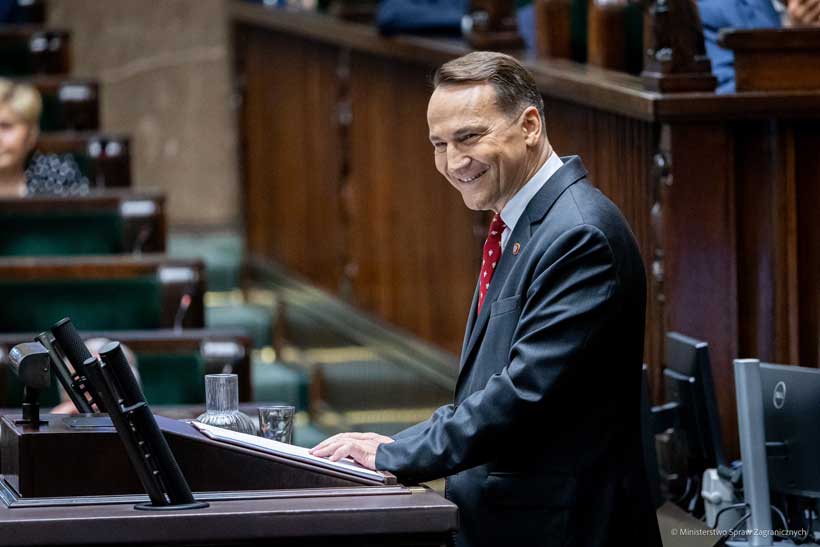
It was against a particularly tense security backdrop, with war on Europe’s doorstep in a country bordering Poland, that the heads of state of the Weimar Triangle members met in March 2025 to reaffirm the need for crucial support for Ukraine. Created on August 28, 1991, in the German city of Weimar, this regional alliance was created at the end of the Communist era, following the collapse of the Soviet bloc, and has seen its role evolve over the decades. Initially seen as a lever for consolidating German-Polish relations and a tool for Poland’s integration into the “West,” the alliance has played a major role in Polish foreign policy and partly explains Poland’s international position today. As shown by the latest meeting of the alliance, the purpose of this one and the benefits that it could bring to Poland radically changed. To understand to what extent the Weimar Triangle played a role in strengthening Poland’s international position and achieving its strategic goals after the fall of communism, going back in time and looking at the long path of this alliance is a necessity. Undeniably, the Weimar Triangle has played a meaningful role in supporting Poland’s reconciliation and integration following the end of communism, while going beyond its initial purpose to become a strategic platform. While marked by both achievements and shortcomings, it has had a lasting influence on Polish foreign policy and helped shape the country’s position on the international stage amid a range of domestic and global challenges.
When R. Dumas (France), H.D. Genster (Germany), and K. Skubiszewski (Poland) met in 1991 in the German city of Weimar to attend the very first meeting of this trilateral alliance that will become the Weimar Triangle, the purpose of this one was far from its current one. As a unique regional exchange and cooperation platform not based on any binding treaty, its particular form earned it the nickname “political UFO” by Rolands [ii]. The Triangle was designed as a forum for trilateral consultations between the foreign ministers of France, Germany, and Poland on the future of Europe after the end of the Cold War. In a nutshell, the three global objectives of this trilateral dialogue organization could be summarized as the following: Bringing Europe closer together after 1989, integrating Poland into the «West», and consolidating the transatlantic link for security in Europe. The very first objective concerning Poland that Hans-Dietrich Genscher wanted to fulfill was the total reintegration and the complete “return to Europe” of Poland after the country faced more than 40 years of communism. Consolidating the position of this country in the eastern part of Europe was a way to enlarge the influence of the Union and assert the involvement of Poland in the «West.». On the Polish view, it was the opportunity to forge strong ties with the Franco-German couple, seen as the «engine» of the European Union and European integration. This reintegration was also combined with the idea of improving the relations between Poland and Germany, the same way France and Germany did after World War II, by working on the rapprochement of two former enemies. Integrating Poland, a ravaged country devastated by war and a long period of Communist domination, into European and Euro-Atlantic institutions was the priority of this initiative. The fact that France and Germany also suffered from this dramatic and bloody war fostered the dialogue and the cooperation between these countries with painful histories.
The project eventually bore fruit, and the impetus given by this trilateral cooperation led to the alliance’s first success, Poland’s integration into NATO in 1999. After eight years of regular exchanges and common alignment on various policies, Poland has seen its first real step towards integration with the “West.” Its integration into the military alliance ensured it a place in the security discussions on Europe and Euro-Atlantic security, as well as additional protection against potential external threats, protected by the nuclear umbrella and common protection intrinsic to the alliance. In terms of foreign and security policy, this integration can be seen as the rise of Poland as an international actor concerned by global security issues. Another major step toward Poland’s integration in the «West» was the year 2004, when the country joined the European Union during the «great enlargement» of the union. Joining the European Union was a pivotal moment in Polish foreign policy, as the country was finally able to participate in internal European discussions and decision-making, carrying its voice as a Central European country. Not to mention the strong economic support the country has received for its development, estimated between 250-300 billion euros since 2004[iii]. However, while European Union membership brought relatively long-term economic and institutional benefits, it rapidly proved inefficient for Poland’s foreign policy concerns. Due to the complex structure of the Union, the length of legislative procedures, and diverging national interests, the impact turned out to be minor. Therefore, the Weimar Triangle stood as a strategic alternative for Poland and a way for the country to develop bilateral and trilateral cooperation that allowed for quicker coordination and more tailored policy outcomes. This momentum marked the beginning of a new era, the shift to an «active position» of Poland in the Triangle, (even though it was already a player before that momentum) after the country got fully institutionally integrated into the European and Euro-Atlantic alliances. Furthermore, Poland’s foreign policy objectives expanded beyond mere security concerns to encompass economic integration and energy resilience, for example. In these domains too, the EU’s procedures often proved too slow or fragmented to be efficient enough. By intensifying cooperation through interparliamentary platforms, military joint ventures, scientific and academic exchanges, and initiatives involving civil society, Poland managed to strengthen its sovereignty and broaden its influence within the Western alliance. Additionally, since the UK left the EU, Poland took a more consequent position within Europe and used the «backbone of Europe»[iv] to get the support of the Franco-German «couple,» notably to promote its position as a strategic European partner regarding the defense industry by showcasing its national groups, Polska Grupa Zbrojeniowa (PGZ) as one of them. More recently, Poland was the instigator of the revival of the alliance, by leading the determination for a more autonomous Europe, in reaction to both the Russian threat on the East and the potential threat of the US withdrawal from NATO and European soil. Cooperation with France and Germany in this critical moment became the major fight of Poland in order to create an autonomous and sovereign Europe, in coherence with its vision and own national agenda, thanks to this cooperation platform.
Nowadays, especially in the tense context of the Russian war of aggression in Ukraine, the role of the «Committee for the Promotion of French-German-Polish Cooperation»[v] (official designation of the Weimar Triangle) and its utility to Poland’s foreign policy radically changed compared to the purpose imagined when the alliance was born. Now that the institutional integration of Poland is behind us, the Triangle has the will to become the driving force of the European Union, particularly by focusing on the third concern of the Triangle : security in Europe. Led by the three major forces embodied by France, Germany, and Poland, the Triangle has the power to become a model and could be beneficial to Poland both internationally and for its own security. Helped by the nuclear power of France, the industrial power of Germany, and its own value mostly based on economy and military power, Poland has an opportunity to grow on the international scene and is now competing to be part of the three most important military forces in the Union. However, even though the subject of security is more than ever at the center of the dialogue, the fact that this organization lacks concrete structure and means represents a limit to its usefulness for Poland’s foreign policy. There is no joint funding of any kind to develop this cooperation platform, thus limiting the benefits it could bring, both globally and for Poland. The other point that is detrimental to Poland’s foreign policy is the divergent levels of involvement of members. While Poland remains the most engaged member of the alliance, it looks like other members of the Triangle have slightly lost interest in it. This limit was particularly visible after the integration of Poland into the EU in 2004, when the Triangle became inactive, even though several progressions could have been debated, taking into account the growing number of concerns within the alliance. This disengagement of other members, to the detriment of Poland, could be explained by the divergence of policies. The energy is one of the concerns that highlighted the divergence within the Triangle. When the fossil fuel crisis started due to the Russian war of aggression on Ukraine, Poland defended energetic autonomy and sovereignty at all costs, while Germany continued relying on Russia and its gas, creating tensions between the two members. The rapid development of Poland’s energetic mix, combining renewable sources of energy and nuclear plants in close partnership with the United States, became incompatible with Germany’s trust in the Russian supplier. On the topic of security, the existence of diverging threats for national security, for instance, the south and terrorist groups for France, and the east and territorial defense for Poland, can also result in a disagreement between partners[vi]. So there are as many potential obstacles to dialogue as there are diverse national interests and priorities. The war in Ukraine and the revival observed in 2023 after the arrival of a new pro-European government in Poland, following a long domination of the PiS Party (Law and Justice), gave new impetus to the dialogue. It also reaffirmed Poland’s determination to use this tool to develop its position in Europe and in major decision-making, particularly in the field of security.
Stay ahead of the geopolitical week.
MD Briefing delivers expert analysis across five global fronts — the Indo-Pacific, energy, geoeconomics, European security, and the Middle East — every Monday morning. Free.
Thus, the Weimar Triangle has been and continues to be an opportunity and a strategic tool for Polish foreign policy, even more than thirty years after its creation. Far from being limited to a mere platform for dialogue and focused on Poland’s institutional integration into the West, this organization has the capacity to remain a major ally for Poland. In the current situation, however, the Triangle is at an impasse, lacking real objectives, a structure, and allocateds [vii]. However, despite its limited means, this forum for dialogue can enable Poland to extend its influence in Europe and develop its foreign policy at a time when Europe needs a voice in Central Europe more than ever and a strong ally in the face of the threats enduring the Union on its eastern front. Looking at the latest position of Poland on the international stage and its will to «deepen bilateral and regional cooperation» within the Weimare [viii], it appears clear that the country will keep on making the most of this strategic tool for its foreign policy. Rethinking the Weimar Triangle both in terms of its objectives and its form is now the order of the day, and a Polish impetus could enable the country to rejuvenate this organization while putting forward its own vision of the West and defending Poland’s foreign policy. The next strategic objective for Poland’s foreign policy will be to make it more than an ephemeral entity, meeting only in times of crisis and according to its needs, in a changing European context shaken by challenges and threats of all kinds. Going beyond the structural limits of this regional cooperation platform would enable Poland to strengthen its already growing position in Europe and assert its influence and voice at a time when the Franco-German couple is faltering and struggling to reinvent the Triangle.
Grzegorz Stachowiak, «Origins of the Weimar Triangle and Weimar summits,» Repozytorium Uniwersytetu Jagiellońskiego, 2012.
[ii] Klaus Heinrich Standke, «The Weimar Triangle Today : Origins—Functioning—Assessment—Expectations,» Weimar Youth Forum 2012—European Security, Committee for the Promotion of the French-German-Polish Cooperation, 2012, Warsaw
[iii] Aleksandra Krzysztoszek, «Poland has tripled its “return on investment” from EU membership», EURACTIV Poland, May 2, 2024.
[iv] Roman Kuźniar, «Poland’s Foreign Policy after 1989», pp. 165-170; 233-238. Wydawnictwo Naukowe Scholar, Warsaw, 2009
[v] Marlena Gołębiowska, «The Weimar Triangle : new-old cooperation horizon,» Institut of Central Europe, April 19, 2024, Lublin.
[vi] David Cadier. “Why France and Poland (Should) Need Each Other.” The Polish Quarterly of International Affairs 1:101-107. https://www.ceeol.com/search/article-detail?id=561146
[vii] Casimir Pulaski Foundation, «Pushing the EU agenda forward with the Weimar Triangle», Warsaw Security Forum Report 2024, September 27th, 2024, Fundacja im. Kazimierza Pułaskiego, https://pulaski.pl/wp-content/uploads/2024/10/WSF_Report_2024.pdf
[viii] Polish National Security Bureau, «National Security Strategy Of The Republic Of Poland», 2020, Warsaw
