



As the war wages on in three different regions of the world, among many others that go unaccounted for, the political gaze is shifting to witness the response of the growing superpower, the People’s Republic of China. While the Israel-Palestine and Russia-Ukraine crises have been going on for multiple years, early this year, a third war has erupted between Iran and Israel-United States of America. What is interesting is that all three wars have great power involvement, i.e., Russia and the USA. Therefore, it is justifiable why the world now looks closely at China to observe its response and actions. China has always claimed to be a rising power that focuses on its own national development, national security, and a strong commitment towards non-interference in the sovereign matters of other countries.
So, as usual, all China watchers are now asking the same question—what will China do?
As Rush Doshi, director of the China Strategy Initiative at the Council on Foreign Relations (CFR), argues in his book The Long Game: China’s Grand Strategy to Displace American Order, China has three steps in its ‘grand strategy’ to eventually rejuvenate the nation and reclaim its past glorious position as the world’s central power. The three steps are:
- Blunt: blunt the influence and impact of the hegemon, the USA, in Asia.
- Build: build its own influence and weight within Asia, making it indispensable for the survival of the region.
- Expand: implement the above two steps in a gradual way and expand its reach globally.
Ever since PRC’s replacement of the Republic of China in the United Nations in 1971, China has enjoyed the privilege of being a major participant in the liberal international order and its affiliated international institutions, like the UN. China’s economic boom, as well as its subsequent growth as a major international power, is thanks to these very ‘Western-centric’ institutions. China does not shy away from accepting this and even becoming a prominent propagator of the international multilateral institutions.
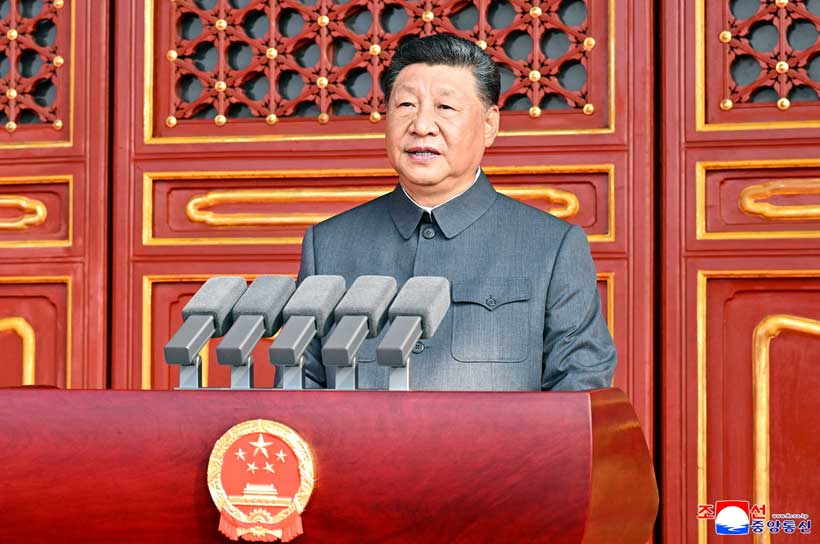
However, in recent years, analysts have noticed an intriguing pattern. The USA, once the flagbearer of liberal democracy and liberal international order, is moving away from international institutions and implementing a more inward, selectively liberal approach to policies. The USA’s withdrawal from major international organizations such as the World Health Organization (WHO), the Paris Climate Agreement, and the UN Human Rights Council (UNHRC) in the name of protecting American interests has, in turn, created a power vacuum. Till now, the USA has been an agent of pressure for China in these institutions, forcing China to implement environmental and health policies aligned with international guidelines. The UNHCR forum was also an outlet for the USA to create pressure and criticize China on its human rights violations in Xinjiang and Tibet. Now, with the USA gone, not only is China remaining unchecked, but it also has the opportunity to take over as the most influential country in these forums. The latest trend, as seen by analysts, is that China is not being revisionist in these international forums but taking over the USA’s role as the flagbearer of the liberal international order. In multiple forums, like the recent APEC Economic Leaders’ Meeting in November 2025, China portrays itself as a responsible leader, conscious about growing instability in the world, both politically and environmentally. In Xi’s 2026 New Year speech, he highlighted how “China always stands on the right side of history,” presenting China as a peaceful, comparatively more rational, and peace-loving country as compared to its rival, who has been constantly criticized for being actively involved in the Israel-Palestine and now the Iran-Israel wars.
While China’s extensive participation in international organizations since its foundation has been profound, we have seen a shift to revisionist tendencies to create alternative avenues of negotiations under Xi through the establishment of transnational organizations such as the Asian Infrastructure Investment Bank (AIIB) in 2016, the Shanghai Cooperation Organization, and participation in BRICS. While these different organizations may not completely replace the current liberal international organizations, they definitely serve as alternatives to the West-dominated ones.
Another example can be the Belt and Road Initiative. (BRI) Unlike the International Monetary Fund and World Bank, which give monetary loans while imposing political conditions on countries requesting loans, the BRI system, while risky, provides the countries with direct infrastructural and technological support without any political interference. To some countries, losing a port would be better than losing their governance models. Additionally, with the recent tariff war between China and the USA, with the USA levying extremely high tariffs not just for China but also for multiple other countries, like India and Brazil, also suffering from major losses, countries seem to be looking at China in a better light. For example, even notable US allies like Singapore were disappointed with the increase in tariffs, and as stated by Prime Minister Lawrence Wong, Southeast Asian countries have no option but to look for other ‘like-minded’ countries to mutually benefit from trade.
In an era of such extensive globalization and economic interdependence, the USA turning protectionist works in favor of China, which can now project itself as the better trading partner, even to an extent a regional leader of the ‘Global South.’ In recent years, we have seen increasing alliances between China and non-Asian Global South countries in Latin America and Africa as well. These conditions are giving China massive opportunities to extend its economic influence across the globe, and if colonization has taught us one thing, it is that once economic influence spreads, the country in charge rules the world.
If we move to more micro-lens now, the role of the global community has become important in the internet age. Social media sites since around the 2020s have been captured by ‘Chinese’ memes, be it either the social credit meme, or John Cena’s meme (Wo Yao Bing Chiling), or the very recent ‘You met me at a very Chinese time in my life’ memes. What is interesting about these memes is that they do not show China in the stereotypical anti-capitalist, authoritarian, or restrictive country but as a country that is seen as modern, cool, cosmopolitan, and increasingly in a positive light. Contrastingly, AI memes and caricatures of right-wing leaders such as Donald Trump, Giorgia Meloni, and Narendra Modi have been on the rise. Interestingly, the entire electoral campaign of Zohran Mamdani, Mayor of New York, makes it evident that the global community no longer believes strongly in the Red Scare, with more and more youth voicing out a more radical but socialist stance. While memes or online culture has not been a topic of inquiry in traditional international relations lenses, the internet boom of ‘meme culture’ or ‘meme wars,’ especially since 2016, has been deemed a reflection of public opinion. Politics now is not just about the physical realities but also the digital perceptions.
What these recent developments show is that China might not be following the same track as the former USSR to pose a challenge to the hegemon, but a new one, perceivably in a less realist-power struggle way. It is slowly blunting the protector image of the USA, which is also accelerating the USA’s actions. It is growing more than just a trade partner to a country that can be depended on for protection. As the Hormuz Strait is still up in flames, China is being perceived as the next energy and tech provider. It is being seen as an option, regardless of the ‘risk’ that it might hold. Over the years, it has built an indispensable presence in the Asian region. It has replaced the USA as the major trading partner to more than 157 countries. In the coming years, China can be seen as a threat to US hegemony, not militarily, but economically and diplomatically. It has already started to blunt and expand, taking advantage of the opportunities provided by the grim realities of world politics today. It is playing a smart long game, sitting back while the USA under Donald Trump is running itself dry by funding wars in other countries’ stead and actively villainizing itself in the eyes of the global community.
Therefore, it would be wrong to think that China will create a completely new world order from scratch. It will simply take charge once the USA is too weak to command hegemony. Till then, China saves, observes, and attracts.
