

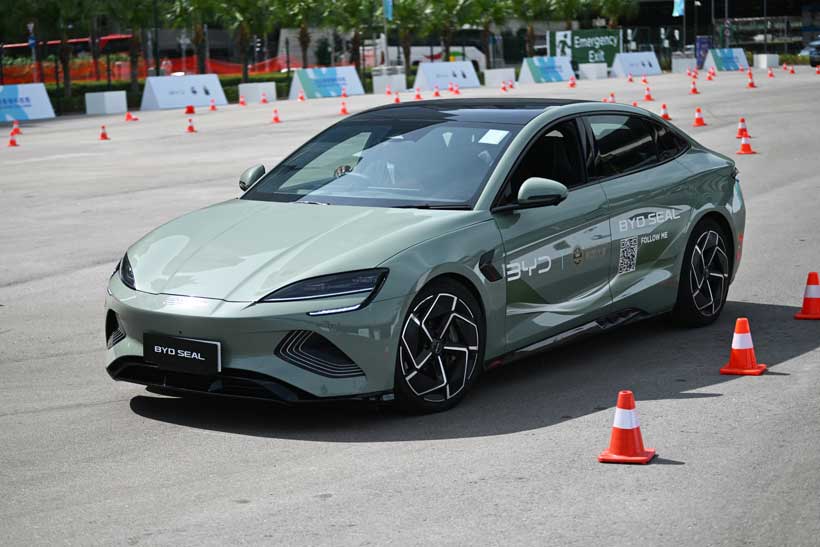
Two major Chinese automakers, BYD and Geely, are competing to buy a Nissan–Mercedes-Benz plant in Mexico, as China aims to increase its manufacturing presence in the country, where U. S. tariffs are leading to factory closures and job losses. They are among the three finalists from nine companies interested in the plant, which also includes the Vietnamese electric vehicle maker, VinFast. The growing interest from Chinese automakers marks a significant change in Mexico’s automotive sector, which has historically been dominated by manufacturers from the U. S., Europe, and Japan, primarily producing for the U. S. market.
Due to tariffs imposed by the Trump administration, Mexico’s auto industry is suffering, and the investment from Chinese firms could create much-needed jobs. However, Mexican officials are concerned that bringing in Chinese production could upset Washington and complicate ongoing North American trade negotiations. The U. S. has effectively barred the sale of Chinese-made vehicles, with President Trump accusing Mexico of allowing Chinese products to enter the U. S. market indirectly.
BYD and Geely’s pursuit of the plant emphasizes the rapid growth of China’s auto industry, with BYD’s sales growing ten-fold since 2020 and Geely’s doubling. Both companies sold over four million vehicles last year, similar to Ford. Chinese automakers’ market share in Mexico has jumped from zero in 2020 to about 10% last year. Mexico sells around 1.5 million cars annually, making it a crucial market for these companies.
While Mexican officials cannot block the sale of the factory, they have urged local authorities to delay Chinese investments until trade talks with the U. S. are complete. The tariffs are motivated by U. S. national security concerns, with officials stating that subsidized Chinese production is leading to overcapacity and price dumping in other markets. In response to trade tensions, Mexico imposed a 50% tariff on Chinese cars, prompting Chinese firms to consider manufacturing in Mexico, despite the complex regulatory environment.
In the face of layoffs in the Mexican auto industry, like the 1,900 job cuts at a General Motors plant, the Mexican automotive sector has become increasingly reliant on the U. S. market. In 2024, 2.8 million of the 4 million passenger vehicles produced in Mexico were sold to U. S. customers. However, this dependence has become a risk due to tariffs, resulting in a nearly 3% decline in vehicle exports to the U. S. and a loss of about 60,000 jobs in the auto sector last year.
The Nissan–Mercedes plant in Aguascalientes is closing for multiple reasons, with U. S. tariffs being a major factor. Both Mercedes and Nissan are moving production elsewhere, as tariffs make manufacturing in Mexico less viable. Trump has asserted that tariffs are boosting U. S. auto manufacturing, but statistics indicate a loss of jobs in the sector since his administration began.
Chinese automakers view Mexico as a crucial market for expanding their sales in Latin America. The interest in the Nissan–Mercedes plant includes various hybrid and electric vehicle makers. Chinese companies require governmental approval for overseas investments, but this proposed purchase doesn’t need approval since the plant opened in 2017. Mexico could gain significantly from Chinese investments, according to business experts, who assert that Mexican states would welcome such opportunities despite political tensions.
With information from Reuters