


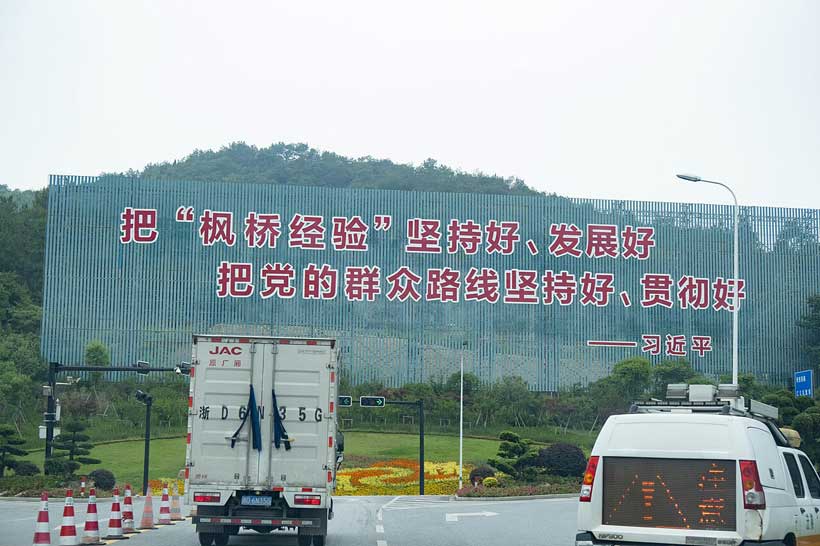
The ongoing discussions within the Egyptian Parliament regarding amendments to the Local Administration Law are focused on studying and implementing a model that integrates citizen participation in local solutions (similar to the community mobilization philosophy of the Fengqiao System Experience in China) with local governance to ensure self-regulation and reduce corruption. This is achieved through strengthening community mobilization and popular participation. This historical concept of community mobilization (the Fengqiao model) in China (currently being revived) relies on involving citizens and local committees in resolving disputes within Chinese communities before they escalate into crimes or legal issues. This reinforces the idea of self-regulation and public cooperation with Chinese authorities. The Egyptian experience and the current amendments to the Local Administration Law, currently under discussion in the Egyptian Parliament, can benefit from this Chinese experience and the Fengqiao model to develop the Egyptian local administration system. The aim is to amend the Local Administration Law in Egypt during the parliamentary discussions to learn from and benefit from the Chinese community mobilization system. The Egyptian House of Representatives witnessed intense legislative activity between April and May 2026 to discuss amendments and draft laws for new local administration in Egypt, with the aim of activating decentralization, restructuring local councils, and promoting comprehensive development in Egypt.
Accordingly, we understand the extent to which the Egyptian House of Representatives, through a joint committee (including the Local Administration and Constitutional Affairs Committee within the Egyptian Parliament), sought to prepare a draft of a new local administration law. This law aims to balance the independence of elected local councils with the effectiveness of services and the integration of community participation (mobilization) as a tool for governance and self-monitoring. This is almost identical to the Chinese Fengqiao model, which grants more powers and authorities to local and popular communities. From my research and analytical perspective—as an Egyptian expert on Chinese politics and the policies of the ruling Communist Party in China—this almost perfectly aligns with the Chinese Fengqiao model in strengthening the control of local and popular districts over the details and content of popular and local decision-making. This reinforces the idea of community self-monitoring and popular participation, which is precisely what the proposed amendments to the new Egyptian Local Administration Law in the Egyptian Parliament for 2026 advocate, under the direct guidance of Egyptian President Abdel Fattah El-Sisi.
The amendments to Egypt’s new Local Administration Law of 2026 can also seek to benefit from and learn from China’s experiences in local development, management, and planning, particularly the Chinese Fengqiao model, especially in urban planning; smart cities, such as the New Administrative Capital; and emergency management, within the framework of the comprehensive strategic partnership between Egypt and China. This can be achieved through Egyptian parliamentary cooperation with Chinese local authorities and provincial and local governments to transfer, promote, and localize the Chinese Fengqiao model (Fengqiao Experience) in Egypt. This Chinese model, Fengqiao, can be incorporated into the amendments and drafts of the new local administration laws in Egypt, bearing in mind that the Fengqiao model (or Fengqiao experience) is a rural, popular, local Chinese model known for integrating three pillars of governance: autonomy, rule of law, and rule of morality. That is, integrating political, intellectual, and administrative governance into popular and local action. The primary objective of the Chinese Feng Qiao model is to resolve conflicts and problems within the local Chinese community (at the village or neighborhood level) without escalating them to higher levels. This model can be applied in Egypt, and there are already signs and indicators of its implementation, especially after Egypt received local and popular Chinese delegations, such as a delegation from the Chinese Academy of Governance, to discuss public administration reform, local development, and crisis management. The new local administration law in Egypt can focus on the Chinese application of the Feng Qiao model. Those responsible for drafting the Egyptian local administration law can benefit from applying the mechanisms of Feng Qiao by activating the local role of Egyptian cities, villages, regions, and governorates. This can be achieved by strengthening the role of popular committees or village councils in Egypt to resolve conflicts and maintain community security, just as in the Chinese experience with the Feng Qiao model. With Egypt adopting a results-based planning model similar to the Chinese experience, the Egyptian House of Representatives, specifically its Local Administration Committee, could adopt the Chinese Xiong’an New Area model for sustainable development and smart cities in Egyptian villages and new cities. This would contribute to the development of rural Egypt, drawing on China’s experience in transforming villages into specialized industrial or agricultural centers. However, as an expert on Chinese politics and the policies of the Chinese Communist Party, I must point out the differences in the political and social contexts between Egypt and China. The Chinese model relies heavily on one-party structures to enforce discipline, unlike Egypt’s multi-party system, for example. This may require adaptation when implementing the Chinese model in Egypt, allowing for the necessary lessons to be learned and applied from the Fengqiao experience in developing local communities.
The ongoing discussions in the Egyptian House of Representatives are focused on activating the role of local committees and elected popular councils (whose membership approaches 60,000) in resolving disputes and addressing citizens’ problems before they escalate. This aligns with the concept of community self-regulation in China, a model that can be replicated and utilized to its fullest potential. It also reinforces the idea of financial and administrative decentralization within Egyptian districts and local councils. The new articles currently under discussion in the Egyptian House of Representatives aim to empower local units to manage their financial resources and allocate an independent budget to each local unit to directly meet citizens’ needs, thereby reducing bureaucracy. This is to be accompanied by the establishment of a Supreme Council for Local Administration in Egypt. The draft law submitted by the Deputy Chairman of the Local Administration Committee in the Egyptian House of Representatives proposes the creation of this council to coordinate work between governorates and activate oversight of local Egyptian authorities. The proposed Egyptian legislation includes several mechanisms to enhance public oversight of local administrative units and financial oversight to ensure transparency. The current parliamentary debate in the Egyptian House of Representatives revolves around the formation of a subcommittee for review. The Local Administration Committee of the Egyptian House of Representatives announced the formation of a subcommittee to review draft laws submitted by the government and members of parliament and prepare a new draft law that aligns with current developments. Several challenges stand out in this context, as current discussions focus on achieving a balance between expanding decentralization and ensuring national unity, in addition to training human resources and providing financial resources for local councils. This requires considerable expertise, financial, administrative, and human resources to ensure the amendments to the Egyptian Local Administration Law are implemented effectively. The timing of these moves is to fulfill the current constitutional requirement in Egypt for 2014, paving the way for local council elections. The new law for local councils in Egypt focuses on transforming Egyptian local authorities from mere service providers into key players in development, emphasizing oversight mechanisms and cooperation with citizens to enhance the stability of local communities.
Stay ahead of the geopolitical week.
MD Briefing delivers expert analysis across five global fronts — the Indo-Pacific, energy, geoeconomics, European security, and the Middle East — every Monday morning. Free.
Here, the local Egyptian experience can study, activate, transfer, and learn from the Fengqiao model or experience, which originated in the 1960s in Zhejiang Province in China and which is a fundamental model in the philosophy of Chinese governance, as it focuses on community mobilization and popular participation as a basic tool for resolving conflicts locally, which contributes directly to self-regulation, reducing corruption, and limiting conflicts without referring to higher authorities. The analysis of the philosophy of community mobilization in this Chinese model, Fengqiao, is based on the principle of relying on the masses themselves to solve problems (Mass Line). This aims to resolve conflicts at their inception. The main objective is to prevent the escalation of conflicts and their transfer to higher levels, addressing them within the local community (at the village and town levels in China). This is achieved by following the model and philosophy of popular mobilization within the Chinese Fengqiao system. Mediation teams are formed from local residents, members of the Communist Party of China, and volunteers to resolve personal and social conflicts through dialogue and persuasion, with the goal of transitioning to the new era. This model has been developed in the current era (under the leadership of Chinese President Xi Jinping) to integrate technology (network governance) with traditions (popular mediation) to enhance social cohesion. It also activates the role and system of local governance and self-regulation. The Fengqiao model links popular participation and self-regulation to strengthen governance and the concept of social control (the community monitors itself). Involving local Chinese residents in monitoring security and public order reduces the likelihood of corruption or administrative abuses, as corruption becomes visible and rejected by the surrounding Chinese community. Activating the principle of direct accountability strengthens the role of grassroots party organizations in listening to people’s demands and resolving their disputes, thus reducing the gap between the authorities and citizens and minimizing the need for costly security interventions. The Chinese Fengqiao model also emphasizes prevention over cure by empowering neighbors and local committees to detect tensions and corruption early on, thereby enhancing popular participation to reduce corruption. Here, the Fengqiao model utilizes grassroots democracy to ensure transparency and combat corruption. Simultaneously, it activates the role of people’s mediation, where emotions and logic act as a lubricant to resolve disputes before they escalate into costly legal cases or corruption complaints. Local conflicts within China are managed through the Fengqiao model using a 1+10 system, where Communist Party members are tasked with the Chinese, by monitoring and educating groups of families to ensure compliance with laws and regulations. It creates a self-regulatory network, which ultimately facilitates the policy of expressing local and popular demands within local communities and Chinese provinces, as this mechanism, the Chinese Fengqiao model, provides several direct channels for the local and popular Chinese public to express their opinions and check the actions of local officials.
In this context, members of the Egyptian House of Representatives and heads of local administration committees can learn from the Chinese Fengqiao model and adapt it to the Egyptian context, shifting from traditional social management to comprehensive community governance. In this model, mobilization and participation become effective tools for strengthening community self-regulation, reducing corruption, and leading to sustainable local stability. This is particularly relevant given the growing parliamentary discussions in Egypt (until April and May 2026) and the strong push to redraft the local administration law to enhance decentralization and empower elected local councils (after years of their absence) as a fundamental mechanism for popular oversight and transparency. This Egyptian approach aligns with the principles of Chinese participatory governance and the Chinese Fengqiao model, aiming to activate a system of self-regulation by strengthening community mobilization and popular participation. This is achieved by emphasizing that elected local councils in Egypt will be the primary link for representing local citizens in various Egyptian governorates, cities, and villages. This ensures direct public oversight of the performance of local executive bodies in Egypt and reduces bureaucracy and corruption.
Furthermore, Egypt can benefit from the Chinese open dialogue model of the Fengqiao system during amendments to its Local Administration Law. This is particularly relevant given that parliamentary committees within the Egyptian House of Representatives adopted the open dialogue approach in 2026, engaging with legal professors, management experts, and local leaders to focus on involving the Egyptian local community in evaluating municipal performance. Members of the Local Administration Committee within the Egyptian House of Representatives can benefit from the experience of the Chinese Fengqiao model of local governance during the drafting and discussion of new local administration laws in Egypt. The new Egyptian amendments to the Local Administration Law in the House of Representatives aim to transform local units into management and development entities, not merely executive bodies, granting them broader powers to manage their resources (15 proposed financial resources) to ensure financial independence and transparency.
Here, Egypt can greatly benefit from China’s experience in digital transformation to reduce corruption, especially since the new Egyptian local administration project includes a complete digital transformation of the licensing and services system. This aims to close legislative loopholes that previously allowed for violations and irregularities while ensuring fair representation for all groups to guarantee comprehensive social and local development. The new law in Egypt focuses on enhancing the representation of youth and women (proposals to raise the percentage of women to 30%) to ensure comprehensive community participation in Egyptian local decision-making, a principle that can be adopted from the Chinese Fengqiao model.
Based on the preceding understanding and analysis, the current Egyptian approach during the drafting of the new local administration law in Egypt can learn from and benefit from the Chinese model of local and popular governance to develop the Chinese system of people’s provinces and local governments. This includes seeking to exchange experiences and resources with China within the framework of the comprehensive strategic partnership between the two countries and on the anniversary of the celebration of Sino-Egyptian diplomatic relations. The aim is to implement the Chinese experience in Egypt and disseminate the Chinese Fengqiao model locally and at the grassroots level in Egypt by adapting successful Chinese mechanisms, particularly in the sectors of technology, planning, and crisis management, within the framework of Egypt’s Vision 2030.
