


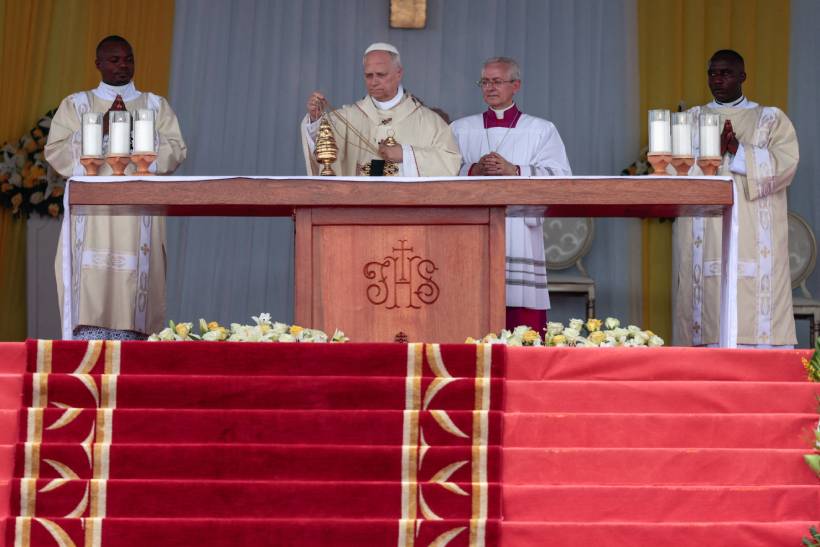
Chinese intelligence and security circles view the Vatican’s increased activity in Africa as a complex soft strategic challenge, one that transcends the religious dimension to have direct geopolitical implications for China’s interests on the continent. This is the crux of the Chinese analysis: Chinese intelligence agencies perceive the Vatican as a seemingly spiritual, moral, and non-political actor, but one that poses a significant strategic threat to China. This necessitates close monitoring of its activities in Africa to ensure they do not undermine the community of shared future that China seeks to build with the African continent. This analysis reflects the depth of Chinese concerns regarding unconventional tools in managing international conflict. Chinese intelligence and security agencies, represented by the Ministry of State Security, view the Vatican’s activities in Africa as a long-term strategic threat. This threat falls under the Western concept of soft power, which aims to undermine the community with a shared future for mankind championed by Chinese President Xi Jinping, who seeks to implement this concept in the Global South and establish it globally within the framework of China’s four major initiatives: development, security, civilization, and global governance. Therefore, Chinese intelligence circles constantly analyze the Vatican’s interest in Africa, considering it a new stronghold for Catholicism. The Vatican recognizes that Africa is the fastest-growing region for the Catholic Church, with the number of Catholics there expected to exceed one million by 2024. Chinese intelligence agencies see this growth and expansion of Catholicism in Africa as a means to establish long-term Western/spiritual influence in areas vital to China within the African community, which is economically closest to China.
The essence of China’s intelligence assessment of the Vatican lies in its apprehension regarding the Vatican’s spiritual and political influence. Beijing believes that the Vatican’s spiritual and moral authority transcends religious work, becoming a tool of soft diplomacy capable of shaping African public opinion, influencing political elites, and inciting local communities against Chinese interests, such as infrastructure projects, mining investments, and debt. Furthermore, China is concerned about the timing and scope of the Vatican’s growing influence. Chinese anxiety intensifies with the Catholic Church’s expanding activities in vital African regions like the Sahel, the Gulf of Guinea, and the Horn of Africa. Beijing perceives this as a race for broader influence, placing African nations in a difficult position between their economic partnerships with China and their cultural and spiritual ties with the West. In addition to the harm the Vatican’s activities in Africa pose to China’s community of shared future doctrine, Chinese intelligence believes that Vatican activity aims to undermine the Chinese development model and sow doubts about the neutrality of Chinese aid. This could disrupt the construction of the community of shared future that Beijing desires to create a stable and strategically aligned African continent, especially given the increasing Chinese intelligence activity abroad to protect its investments.
Chinese circles are concerned about the Vatican’s information networks and Catholic influence within African societies, which they perceive as opposing China’s own interests and investments. In this context, China views Vatican intelligence within Africa as a network of Catholic Church networks operating in remote areas of the continent, used as effective tools for gathering information and influencing impoverished African communities. The Vatican’s social and ecclesiastical influence in the heart of Africa, from China’s perspective, could sway African public opinion against Chinese investments and interests or against the assertive policies of the Chinese Communist Party within Africa.
China is also concerned about the influence of the Catholic Church in Africa on political stability there, given the strong influence Catholic bishops and priests wield in political mediation, education, and healthcare in Africa. For this reason, China believes this influence could hinder the Chinese model of governance that it seeks to promote on the continent through the Belt and Road Initiative. China believes that the Vatican’s strategies could affect its interests in Africa, especially given the complexity of the competition for hearts and minds. While China uses hard power (infrastructure, investments) and soft power (media), the Vatican possesses a deeper spiritual and social power. This competition between China and the Vatican weakens China’s attempts to promote its own narrative and model in Africa.
Stay ahead of the geopolitical week.
MD Briefing delivers expert analysis across five global fronts — the Indo-Pacific, energy, geoeconomics, European security, and the Middle East — every Monday morning. Free.
In this context, Beijing is concerned about the risks of the Vatican aligning itself with the Western and American agenda in Africa, given that the Catholic Church in Africa might adopt Western and American positions critical of human rights or freedom of worship, which could damage China’s reputation on the continent. Furthermore, there is the connection between the African issue and the Taiwan issue, as the Vatican is Taiwan’s only European diplomatic ally. China fears that the Vatican might use its influence in Africa to pressure it on vital issues, including the Taiwan issue and the recognition of the Catholic Church in China, which is aligned with the Vatican, in contrast to the pro-Chinese National Association of Catholics of China, which is loyal to the Chinese government and the ruling Communist Party.
To this end, China is managing its conflict with the Vatican through realpolitik (political pragmatism). In return, China is attempting to leverage the temporary agreement with the Vatican (which grants Beijing a say in the appointment of Catholic bishops within China) to exert control over the Church within China and to neutralize the Vatican globally, including in Africa, to ensure that the Catholic Church does not interfere in China’s internal affairs. The mechanisms of Chinese action (based on its apprehension towards the Vatican) involve diligent Chinese intelligence monitoring of Vatican activities and expansion within Africa through increased Chinese surveillance of Vatican-affiliated educational, charitable, and missionary institutions, classifying them as potential centers of external influence against China. Therefore, Beijing seeks to strengthen Chinese soft power in Africa to counter the Vatican’s expanding influence through policies of expanding Chinese Confucius Institutes and scholarship programs to cultivate African elites loyal to China. While China simultaneously focuses on development diplomacy by intensifying Chinese economic projects within the Forum on China-Africa Cooperation (FOCAC) to solidify tangible ties that the Vatican cannot rival and to attempt to isolate African communities from any Western and American cultural influences.
Based on the preceding analysis, we understand that, in short, the Chinese view the Vatican as a seemingly non-political actor but, in essence, as a sophisticated soft power tool of the West capable of indoctrinating African populations against Chinese expansion in the region.
