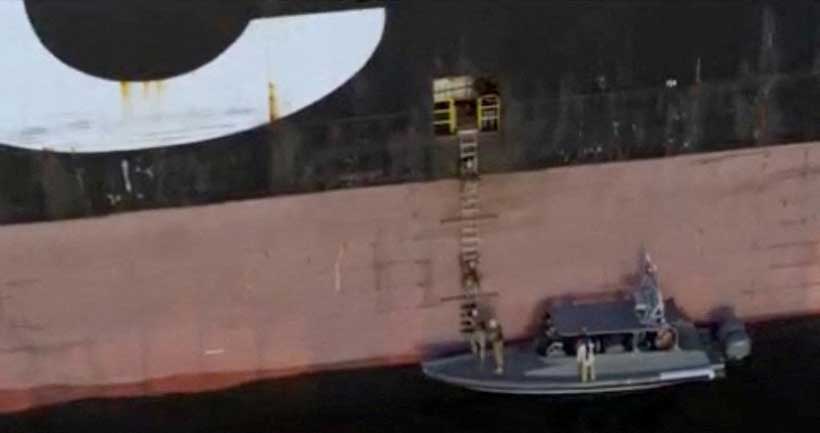
Iran displayed its strengthened control over the Strait of Hormuz on Thursday by releasing video footage of its commandos boarding a large cargo ship. The video, aired on state television, showed masked troops storming the MSC Francesca and included scenes of another captured ship, the Epaminondas, which Iran accused of trying to cross the strait without proper permits.
As tensions remain high, the U. S. announced that it boarded another tanker, the Majestic, in the Indian Ocean. This was likely a reference to the supertanker, the Phonix, which was carrying 2 million barrels of crude oil off Sri Lanka. Since the start of conflict in February, Iran has effectively restricted access to the strait, asserting control after peace talks between the U. S. and Iran were halted shortly before a ceasefire expired.
Iran’s willingness to re-engage in talks depended on the U. S. lifting its blockade and releasing Iranian ships. In a post on Truth Social, U. S. President Donald Trump indicated that he ordered the Navy to “shoot and kill” Iranian boats that were laying mines in the strait, escalating military actions without addressing other Iranian tactics like speedboats and drones.
Iran’s judiciary chief stated that the merchant vessels attacked by Iran’s forces had faced legal consequences, while Iran’s vice speaker announced that the first toll revenue collected from ships using the strait had been transferred to the central bank, but provided no specifics on payments or amounts.
Tehran proclaimed it would not reopen the strait, which typically handles a significant portion of global oil and gas shipments, until the U. S. lifted the blockade considered a breach of the ceasefire. Although Trump refrained from escalating attacks in the ceasefire’s final hours, he remained firm on not lifting the blockade. There was no formal extension of the ceasefire nor plans for new negotiations.
Iranian citizens faced uncertainty and anxiety in what they termed a state of “neither peace nor war,” fearing potential attacks from the U. S. or Israel. Pakistan, previously facilitating talks, remained in contact with both countries about reviving discussions, but Iranian officials hesitated to commit due to the U. S. blockade.
On the U. S. side, another round of discussions was set for Thursday, focused on Israel and Lebanon, where Lebanon sought an extension of a recent ceasefire amidst continued Israeli airstrikes that resulted in casualties, marking a significant day since the ceasefire began.
In a significant personnel change, U. S. Navy Secretary John Phelan was dismissed amid conflicts over shipbuilding decisions and tensions with high-ranking officials.
The ongoing situation in the Strait of Hormuz has caused volatility in markets, pushing oil prices upward, while stock prices in the U. S. reached record highs despite uncertainty about energy supply. Washington has thus far failed to achieve its stated war goals of limiting Iran’s military capabilities, ending its nuclear efforts, and fostering regime change. Iran maintains its missile and drone capabilities and stockpiles of highly enriched uranium, while its government remains resilient against internal dissent. Despite threats from Trump, Iran’s control over the strait appears to strengthen its position in the conflict.
With information from Reuters