


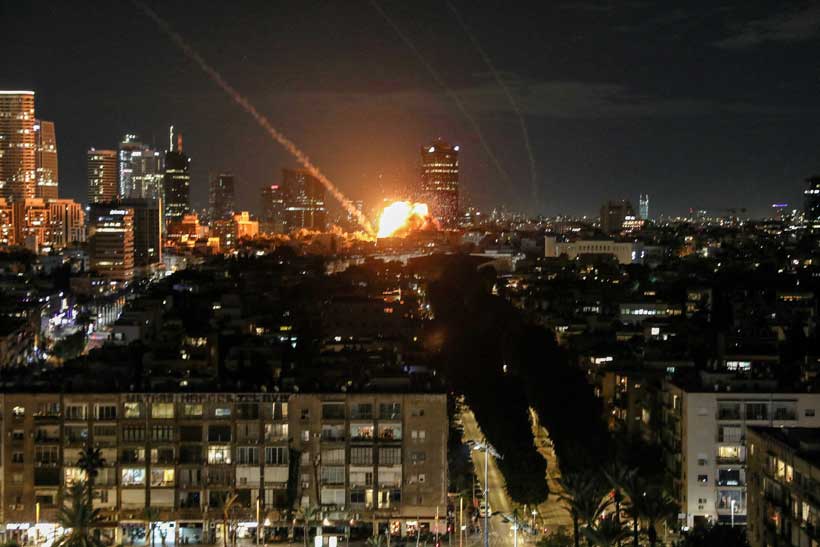
Iran launched multiple waves of missiles at Israel, setting off air raid sirens across cities including Tel Aviv. While interceptions prevented major casualties, falling debris damaged homes in northern Israel.
The escalation followed claims by Donald Trump that Washington and Tehran were engaged in “productive” talks, prompting him to delay a planned strike on Iran’s energy infrastructure. Tehran swiftly rejected this narrative, deepening uncertainty over whether diplomacy is underway at all.
Conflicting Narratives and Escalation
Iranian officials categorically denied any negotiations, with Mohammad Baqer Qalibaf calling the claims “fake news” aimed at manipulating global markets. The Islamic Revolutionary Guard Corps reinforced this stance, describing U.S. messaging as psychological warfare while announcing continued attacks.
This disconnect between U.S. and Iranian accounts reflects a broader struggle to control the narrative, even as military exchanges intensify.
Stay ahead of the geopolitical week.
MD Briefing delivers expert analysis across five global fronts — the Indo-Pacific, energy, geoeconomics, European security, and the Middle East — every Monday morning. Free.
Strait of Hormuz and Energy Leverage
At the center of the crisis is the Strait of Hormuz, effectively disrupted by Iran since the conflict began. The waterway carries roughly one fifth of global oil and gas flows, making it a critical pressure point.
Trump’s threat to target Iran’s energy infrastructure was tied to demands that Tehran reopen the strait. Iran’s counter threat to strike infrastructure of U.S. allies raises the risk of prolonged disruption to global energy supplies.
Market Volatility and Economic Shock
Financial markets have reacted sharply to shifting signals. Trump’s suggestion of progress in talks briefly lifted equities and pushed oil prices lower. However, Iran’s denial quickly reversed that sentiment, with crude prices rebounding and volatility returning.
This pattern underscores how tightly markets are now linked to geopolitical messaging, with even unverified diplomatic signals triggering major swings in investor behavior.
Backchannel Diplomacy and Mediation Efforts
Despite public denials, indirect diplomacy appears to be ongoing. Countries such as Pakistan, Egypt and Gulf states are reportedly relaying messages between the two sides. There are indications that potential talks could take place in Islamabad, involving figures like Steve Witkoff and Jared Kushner.
Iran has also engaged in consultations with Oman, a traditional mediator, suggesting that diplomatic channels remain open even if not formally acknowledged.
Implications
The situation remains highly volatile, with simultaneous escalation and tentative diplomatic signaling. The lack of clarity increases the risk of miscalculation, particularly as both sides continue military operations while hinting at negotiations.
Energy markets remain the most immediate global concern. Sustained disruption in the Strait of Hormuz could trigger prolonged inflationary pressures and economic instability worldwide.
Analysis
This phase of the conflict illustrates a convergence of warfare and strategic communication. Military actions are being accompanied by competing narratives designed to influence not just adversaries, but global markets and international opinion.
For the United States, projecting the possibility of negotiations may be intended to stabilize markets and create diplomatic leverage. For Iran, publicly rejecting such claims reinforces domestic credibility while preserving bargaining power.
However, this dual track approach carries inherent risks. The absence of a clear and credible diplomatic framework makes it difficult to distinguish genuine de escalation from tactical signaling. As a result, both escalation and misinterpretation become more likely.
Ultimately, the conflict is entering a stage where perception and reality are increasingly blurred. Until diplomatic efforts move from ambiguity to formal engagement, the trajectory will remain uncertain, with both regional security and the global economy exposed to sudden shocks.
With information from Reuters.
