


China has adopted a strategy of securing passage through bilateral channels, meaning that Beijing prefers to rely on domestic diplomacy and direct communication with Tehran to ensure the safety of its tankers through the Strait of Hormuz. This strategy has proven successful, as some Chinese ships continued to pass through despite the near-total closure of the strait to US and allied vessels. Therefore, in March 2026, the official Chinese position adopted a cautious approach to US President Donald Trump’s call for an international maritime coalition (or what became known as the Hormuz Pact) to secure navigation in the Strait of Hormuz, preferring diplomatic channels to direct military intervention. The justifications for China’s rejection or reservations can be summarized as follows: (Avoiding military escalation) due to China’s fear of the risk of a full-blown conflict. Beijing believes that sending more foreign warships to the Strait of Hormuz will increase the risk of military clashes and turn the region into a flashpoint, potentially leading to an expansion of the conflict rather than its de-escalation. Therefore, Beijing prioritizes diplomacy. The Chinese Foreign Ministry has repeatedly called on all parties to immediately cease military operations and resort to negotiation as the only way to ensure global energy security. This is further complicated by China’s sensitive strategic relationship with Iran, particularly through energy and economic partnerships. China maintains close ties with Iran (including a 25-year strategic cooperation agreement) and considers Tehran a strategic partner and a major oil supplier.
Consequently, China rejected President Trump’s call to form an international force to protect oil tankers in the Strait of Hormuz, emphasizing that it is not a party to the conflict and calling for de-escalation. China also refused to link cooperation to Trump’s visit to Beijing. China justifies its position by citing its commitment to an independent foreign policy, its balanced relations with Iran, and its rejection of American political blackmail. It considers securing the Strait a collective international responsibility, not solely China’s. China also affirms that it is not a party to regional conflicts in the Middle East and does not interfere in the internal affairs of other countries, preferring diplomatic solutions.
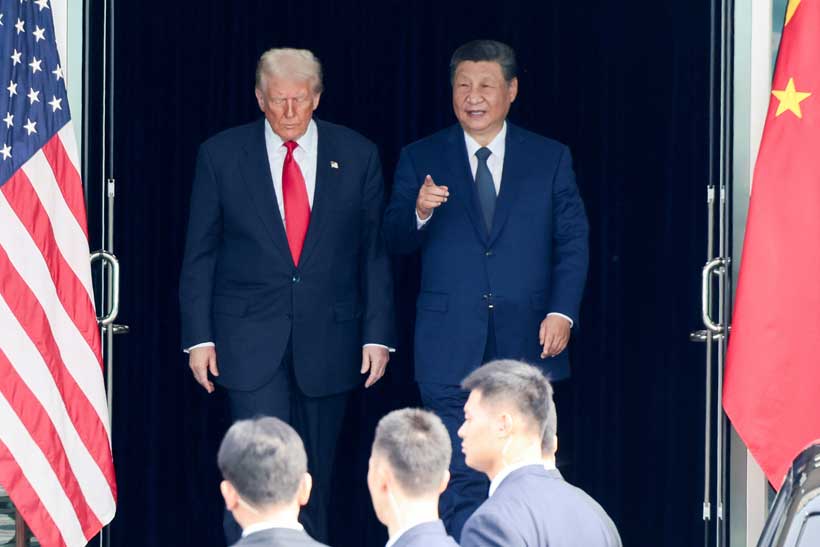
China also rejected the American political bargaining tactic of linking Chinese approval for sending an international security force to the Strait of Hormuz to Trump’s visit to Beijing. Chinese intelligence, military, defense, and security circles considered this a form of unacceptable American political blackmail and bullying, especially given the Trump administration’s attempt to exert public pressure by linking the success of his visit to Beijing to China’s cooperation in the Strait of Hormuz. This was met with a firm Chinese response, due to China’s insistence on a policy of separating the issues. China emphasized that summit diplomacy with Trump has an independent and irreplaceable strategic role and stressed that any postponement of the visit should not be linked to the Strait of Hormuz issue. With China’s firm response to American threats, while Trump threatened to postpone the visit to first ascertain Beijing’s position, China maintained official silence regarding American requests for military assistance, merely stating that communication is ongoing concerning the visit. This reflects an implicit rejection of the logic of American political blackmail. Therefore, China rejects the American political bargaining tactic of exploiting the situation. Beijing might see the postponement of the visit (later announced by Trump under the pretext of being preoccupied with the war) as an opportunity to observe Washington’s stumbling blocks in Middle Eastern conflicts, thus granting China greater leverage in future trade and technology negotiations.
The reasons and justifications for Beijing’s refusal to join the coalition called for by Trump can be summarized as follows: (Avoiding military escalation): The Chinese Foreign Ministry explicitly called for an immediate cessation of military operations in the region. Beijing believes that the formation of a new international military force could escalate tensions rather than de-escalate them, threatening regional stability and the global economy. In addition to adhering to a policy of maintaining neutrality and strategic balance, China is careful to balance its relations with all parties, including Iran and the Gulf Arab states. Joining a US-led coalition against Tehran would constitute a clear bias that would harm its strategic interests and economic partnerships with Iran. Furthermore, China prioritizes diplomatic solutions, asserting that dialogue and restraint are the only way to guarantee freedom of navigation. It refuses to engage in formal military alliances and prefers to operate through independent monitoring or multilateral diplomatic efforts. Most importantly, China is demonstrating its resilience to Washington’s pressure tactics. While Trump argued that China relies on the Strait of Hormuz for 90% of its oil, China maintains that it possesses substantial strategic reserves (sufficient for 3-4 months) and has diversified its energy sources, making it less vulnerable to direct oil pressure from Washington.
Stay ahead of the geopolitical week.
MD Briefing delivers expert analysis across five global fronts — the Indo-Pacific, energy, geoeconomics, European security, and the Middle East — every Monday morning. Free.
China has thus called for holding Washington accountable and criticized the US initiative to send an international force to the Strait of Hormuz. Chinese officials and state media criticized Washington for initiating the conflict (referring to the military strikes against Iran in February 2016) and then demanding that others share the burden of securing the consequences. Beijing has adopted a policy of rejecting the US risk-sharing, questioning whether Trump’s call was genuinely aimed at sharing responsibility or merely an attempt to shift the burden of US-made military risks onto other countries. China’s position is based on several political and legal principles, most importantly respect for the sovereignty of states. Beijing has stressed the need to respect the sovereignty of Iran and other countries in the region in any security arrangements, opposing any military interventions that lack a clear international mandate from the United Nations. With China rejecting all the political pressure and bargaining exerted upon it by the US to send an international security force to the Strait of Hormuz, China did not respond to Trump’s attempts to link its cooperation in the Strait of Hormuz to his planned visit to Beijing at the end of March 2026. China considered the priority to be de-escalating the overall regional situation.
Based on these justifications, China limited itself to calling for restraint and communicating with all parties (including Washington and Tehran) to work towards calming the situation, without committing to sending naval vessels to participate in the proposed international force. Here, we conclude that China refuses to allow the Strait of Hormuz to become an arena for international military confrontation led by the US and adheres to its policy of zero crises to protect energy flows without engaging in armed conflicts. It considers the attempt to link this issue to presidential visits a form of unacceptable American political bullying.
