


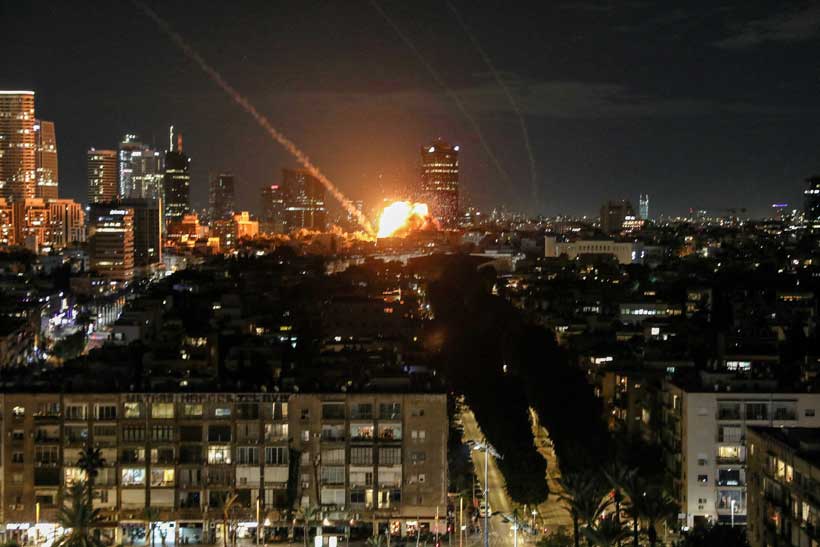
The conflict between Iran and Israel has entered a far more dangerous phase, moving beyond limited strikes into a sustained and widening regional war. What began as targeted military action has evolved into a confrontation involving multiple countries, armed groups, and critical global trade routes.
The latest escalation follows Israel’s assassination of Ali Larijani, one of Iran’s most senior security figures. His killing comes shortly after the death of Ali Khamenei in earlier strikes, marking a severe blow to Iran’s leadership and prompting a forceful response from Tehran.
Iran’s strike on Tel Aviv
Iran’s missile attack on Tel Aviv marks a significant escalation in both scale and intent. The reported use of cluster warheads, carried by Khorramshahr 4 and Qadr missiles, points to a shift toward weapons designed to spread damage across a wider area rather than strike precise targets.
Stay ahead of the geopolitical week.
MD Briefing delivers expert analysis across five global fronts — the Indo-Pacific, energy, geoeconomics, European security, and the Middle East — every Monday morning. Free.
Cluster munitions release multiple smaller explosives mid-air, making them harder to intercept and increasing risks for civilians. Their use in a densely populated urban centre suggests Iran is seeking to impose visible costs on Israel rather than rely solely on deterrence.
The strike also signals that Iran is willing to directly target Israel’s main economic and population hubs, raising fears of further attacks on major cities.
Hardline leadership and no path to ceasefire
Iran’s new leadership under Mojtaba Khamenei appears to be taking a more uncompromising stance. Early indications suggest that ceasefire proposals are being rejected, with leadership framing the conflict as one that must continue until its strategic objectives are met.
This approach reduces the likelihood of near-term diplomacy and signals that Iran is preparing for a prolonged confrontation despite mounting pressure.
Conflict expands across the region
The war is no longer confined to Iran and Israel. Hezbollah has intensified its involvement, drawing Lebanon deeper into the conflict. Israeli airstrikes on Beirut and other areas have led to rising civilian casualties and large-scale displacement.
At the same time, attacks linked to Iran have targeted United States bases, oil infrastructure, and shipping routes across the Gulf. This multi-front dynamic increases the risk of miscalculation and makes containment more difficult.
A reported projectile landing near the Bushehr Nuclear Power Plant, even without damage, has heightened concerns about the risk of a nuclear-related incident. Rafael Grossi has warned that continued escalation could have severe consequences if sensitive facilities are affected.
Strait of Hormuz and global impact
The involvement of the United States has added a strategic maritime dimension. United States strikes along Iran’s coastline near the Strait of Hormuz aim to protect shipping lanes, but they also risk provoking further retaliation.
The Strait is one of the world’s most critical oil chokepoints. Disruptions there have already pushed global oil prices sharply higher, increasing inflationary pressure and raising costs for industries and consumers worldwide.
The International Energy Agency has warned that the current crisis could become the most severe oil disruption in decades, with ripple effects across energy markets, aviation, and food supply chains.
Strains within Western alliances
The war is also exposing divisions among Western allies. United States President Donald Trump has criticised NATO partners for their reluctance to become directly involved, reflecting broader concerns about the risks of a prolonged conflict.
At the same time, questions remain over the strategic objectives and legal basis of the war, particularly within the United States, where internal disagreements have begun to surface.
Analysis
This conflict has moved beyond a conventional military confrontation into a complex and escalating regional crisis with global consequences.
First, the geographical spread of the war is accelerating. With Lebanon, Gulf states, and key maritime routes involved, the risk of a broader regional war is increasing.
Second, the intensity of the conflict is rising. The use of cluster munitions and the targeting of senior leadership figures suggest both sides are prioritising escalation over restraint.
Third, the economic impact is becoming global. Rising oil prices, disrupted trade routes, and pressure on food and energy supplies are turning a regional conflict into an international economic shock.
Without credible diplomatic intervention, the trajectory points toward a prolonged and destabilising war. The longer the conflict continues, the greater the risk that it will reshape not only the Middle East but also the global economic and security landscape.
With information from Reuters.
