


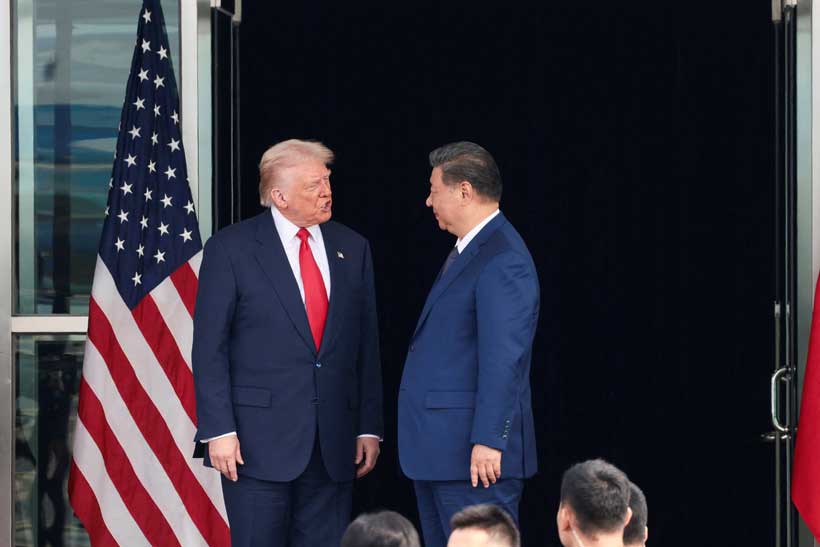
A planned summit between U.S. President Donald Trump and Chinese President Xi Jinping later this month is unlikely to deliver a breakthrough in economic relations, according to several sources involved in preparations for the meeting.
Instead of attempting a major reset in business or investment ties, both Washington and Beijing appear focused on maintaining the fragile stability that has characterised relations between the world’s two largest economies since late last year.
The visit, expected to take place from March 31 to April 2, would mark the first meeting between the two leaders since they agreed to a trade truce in October after months of escalating tensions that included tariffs imposed by the United States and Chinese restrictions on rare earth exports.
A Summit with Shrinking Ambitions
Initial hopes that the visit could revive broader economic cooperation have steadily diminished. American business leaders had pushed for a large delegation of corporate executives to accompany the president, hoping to reopen channels for investment and market access. However, such a delegation has not yet materialised.
Stay ahead of the geopolitical week.
MD Briefing delivers expert analysis across five global fronts — the Indo-Pacific, energy, geoeconomics, European security, and the Middle East — every Monday morning. Free.
Similarly, Beijing has not received assurances it has been seeking regarding protections for Chinese investments in the United States.
Analysts say the trip increasingly resembles a scaled-down diplomatic engagement rather than a major state visit designed to reshape bilateral relations.
Ryan Hass of the Brookings Institution described the visit as an “ever-shrinking state visit,” suggesting that expectations for meaningful policy outcomes have been declining as preparations continue.
Trade Frictions Still Loom
Despite the emphasis on stability, several contentious issues remain unresolved. U.S. tariffs imposed during the Trump administration continue to shape the economic relationship, and disputes over investment restrictions and technology controls remain significant obstacles.
Another complication emerged after the Supreme Court of the United States invalidated a 10 percent tariff previously imposed by Washington on Chinese goods related to fentanyl enforcement. U.S. officials have signalled that the administration may reimpose the tariff under a different legal authority, potentially reopening trade tensions.
American officials have indicated that the summit is not intended to become a confrontation over tariffs but rather an opportunity to monitor the implementation of existing agreements.
Potential Deals Still Under Discussion
Although expectations for sweeping policy changes are low, negotiators are exploring several potential economic deliverables.
One possible agreement under discussion involves China purchasing around 500 narrow-body aircraft from Boeing, a deal that could become one of the most significant commercial outcomes of the summit.
However, Beijing has reportedly sought concessions from Washington in exchange, including long-term guarantees for aircraft parts supplies. The negotiations remain complex, particularly given Boeing’s existing production backlog and the long timeline required to deliver such orders.
China is also seeking greater assurances for Chinese companies investing in the United States, especially following the forced divestiture of the video platform TikTok, which heightened concerns in Beijing about the security of Chinese investments in American markets.
Diplomatic Preparation and Timing
Preparations for the summit have also faced logistical challenges. Chinese officials have reportedly expressed frustration over what they view as unusually late planning for a visit that typically involves months of detailed diplomatic coordination.
Chinese Foreign Minister Wang Yi indicated that discussions about the summit’s agenda are ongoing, emphasising the need for both sides to create conditions that allow them to manage their differences.
Meanwhile, U.S. Treasury Secretary Scott Bessent is expected to meet Chinese Vice Premier He Lifeng in Paris this week to explore possible outcomes that could be announced during the Beijing summit.
Analysis: Managing Rivalry Rather Than Resetting Relations
The modest expectations surrounding the Trump–Xi summit highlight a broader shift in U.S.–China relations from engagement toward strategic management of rivalry.
Over the past decade, economic ties between the two countries have increasingly been shaped by national security concerns, supply chain competition and technological rivalry. As a result, the political space for sweeping economic agreements has narrowed considerably.
For Washington, the priority appears to be preserving access to key resources such as rare earth minerals and ensuring that China continues purchasing American agricultural products and aircraft under existing arrangements.
For Beijing, the objective is to stabilise relations while protecting Chinese companies from growing regulatory scrutiny and investment restrictions in the United States.
In this context, the upcoming summit is less about achieving a dramatic diplomatic breakthrough and more about preventing tensions from escalating into a deeper economic confrontation. Maintaining predictability between the world’s two largest economies has become a strategic goal in itself, particularly at a time when geopolitical tensions from trade disputes to regional conflicts are already straining the global economic system.
With information from Reuters.
