


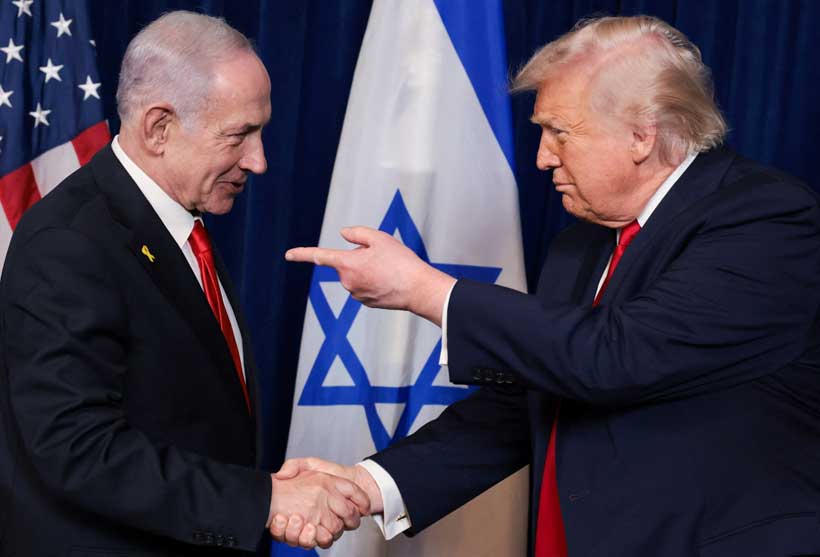
Israeli Prime Minister Benjamin Netanyahu said the war against Iran “is not going to take years,” rejecting comparisons to protracted Middle East conflicts. Speaking on Fox News, he described the campaign as potentially “quick and decisive,” even as the fighting entered its fourth day with missile exchanges and drone strikes expanding across the region.
The conflict began with joint U.S.-Israeli strikes on Tehran that reportedly killed Iran’s Supreme Leader Ali Khamenei. Iran retaliated with missile and drone attacks targeting Israel, U.S. bases, and Gulf states hosting American forces. Explosions rocked Tel Aviv as air defenses intercepted incoming projectiles, while two drones struck the U.S. embassy in Riyadh.
Iran’s Islamic Revolutionary Guard Corps claimed it destroyed the headquarters of a U.S. airbase in Bahrain as part of a broader wave of missile and drone operations. Meanwhile, Israeli strikes hit the compound of Islamic Republic of Iran Broadcasting in Tehran and targeted Hezbollah positions in Lebanon, widening the battlefield.
U.S. President Donald Trump, who initially projected a four-to-five-week campaign, has since framed the war as open-ended. Secretary of State Marco Rubio warned that “the hardest hits are yet to come,” while not ruling out the deployment of ground forces.
Stay ahead of the geopolitical week.
MD Briefing delivers expert analysis across five global fronts — the Indo-Pacific, energy, geoeconomics, European security, and the Middle East — every Monday morning. Free.
Regional Escalation
The conflict has drawn in multiple arenas simultaneously: Israel, Iran, Lebanon, Saudi Arabia, Bahrain, Kuwait and Iraq. U.S. forces report striking over 1,250 targets in Iran, while Tehran claims significant counterstrikes on American and allied assets. Six U.S. service members have been killed in retaliatory attacks, and friendly fire incidents have added to the chaos.
Hezbollah’s involvement from Lebanon signals the potential reopening of Israel’s northern front. Gulf states hosting U.S. bases have become direct targets, increasing the risk of further regional entanglement.
Transport and Energy Shock
The war has disrupted global transport and energy flows. Shipping through the Strait of Hormuz has largely halted, affecting roughly one-fifth of global oil trade. Supertanker rates have surged to record highs. Major Gulf aviation hubs, including Dubai’s airport, remain closed, stranding tens of thousands of passengers and triggering airline share sell-offs in Asia.
Oil prices have spiked amid fears of prolonged supply disruptions, compounding economic uncertainty already facing global markets.
Political Fallout
At home, Trump faces mounting scrutiny. A Reuters/Ipsos poll shows only a quarter of Americans support the Iran attack, raising political risks ahead of midterm elections. Lawmakers have questioned the evidence behind claims of an imminent Iranian threat.
Internationally, Russia, China and Turkey have condemned the war, increasing diplomatic polarization at the global level.
Analysis
Netanyahu’s insistence that the war will not last years reflects both strategic intent and political necessity. Israel seeks a rapid degradation of Iran’s missile and nuclear capabilities before regional pressure and international diplomacy constrain its freedom of action. However, the widening battlefield from Lebanon to the Gulf suggests escalation dynamics that are difficult to control.
For Washington, the campaign represents a high-stakes gamble. While U.S. officials argue that objectives can be achieved without ground troops, history shows that air campaigns alone rarely neutralize entrenched military networks. The possibility of Hezbollah intensifying attacks or Gulf states being drawn deeper into direct confrontation raises the risk of a prolonged regional war.
Energy disruptions and transport paralysis add a global dimension, increasing pressure for diplomatic intervention. Whether the conflict remains a concentrated military campaign or evolves into a broader, multi-front war will depend on Iran’s capacity for sustained retaliation and the willingness of external powers to push for de-escalation before the conflict hardens into a long-term regional crisis.
With information from Reuters..
