



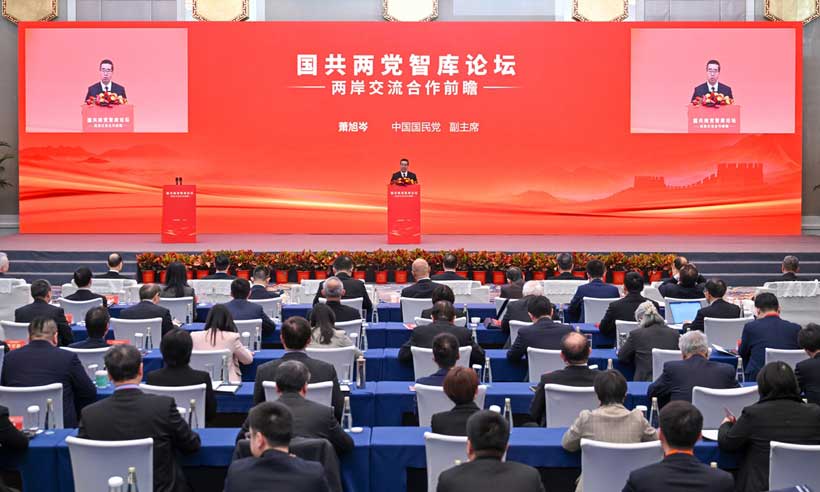
The Chinese Think Tank Forum was held in Beijing, China, on Tuesday, February 3, 2026, with the participation of think tanks affiliated with the Communist Party of China (CPC) and the Kuomintang (KMT) in Taiwan. This meeting marked the resumption of a major inter-party exchange platform after a nine-year hiatus. The forum, themed “Prospects for Cross-Strait Exchanges and Cooperation,” aimed to promote cooperation under President Xi Jinping’s vision for the rejuvenation of the Chinese nation. This key inter-party exchange platform, which had been suspended since 2016, was intended to implement the shared vision put forward by President “Xi Jinping” for strengthening cross-Strait relations. More than 100 experts and representatives from both sides of the Taiwan Strait and the Chinese mainland participated in the forum, including members of think tanks from the “CPC” and the “KMT” in Taiwan, representing sectors such as tourism, industry, science and technology, healthcare, and environmental protection, among others. This reflects a popular desire to transform confrontation into practical exchanges. The most prominent outcomes and roles of this meeting included the ability to resume political dialogue between political parties in Beijing and across the Taiwan Strait: The forum represents a concrete step towards implementing the “spirit of the exchange of letters” between the leaders of the two parties, which emphasizes adherence to the “1992 Consensus” and opposition to “Taiwan independence.” This paved the way for a potential meeting between Chinese President Xi Jinping and Kuomintang leader Chung Liu-wen in March 2026.
The China Forum of Chinese Think Tanks put forward more than 15 common views on rapprochement between mainland China and the Taiwan Strait. Participants (more than 100 experts and representatives) agreed on 15 points covering five key areas of cooperation, most notably: (Freedom of Movement and Lifting Restrictions): The Forum called on the Democratic Progressive Party authorities in Taiwan to lift restrictions on people-to-people exchanges and fully resume direct air and sea transport services, demanding the restoration of normal travel and the lifting of restrictions on people-to-people exchanges and the resumption of direct air and sea passenger services. (Technological and Industrial Cooperation): Proposing model projects in artificial intelligence and manufacturing, and establishing a global AI innovation center. (Service Sector Cooperation): Strengthening exchanges in tourism, medicine and healthcare, environmental protection, and disaster prevention. With the aim of achieving integrated development, Wang Hanning, China’s top political advisor, called on Taiwanese companies and patriots to participate in implementing “China’s 15th Five-Year Plan” (2026-2030) to achieve integrated cross-strait development. This plan emphasizes improving livelihoods and common economic growth as an alternative to increased military spending and tensions.
With the aim of maintaining peace: The meeting stressed that maintaining peace in the Taiwan Strait requires unity and opposition to external interference and separatist activities. It also aimed to guide relations toward the “correct path of development” by upholding political principles. Both sides affirmed their commitment to the 1992 Consensus and their opposition to Taiwan independence as the fundamental basis for stable and peaceful relations. This forum is seen as a practical step toward implementing the spirit of the exchange of letters between the leaders of the two parties and may pave the way for a possible meeting between Chinese President Xi Jinping and the new Kuomintang Chairwoman Cheng Liwen.
Song Tao, head of the State Council Taiwan Affairs Office, also emphasized the need for both sides to oppose Taiwan independence and promote the peaceful development of cross-strait relations. Hsiao Hsu-zen, vice chairman of the Kuomintang, echoed this sentiment, stating that “Taiwan independence must be opposed and peaceful development pursued jointly.” ”.
In this context, Chinese think tanks affiliated with the ruling Communist Party of China serve as strategic “intellectual reservoirs,” playing a pivotal role in shaping national policies and public diplomacy, particularly as they approach 2026. These centers have become key tools for enhancing China’s soft power and analyzing big data to predict future trends. Think tanks in China are classified into major categories based on their affiliation and influence, as follows:
1) Official Centers (State and Party Affiliated)
These are the most influential on decision-making, as they are led by Communist Party officials and serve as direct research arms of the government. The most prominent include:
· Chinese Academy of Sciences (CAS): The world’s largest research institute, comprising over 100 research institutes and 70,000 employees, focusing on science and technology policies.
· Chinese Academy of Social Sciences (CASS): A comprehensive research center providing consultations on various political, social, and economic issues.
· Development Research Center of the State Council (DRC): Provides direct recommendations to the State Council of China on economic and social policies.
· Xi Jinping Thought on Culture Research Institute: A specialized center whose annual academic conference was held in February 2026 to deepen research on Chinese civilization and information technology.
2) Academic and University Centers
These institutions leverage the multidisciplinary resources of major Chinese universities, such as:
· The Silk Road Studies Institute at Beijing Foreign Studies University, which focuses on Belt and Road Initiative strategies.
· The Center for Public Diplomacy Studies, which contributes to shaping China’s international image.
· The Chongyang Institute of Financial Studies at Renmin University, which is among the most influential think tanks in the fields of finance and economics.
3) Semi-Official and Non-Governmental Think Tanks in China
These institutions have greater scope for international communication and informal diplomacy (the second track of China’s informal diplomacy) and include
· The Center for China and Globalization (CCG): ranked among the top 80 think tanks globally, which focuses on global governance, international migration, and trade.
· The China Center for International Economic Exchanges (CCIEE), which includes former high-ranking officials and focuses on responses to global economic crises.
The most important strategic roles for Chinese think tanks in 2026, especially those directly affiliated with the Communist Party of China, include the ability to formulate national policies, acting as channels for gathering information and analyzing future trends using artificial intelligence. They also play a role in think tank diplomacy by organizing international forums to promote cooperation, such as the Think Tank Forum held in February 2026 to discuss cross-strait cooperation. Furthermore, they contribute to enhancing soft power by disseminating the Chinese perspective globally through research and academic exchanges.
This underscores the importance of the Think Tank Forum between the Communist Party of China and the Kuomintang of Taiwan held in February 2026. This meeting, the first of its kind between the two parties in nearly nine years, paved the way for enhanced cross-strait dialogue, promoting integrated and peaceful development for both sides. By strengthening ties with Taiwan’s Kuomintang party, China appears to be aiming to contain the administration of Taiwan’s Democratic Progressive Party (DPP) under President “Lai Ching-te” ahead of Taiwan’s unification elections this year and the 2028 presidential election. China views Lai’s administration as pro-independence, a position it firmly opposes.
