


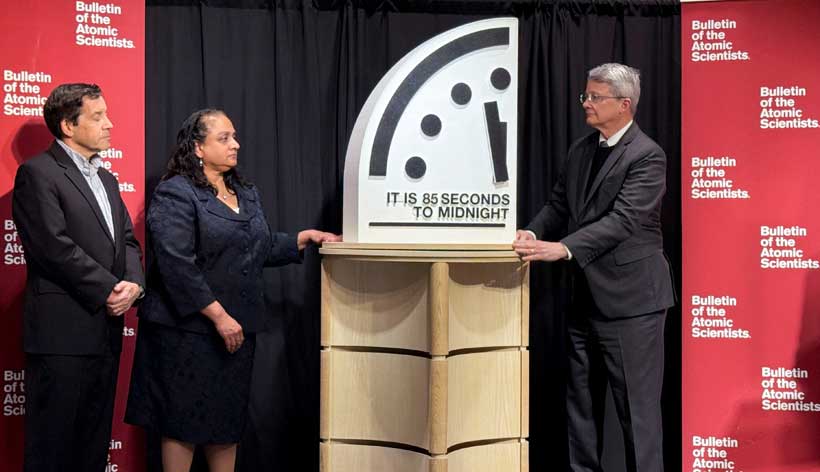
Midnight representing a global catastrophe, one brought on by human decisions rather than just nature or fate. An imagined moment of civilization`s dimise is represented by midnight on the Doomsday clock, where midnight signifies annihilation.
The clock is not an indication of the future but a warning. Its movement can be viewed as a generalized evaluation of scientists and security professionals regarding the seriousness of existential threats to the world. The fact that the clock has now become more of a midnight hour than it has ever been during the Cold War highlights a disturbing fact; the world is becoming increasingly exposed to risks, yet the global collaboration is getting less effective. The reason why the Doomsday Clock has been set to its present status is due to the combination of related threats. A combination of nuclear instability, the escalating climate change, disruptive developments in technology, and weak world governance structures are complex and more perilous than any single crisis experienced in the past. It is important that the policymakers, diplomats and even global citizens understand why the clock has come this far to midnight.
The most direct and devasting menace to human life is still nuclear. Although the Cold War ceased decades ago, the effects of the nuclear legacy remain, and in most aspects the risk environment is worse. Systems of arms control which previously offered predictability and restraint have continued to weaken. Pact like the Intermediate-Range Nuclear Force (INF) Treaty is dead, and the agreements that are still in place are uncertain to have a future.
At the same time, the tensions between geopolitics are becoming more acute. The nuclear rhetoric in Europe has been rejuvenated with implicit and explicit threats to the long-standing taboos against the use of nuclear weapons in light of the war in Ukraine. Elsewhere, tensions in East Asia, particularly around Taiwan and the Korean Peninsula, increase the possibility of miscalculation between the states that possess nuclear weapons. Modernization of nuclear arsenals such as the creation of hypersonic weapons and lower yield warheads further reduce the time available in the decision-making process during the crisis and increase the likelihood of an accidental or rapid escalation.
Stay ahead of the geopolitical week.
MD Briefing delivers expert analysis across five global fronts — the Indo-Pacific, energy, geoeconomics, European security, and the Middle East — every Monday morning. Free.
The movement of the Doomsday Clock is an expression of the existence of nuclear weapons as well as the degradation of norms and communication systems that are supposed to control them. Trust is very little between big countries and in such a world the smallest incidence can blow up into a world disaster.
Climate change is not a faraway an abstract threat but a current and accelerating problem. The increase in global temperatures increases heatwaves, floods, storms, droughts, and rise in sea levels across regions(NASA Climate Portal). In addition to environmental degradation, climate change acts as a threat multiplier, exacerbating economic, social and political vulnerabilities. It is also increasing stress related to food insecurity, forced displacement and water scarcity. Enhancing internal turmoil, transnational immigration and civil wars in fragile states. To developing nations, the climate crisis poses a risk to development gains whereas the major powers face infrastructure and supply chains problems. International emissions continue to increase and climate funding to the vulnerable countries is inadequate. The Doomsday Clock points to the fact that humanity did not manage to take sufficient actions to avoid making an irreparable damage (Bulletin of the Atomic Scientists)
The additional existential risk is contributed by rapid technological development. The development of artificial intelligence, cyber abilities, and the autonomous weapons system is changing military, economic and social environments at a rate that governments struggle to keep up. Although these technologies have advantages, their use or accidental results are a great threat. (Wired)
The use of AI in decision-making in military systems might ensure that the human factor in life-and-death scenarios decreases. Infrastructure such as energy grids, financial networks and nuclear command-and-control networks are among the most important systems that are vulnerable to cyberattacks to result in chaos or misinterpretation in times of crisis. The Doomsday Clock is the expression of fear not only towards technology, but also towards the inability of humankind to handle it with responsibility. The technological advancement can surpass wisdom in the absence of international conventions, morals and collaborative control.
One of the most troubling aspects that make the clock even nearer to midnight is perhaps the loss of balanced global governance. Multilateral institutions that are meant to deal with joint risks are being put under pressure. The power rivalry is growing stronger, crowding out collaboration, and nationalistic interests and selfish political gain threatens long-term solution to problems.
States cannot undertake global challenges related to pandemics, climate change, nuclear proliferation and technological regulation. However, it has become harder to build consensus and the international lam is either disregarded, or is applied selectively.
The Doomsday Clock is not merely a metric of threat, but of political determination. The later in the day it is more obvious that the human race is not doing what it can collectively to help its survival (Encyclopaedia Britannica). (Britannica)
The secret of the Doomsday Clock symbolic power is its simplicity. “85 second to midnight is not a technical measure, it is a moral and political warning.” It has urgency that statistical data is not always able to bring. Experts have never considered the world to be in such a near-death situation like we are today, even during times like the Cuban Missile Crisis.
But it is not the clock that cannot change. In the past, it has been demonstrated that existential risks can be minimized through arms control deals, diplomatic interaction, scientific collaboration, and civil pressure. The clock has been shifted to a time before midnight, that is, human decisions do not go to waste.
Diplomacy is one of the only instruments that could be used to deal with global interconnected risks. The survival imperatives are the revitalization of arms control, the enhancement of climate collaboration, formation of norms of emerging technologies, and the restoration of trust in multilateral institutions.
The signaling toward 85 seconds before midnight is to be interpreted as a last warning and not a sentence to death. Humanity does have the knowledge, resources and institutions required to make the change. The questions that still remains open-ended are whether political leaders will be more of a hurry and responsible as the time calls.
Ultimately, time is not on the Doomsday Clock, rather it is choices that are on it. And at 85 seconds to midnight the margin of error has never been less.
