


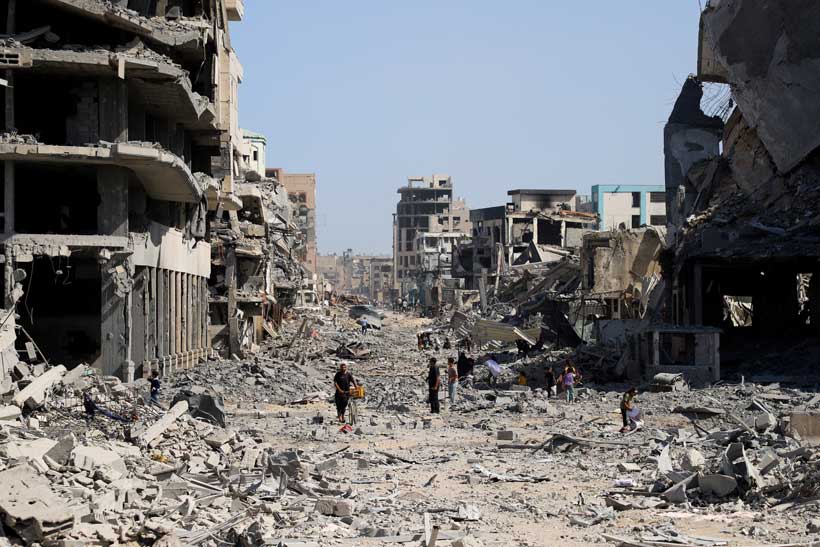
Gaza’s name evokes images of conflict, destruction and despair. Images that fail to capture the extend of destruction and death toll in Gaza. According to the United Nations Satellite Center 78 percent of Gaza structures had been destroyed by July 2025 since October 2023. A further examination of satellite images shows nearly 91.8 percent of school buildings either need full reconstruction or major rehabilitation work. In September Food and Agriculture Organization United Nations (FAO) reported that only 232 hectares or 1.5 percent of cropland in Gaza is accessible for cultivation. It is estimated that 67,000 Palestinians have been killed in two years of war between Hamas and Israel. The road to recovery will be long, painful and full of challenges, both domestic and foreign to Gaza and its population.
Yet, buried beneath the headlines lies a different story — one of immense economic potential denied. The narrow coastal strip could, under different circumstances, be a thriving Mediterranean hub for trade, energy, and tourism — a bridge between Asia and Africa rather than a flashpoint between them. As it was for thousands of years since the time of pharaohs and their empire in ancient Egypt.
A Strangled Economy at the Crossroads of Continents
The World Bank’s 2017 report on Palestinian trade performance paints a stark contrast between Gaza’s geographic promise and its economic reality. Wedged between Egypt and Israel, with access to the Mediterranean Sea and proximity to the Suez Canal, Gaza could have been a logistics and export center connecting regional markets from the Gulf to Southern Europe.
Stay ahead of the geopolitical week.
MD Briefing delivers expert analysis across five global fronts — the Indo-Pacific, energy, geoeconomics, European security, and the Middle East — every Monday morning. Free.
Instead, the region functions as an enclave economy. Trade through Gaza is funneled almost exclusively via Israel’s Kerem Shalom crossing, where every shipment faces costly and time-consuming inspections. Goods that flowed through Gaza’s now-ruined airport or the port of Gaza City are rerouted or blocked. Even when the Rafah crossing into Egypt opens, it does so only intermittently and primarily for humanitarian movement, not commerce. However, this is the trade and not international aid that will improve households’ productivity and their shopping power.
Yet, the economic models are clear: if restrictions were eased and border crossings reopened, Gaza’s GDP could grow by one-third by 2025. A functioning port, modern customs system, and reduced dual-use restrictions could revitalize exports in agriculture, textiles, and light manufacturing — sectors with proven competitiveness before the blockade.
Gaza’s position offers another advantage rarely discussed: it could serve as the gateway to the Palestinian economy, integrating the West Bank’s service and educational strengths with Gaza’s access to the sea and its labor force. In a different political climate, Gaza could be the UAE of the Levant — small but globally connected.
An Energy Opportunity Waiting Offshore
Perhaps the most dramatic example of untapped potential lies just 30 kilometers off Gaza’s shore. The UNCTAD 2019 report identifies the Gaza Marine natural gas field, discovered in 2000, as a potential game-changer. Estimated at 1 trillion cubic feet of recoverable gas, it could supply domestic energy needs for decades, reduce dependence on imported Israeli electricity, and even generate export revenue.
Gaza Marine is part of the larger Levant Basin, which contains an estimated 122 trillion cubic feet of natural gas and 1.7 billion barrels of oil, worth over $500 billion in today’s prices. Yet none of it benefits the two million Palestinians living in Gaza. Instead, political barriers have turned natural wealth into an inaccessible dream. Even before the ceasefire Michael Barrod, one of the experts who worked on developing the unexploited gas reserves, has suggested in a recent book an independent and recognized Palestinian state could develop disputed gas resources. Reconstructing Gaza is bringing together a new array of stakeholders who can make that a reality.
If developed under international supervision, the Gaza Marine field could:
- Provide energy security and improve Gazans’ welfare by reducing frequent blackouts.
- Create jobs and encourage investments in Gaza resulting in more stability and less incentives for violence and terrorism.
- Create cross-border incentives for stability, since shared pipelines and markets tie neighbors’ interests together.
Energy could also empower Gaza to rebuild its tourism and trade sectors, powering hotels, manufacturing zones, and export terminals. It also can reward those who have contributed to stability and prosperity of Gaza.
Tourism: The Forgotten Frontier
Before the early 2000s, Gaza’s beaches drew visitors from across the Middle East. Its Mediterranean coastline stretches 40 kilometers, comparable to that of Tel Aviv or Limassol, sharing the same climate and sea. In another timeline, Gaza could have followed Cyprus or Tunisia—developing beach resorts, cultural heritage sites, and religious tourism centered on its ancient history.
As Gaza and its neighbors revisit their shared past, rich with examples of collaboration and coexistence, tourism offers a genuine opportunity for regional renewal.
Reviving this sector would require infrastructure, energy stability, and freedom of movement, but the market potential is substantial. A peaceful, connected, and internationally protected Gaza could employ tens of thousands in hospitality and related services, generating income multipliers far beyond aid.
Unlike much of the twentieth century, human capital and executive experience needed to build such a sector now exist across the region. Turkey, the UAE, and Qatar attract millions of visitors each year; their presence in Gaza could open opportunities for knowledge sharing, investment, and joint tourism ventures.
The Cost of Lost Potential
Together, these reports quantify what Gaza’s people already understand: occupation and blockade have converted an economy of promise into one of survival feeding frustration and producing recruits for terrorist organizations. The economic cost is measured not only in billions of dollars of lost output or gas revenue but in the erosion of human capital — generations unable to apply their skills in a functioning market, and in thousands of lives lost. This might be the moment to change that.
Reconnecting Gaza to the world economy would not only lift its people but also benefit its neighbors. Israel, Egypt, and Jordan would all gain from a dynamic, energy-rich, and trade-oriented Gaza integrated into regional supply chains and power grids.
A Vision Worth Restoring
To view Gaza only through the lens of conflict is to miss its economic truth: it sits atop natural resources, human talent, and geographic advantages that could make it a regional success story. The same Mediterranean that brings in blockades could one day carry trade, energy, and tourists to its shores.
The world once imagined Singapore emerging from colonial occupation and civil strife to become a model of prosperity. Gaza’s transformation is harder to envision — but no less necessary. Its revival would not just rebuild an economy; it would restore hope in the possibility that shared prosperity can follow shared suffering and prevent future conflicts.
