



An international order constructed based on norms and treaties to stop the proliferation of nuclear weapons, India stands as a disturbing exception. India, despite remaining outside the Nuclear Non-Proliferation Treaty (NPT), has access to civilian nuclear technology, nuclear trade and a fast-growing arms depot outside international safeguards. This exceptional treatment is driven by geopolitical interests instead of rules of non-proliferation framework, which threatens the credibility of the global non-proliferation regime and fuels the risk of instability in South Asia.
India’s nuclear journey started under the guise of peaceful purposes. In 1974, the first nuclear test of India, named Smiling Buddha, was conducted using the plutonium derived from the CIRUS reactor supplied by Canada and the US. India declared that the reactor would be used only for peaceful purposes. This violation of international norms led to the creation of the Nuclear Suppliers Group (NSG) in 1975 to stop the diversion of civilian nuclear technology for military purposes.
India was given NSG waiver and despite not being its member, India-US civil nuclear deal was signed in 2008. This deal gives India the leverage to trade in civil nuclear technologies, despite its refusal to join the Non-Proliferation Treaty (NPT). India was allowed to retain various civil nuclear reactors outside the IAEA safeguards, that favoured India to exploit civil uranium enrichment program for military uses. NSG waiver pushed by the US and endorsed by many Western countries was politically driven and exceptional in its substance and implications. The rationale behind the deal was given that it would bring India closer to non-proliferation practices. Although reality is self-contradictory as India only agreed to place 14 out of 24 power reactors under IAEA safeguards. India also produces fissile material for weapons, which is a key concern for arms control advocates. India’s nuclear arsenal has developed considerably.
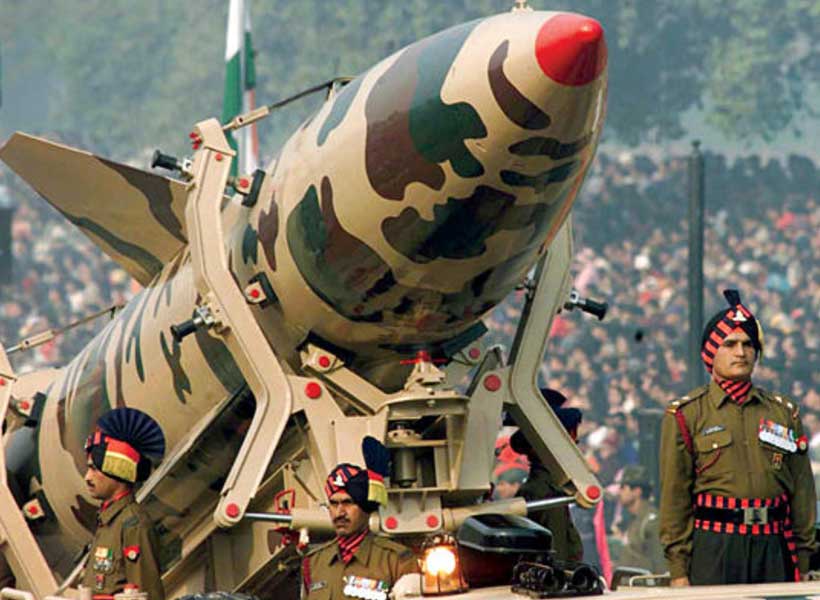
According to the Stockholm International Peace Research Institute (SIPRI), India carries around 172 nuclear warheads. India is enhancing its nuclear weapons stockpile, focusing on technological advancements and strategic reach. For example, the expansion of the Agni V intercontinental ballistic missile, efficient in hauling Multiple Independently Targetable Re-entry Vehicles (MIRVs), shows a shift toward more adaptable and active nuclear actions. The programme of Agni VI is back on track, where the Defence Research and Development Organisation (DRDO) is proactively working on the Submarine Launched Ballistic Missile (SLBM) variant. These developments indicate a doctrinal shift from minimum deterrence.
India claims to follow a No First Use (NFU) policy, however, there is ambiguity in its commitment to this policy. The Indian officials who are committed to NFU, including Defence Minister Rajnath Singh, stated that however, what happens in the future would depend on the circumstances. India’s adoption of the Cold Start Doctrine and portrayals further increase mutual distrust and sabotage Pakistan’s attempts towards arms control and conflict settlements in South Asia. These policies undermine deterrence in South Asia. The region faces volatile environment where any potential crisis escalates rapidly due to pre-emption and misperception.
Beyond the regional dynamics, the exceptional treatment of India undermines the global non-proliferation norms. It sets a base for other non-NPT states like Pakistan and Israel to pursue similar treatment, reducing the universality of the NPT. It also harms the credibility of enforcing non-proliferation in other places. For example, Iran, under the Joint Comprehensive Plan of Action (JCPOA), faces severe sanctions for its nuclear activities. Contrarily, India obtained nuclear technology without signing the NPT. These double standards destroy faith in the rule-based global order. The Western powers are involved in this erosion.
Global geopolitical competition between the US and China has shaped strategic decisions like NSG waiver. According to the report of the Congressional Research Service, the US supports India’s nuclear programs for a broader strategy to counter Chinese influence in Asia. Western allies and the US have emphasised strategic alliances over non-proliferation norms. This temporary strategic calculus might yield geopolitical gains, but it has a long-lasting cost for the international nuclear order. IAEA, NSG and other non proliferation frameworks need to be revisited to revive and enhancing their reputation as responsible stakeholder. India shall be encouraged to cease the production of fissile material for weapons and support the Fissile Material Cutt Off Treaty (FMCT). India should place its all-civilian program under the safeguards of IAEA.
In this era where arms control is unrevealing and the new technologies are threatening nuclear thresholds; the world cannot afford enforcement. The nuclear exceptionalism of India’s threatens to resolve decades of development and set an unsafe precedent for future proliferation.
