


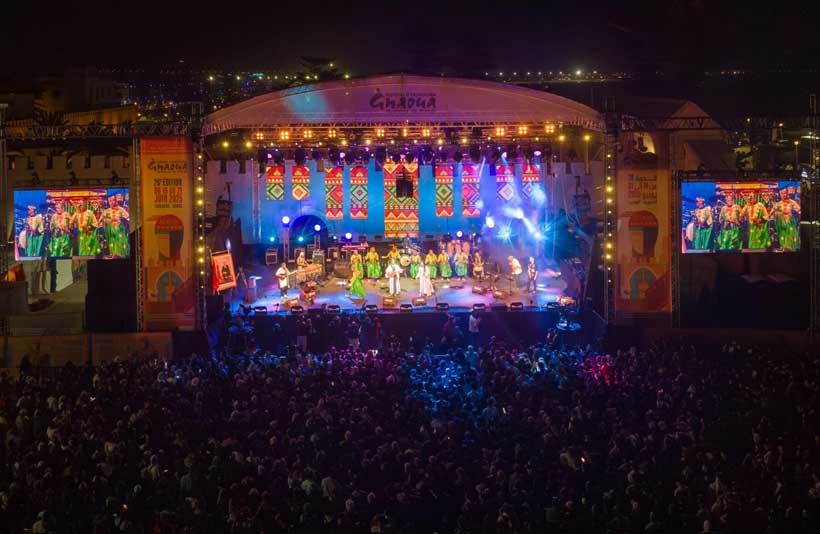
“Gnaoua Festival Essaouria: World music, fusion, and living culture. Join us from June 19 to 21, 2025, for a unique edition in Essaouira.”
This is the promotional slogan of Morocco’s internationally recognized music festival. For more than two decades, the Gnaoua and World Music Festival has drawn attention from artists as well as audiences globally. The festival is framed as a celebration of diversity and heritage and has helped turn the traditional Gnaoua music into Morocco’s prominent cultural export.
On the surface, the festival showcases the success story of preservation and global fusion. However, behind the very celebratory tone lies a profound tension: the transformation of Gnaoua music from a spiritual and marginalized practice rooted in the memory of enslavement to a commodified cultural product that is consumed by foreign tourists. As Morocco leverages Gnaoua music for soft power and nation branding, the communities that sustain it are often excluded from the economic and symbolic benefits. This dynamic raises a very critical question regarding inequality, cultural appropriation, and neocolonialism in the age of music tourism.
For the majority of Moroccan history, Gnaoua practitioners have occupied the margins of society socially and economically. Their music was seen as mystical and primitive, tolerated by the government, but not necessarily embraced. The music was a marginalized practice rejected by the Moroccan cultural elite and only rose to fame in the 1970s. Throughout the 90s and early 2000s, Morocco began to strive to create a global image strategy that is more rooted in cultural openness and tourism. The center of this campaign was the Essaouira Gnaoua and World Music Festival. International musicians, which include jazz legends as well as French fusion artists, were invited to play and collaborate with Gnaoua masters. These collaborations pushed the genre onto the global stage.
Stay ahead of the geopolitical week.
MD Briefing delivers expert analysis across five global fronts — the Indo-Pacific, energy, geoeconomics, European security, and the Middle East — every Monday morning. Free.
Gnaoua music became the symbol of the country’s multicultural tolerance and spiritual depth. Nevertheless, the framing of the music in this glossy promotional material and state-backed events reduced the dark and complex historical context into digestible entertainment. Traditional healing rituals were replaced by shortened stage sets for the eyes of foreigners. The deep rhythms that were once utilized to open dialogues with spirits became beats for global audiences to dance to. These performances that were once a sacred communal practice became heavily commercialized. Additionally, many Gnaoua musicians remained poor, excluded from the festival’s financial benefits or even pushed into the background roles of well-paid foreign performers. This underscores the discrepancy between the festival’s image as a celebration of Gnaoua traditions and the reality ignored in the media.
Morocco is engaging in what scholars describe as ‘nation-branding,’ or the strategic use of culture, tourism, and imagery to shape how a particular country is seen internationally. It is part of a broader soft power toolkit, a tactic that is increasingly common across the region of the Middle East and North Africa. But this strategy also has its ethical implications.
The Moroccan state’s use of Gnaoua culture for diplomatic prestige and tourism risks repeating a very familiar colonial pattern: appropriating cultural expression while excluding the creators and performers from the profit and power. During French colonial rule in the region, African and Berber cultural forms were selectively promoted or repressed in order to control populations. This similarity in the dynamics can be seen today but are covered under the banner of postcolonial nationalism. Foreign visitors may walk away from the festival feeling inspired, while the local Gnaoua musicians return to their homes in marginalized communities with little change. Meanwhile, international musicians (many of whom are from France, Morocco’s former colonizer) often headline the event and receive higher compensation. The shadows of cultural hierarchies and neocolonialism are hard to ignore here.
What is lost when music tied to historical trauma becomes entertainment for tourists? The problem that comes with the commodification of Gnaoua music becomes more evident when considering the background of the music. Historically, Gnaoua music is a medium to narrate the historical trauma of enslavement and marginalization of the people.
Gnaoua songs are historically not simply a “performance”; rather, they are rituals of remembrance of slavery. This genre of music acts as a collective healing and resistance of the people. Repetition of this remembrance keeps alive the memory of slavery and discrimination but also resilience. Stripping these practices from their context for international consumption risks turning this historical memory into a mere spectacle.
This commodification is not unique to Morocco. Across the Global South, states are embracing this cultural commodification as a development strategy. Indonesian Balinese traditional dances, for example, were traditionally served for ceremonial purposes. And yet, religious contexts are diminished due to dances being performed solely for entertainment for tourists. Other instances include Indian Kathakali dances. This classical dance-drama from Kerala loses its cultural significance over time due to its use for tourism, turning it into a superficial spectacle for outsiders.
Sacred rituals risk losing their spiritual and historical importance when they are transformed into spectacles, becoming consumable artifacts that are no longer connected to their original function. When individuals who uphold these traditions continue to be marginalized, this commodification presents concerns about ethics regarding the exploitation of cultural memory for commercial purposes.
International exposure is not inherently harmful, but the problem lies in who controls the narratives, who profits, and whether the deep history and meaning of the culture are being preserved. Local ownership, fair pay for the traditional artists, and educational components about the origins and meanings of culture could bridge the gap between celebration and exploitation. The challenge is to balance these aspects.
The case of Gnawa music highlights the ethical challenges of commodifying a cultural practice rooted in marginalization and trauma. The process of detaching the genre from its historical roots and reducing it to an exotic consumption perpetuates neocolonial dynamics. There is a need to prioritize the agency of marginalized communities in representing their heritage, resisting exploitative practices, and adopting a decolonized approach that prioritizes historical context.
Music, arts, and culture can be a form of soft power and diplomacy. Gnaoua music is a powerful symbol of Morocco’s rich and layered identity. But when it disconnects from the people and pain that shaped it, it risks becoming a hollow echo of itself. The country’s international image may shine with festival and fusion, but it will definitely be stronger if it ensures the bearers of the tradition are also empowered.
