



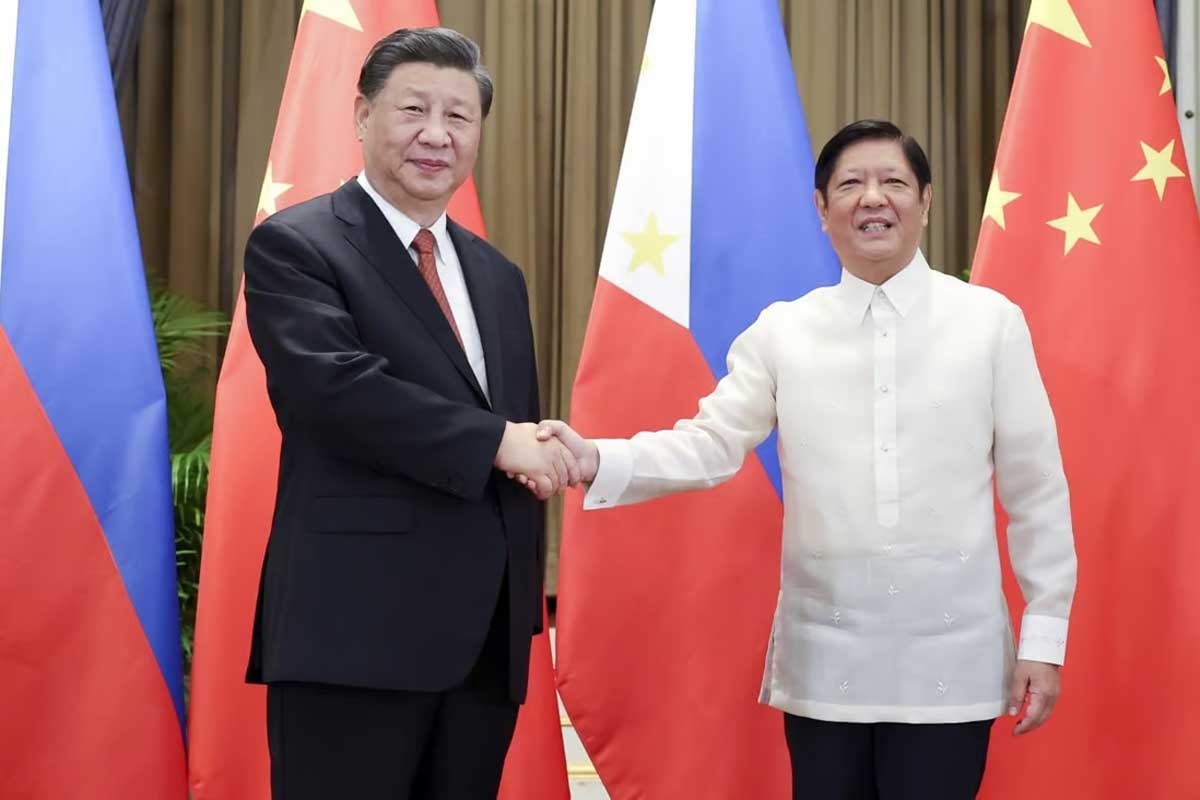
In May 2025, at the oath-taking ceremony of newly promoted Philippine Coast Guard Officers (PCG), Philippine President Ferdinand “Bongbong” Romualdez Marcos Jr. reaffirmed his commitment to protecting the country’s territory and sovereign rights in the West Philippine Sea. The message was a clear indication of a shift in Manila’s foreign policy from Beijing.
“This administration stands with you to boost your capabilities through advanced vessels, through new technologies, and to support systems that reflect the scale and the urgency of your work,” Marcos Jr. said in a speech during an oath-taking ceremony, according to a report by the Inquirer.
This shift is not simply out of external pressure or some great power play but is rooted deeply in domestic political calculations. As China grows aggressive and assertive in the Philippine waters, the distrust among the public intensifies. Now, Marcos Jr. must navigate between security-driven ties with Washington and Chinese investments.
Now the question is how domestic political pressure is driving Manila’s foreign policy and what the international responses are.
The recalibration of foreign policy under Marcos Jr. shows a clear departure from his predecessor, former President Rodrigo Duterte, who adopted a conciliatory stance on China, calling it an “independent foreign policy,” and reduced dependence on the United States.
Duterte pursued economic diplomacy and attracted investment under China’s Belt and Road Initiative—proven to be failures—by downplaying the role of victory under the 2016 Permanent Court of Arbitration ruling, which rejected China’s claims to the South China Sea, which China does not accept and calls illegal.
But soon he was criticized for putting the sovereign rights at risk and appeasing China. Albert del Rosario, former foreign affairs chief, even warned him of impeachment for allowing Chinese vessels to fish in Philippine waters, which is, by the constitution, a right of Filipinos.
With the conclusion of joint maritime exercises in the West Philippine Sea off Palawan between the Armed Forces of the Philippines and the US Indo-Pacific Command in January 2025, it is clear that Marcos Jr. is moving ahead with the revival of security-driven ties with Washington, being cautious of domestic voices.
According to the Pulse Asia survey conducted in September 2024, 73 percent of Filipinos will not support the political candidates with China leanings in the May 2025 midterm elections. This indicates a public mood against China’s aggressive activities in the West Philippine Sea, challenging the country’s sovereign rights.
Additionally, Oculum Research and Analytics conducted a survey in February 2024 and found that only 17 percent of respondents have “great trust” in China, while 75 percent have “great trust” in the United States.
In the past decade, Beijing has shown aggressive behavior, deploying military militia to assert territorial claims in the West Philippine Sea. While these are not new. In 2023 and 2024 alone, China’s Coast Guard conducted several provoking and illegal activities, such as the installation of floating barriers in Scarborough Shoal (or Bajo de Masinloc), which China seized in 2012, preventing fishermen from entering the area and firing a water cannon against Philippine resupply missions at Ayungin (or Second Thomas) Shoals in the Spratly Islands.
These aggressive actions have now become the rallying points in Philippine domestic politics, and people have voiced support for a candidate who will not be pro-China and will put national interest at the forefront. This is exactly how Marcos Jr. started his term, responding to Chinese aggression in Philippine waters, reflecting a moral imperative.
In retaliation for China’s aggressive actions, Manila under Marcos Jr. has unleashed a multifaceted approach. First, Manila has developed closer ties with Washington and revived the joint patrols, naval exercises, and extended access to military bases under the Enhanced Defense Cooperation Agreement (EDCA). Second, it had used transparency as a tool of deterrence to pressurize China, releasing videos of aggressive attacks on Philippine vessels, which was not seen under Duterte’s regime. Lastly, Marcos Jr. has pushed for international community involvement and emphasized a legally binding ‘Code of Conduct’ to respond to the maritime disputes and prevent further escalation in the South China Sea.
Marcos Jr. also called on ASEAN to work collectively to address challenges such as geopolitical tensions, unexpected trade barriers, and climate change and use them as an opportunity for shared growth and regional stability, according to the Inquirer.
Unlike the other claimant states, Manila’s current posture is not only assertive, but it also condemns and confronts China openly and positions itself as a norm setter. It has emphasized the respect for international law and freedom of navigation and reiterated a rule-based order, not a power-based one.
During a time of heightened maritime tensions, a turn to a strategic partner, the United States, is a significant foreign policy shift under Marcos Jr.’s administration since Duterte’s proximity to Beijing. With the approval to access four more military bases under the EDCA in 2023, Manila has shown its willingness for the U.S. to play a more active role in regional stability.
For the United States, this realignment is crucial, as it deepens its Indo-Pacific strategies to counter China’s growing control in the region. But for Manila, it comes with complexities and questions of economic dependence on China—a top trading partner of the Philippines. Therefore, it is needed for the administration to maintain deterrence while trying not to provoke any further escalation.
Meanwhile, Manila has been engaged in a process to diversify its defense and security partnership beyond the US. The Philippines has signed several defense and military agreements with Japan and Australia, involving the Reciprocal Access Agreement. Additionally, it is also participating in multilateral dialogues like the ASEAN Defence Ministers’ Meeting Plus (ADMM-Plus). These engagements provide multilateral support and cooperation without being dependent on a single nation.
Unlike the Duterte era, Marcos Jr.’s administration has stronger domestic legitimacy for re-alliance with the U.S. than in the past, when leftists opposed and had anti-American sentiments. But Marcos Jr. does need to think of the economic alternatives if China stops the trade.
Hence, the Philippines’ evolving foreign policy trajectory shows that middle powers cannot remain silent in the strategic rivalries, and domestic politics should be at the heart of the foreign policy. As Manila recalibrates its position in the Indo-Pacific with the U.S., it has a firm stance on the South China Sea to assert its sovereign rights in the region. Manila has won the confidence of the West, and the Marcos policies are based on public opinions and external necessity. Yet, the economic challenges continue due to the dependence on China. Unlike the past administration, Manila must act as more than a pawn in the geopolitical chessboard. It is still unclear whether the country can sustain this serious balancing act because it will not only shape the future of Manila but also of Southeast Asian strategic terrain.
