



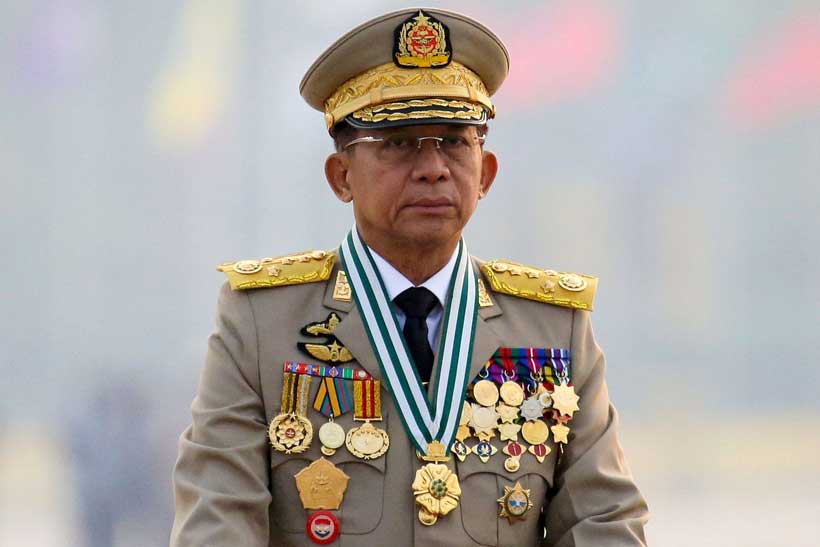
Myanmar’s new president, Min Aung Hlaing, has formally assumed office, marking a transition from military chief to civilian head of state following the Myanmar coup 2021.
The move consolidates his control after years of political upheaval, civil conflict, and international isolation. In his inauguration speech, he acknowledged the scale of challenges facing the country, while pledging a path toward democracy, peace, and economic recovery.
A Contested Path to Power
Min Aung Hlaing’s presidency follows an election widely dismissed by critics and Western governments as lacking credibility. The vote, dominated by a military backed party, took place in a political environment with no meaningful opposition.
The transition from junta leader to civilian president is seen by many as an attempt to legitimise continued military influence under a different institutional framework.
This follows the overthrow of the elected government led by Aung San Suu Kyi, whose detention remains a focal point of international criticism.
Promises of Democracy and Reform
In his address, Min Aung Hlaing emphasised a roadmap based on democracy and federalism, positioning his administration as a stabilising force.
He outlined ambitions to attract foreign investment, boost domestic business, and implement long term development strategies in resource rich Myanmar.
However, the speech lacked concrete policy details, particularly on how the government intends to address the ongoing civil war or rebuild trust with the international community.
Civil War and Human Rights Concerns
Myanmar remains deeply engulfed in conflict, with widespread fighting between the military and various resistance groups across the country.
The military faces persistent allegations of human rights abuses, including violence against civilians. These accusations have contributed to sanctions and diplomatic isolation, particularly from Western nations.
Despite calls for peace and reconciliation, the absence of a clear strategy to end hostilities raises questions about the feasibility of the government’s stated goals.
ASEAN and Regional Diplomacy
A key priority outlined by Min Aung Hlaing is the restoration of relations with ASEAN.
Myanmar has been largely sidelined by the regional bloc since the coup, with its leaders barred from high level summits in response to the military’s actions and failure to implement agreed peace measures.
Re engaging with ASEAN is crucial for Myanmar’s diplomatic rehabilitation, particularly within Southeast Asia, where regional cooperation plays a central role in economic and political stability.
Economic Pressures and Investor Flight
The 2021 coup triggered a sharp withdrawal of foreign investment, undermining what had once been seen as one of Asia’s most promising emerging markets.
Restoring investor confidence will be a major challenge, especially given ongoing instability and uncertainty over governance.
Min Aung Hlaing’s emphasis on economic development reflects an awareness that political legitimacy is increasingly tied to economic performance.
Amnesty Signals and Political Prisoners
The new president hinted at possible amnesties as part of efforts toward national reconciliation. However, no specifics were provided.
Thousands of political detainees remain imprisoned, including Aung San Suu Kyi, whose continued detention complicates any claims of democratic transition.
Without meaningful steps toward political inclusion, gestures such as amnesties risk being seen as symbolic rather than substantive.
Implications
Myanmar’s trajectory under Min Aung Hlaing presents several key dynamics
An attempt to rebrand military rule under civilian leadership
Continued internal conflict with no clear resolution
Efforts to rebuild regional ties while facing global scepticism
The gap between rhetoric and reality remains a defining feature of the current moment.
Analysis
Min Aung Hlaing’s presidency represents a strategic recalibration rather than a fundamental political transformation. By adopting the language of democracy and federalism, the new administration seeks to reshape both domestic and international perceptions while maintaining core power structures.
The outreach to ASEAN signals recognition that regional legitimacy is essential for breaking isolation. However, without tangible progress on conflict resolution and political inclusion, such efforts are likely to face resistance.
At the same time, the absence of detailed policy direction suggests a cautious approach, prioritising consolidation of control over rapid reform. This reflects the inherent tension in the regime’s position: the need to project stability and openness while preserving military dominance.
The broader challenge lies in reconciling these competing objectives. Economic recovery, diplomatic reintegration, and internal peace are deeply interconnected, yet progress in each area depends on political concessions the current leadership may be unwilling to make.
With information from Reuters.
