



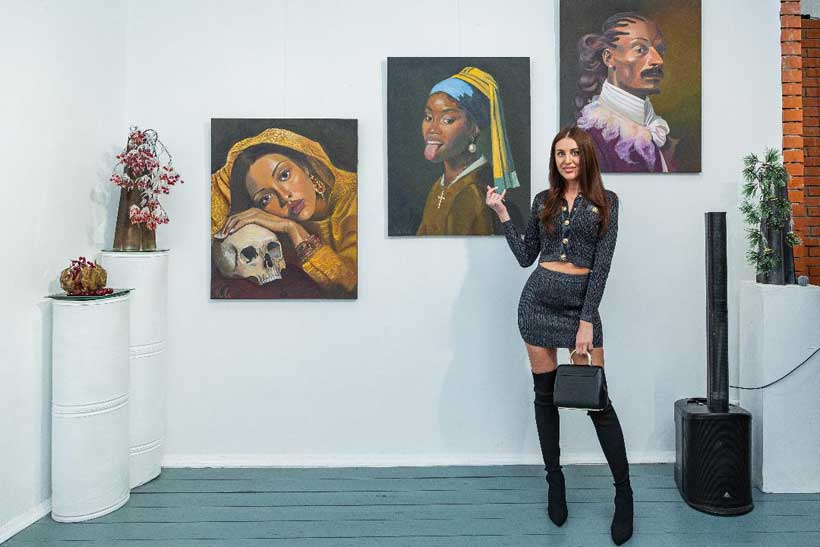
In this insightful interview, Natali Kalalb, founder of the Natali Kalalb Art Gallery, discusses her practical experiences of handling Africa’s contemporary arts, her professional journey into the creative industry and entrepreneurship, and also strategies of building cultural partnership as a foundation for Russian-African bilateral relations. Here are the interview excerpts:
Given your experience working with Africa, particularly in promoting contemporary art, how would you assess its impact on Russian-African relations?
Natali Kalalb: Interestingly, my professional journey in Africa began with the work “Afroprima.” It depicted a dark-skinned ballerina, combining African dance and the Russian academic ballet tradition. This painting became a symbol of cultural synthesis—not opposition, but dialogue.
Contemporary African art is rapidly strengthening its place in the world. By 2017, the market was growing so rapidly that Sotheby’s launched its first separate African auction, bringing together 100 lots from 60 artists from 14 foreign countries, including Algeria, Ghana, Mali, Nigeria, Senegal, and others. That same year during the autumn season, the Louis Vuitton Foundation in Paris hosted a major exhibition dedicated to African art. According to Artnet, sales of contemporary African artists reached $40 million by 2021, a 434% increase in just two years. Today, Sotheby’s holds African auctions twice a year, and in October 2023, they raised $2.8 million.
In Russia, this process manifests itself through cultural dialogue: exhibitions, studios, and educational initiatives create a space of trust and mutual respect, shaping the understanding of contemporary African art at the local level.

Do you think geopolitical changes are affecting your professional work? What prompted you to create an African art studio?
Natali Kalalb: The international context certainly influences cultural processes. However, my decision to work with African themes was not situational. I was drawn to the expressiveness of African visual language—color, rhythm, and plastic energy. This theme is practically not represented systematically and professionally in the Russian art scene.
The creation of the studio was a step toward establishing a sustainable platform for cultural exchange and artistic dialogue, where the works of African artists are perceived as a full-fledged part of the global cultural process, rather than as exotica.
To what extent does African art influence Russian perceptions?
Natali Kalalb: Contemporary African art is gradually changing the perception of the continent. While previously viewed superficially or stereotypically, today viewers are confronted with the depth of artistic expression and the intellectual and aesthetic level of contemporary artists.
Portraits are particularly impactful: they allow us to see not just an abstract image of a “continent,” but a concrete personality, character, and inner dignity. Global market growth data and regular auctions create additional trust in African contemporary art and contribute to its perception as a mature and valuable movement.
Does African art reflect lifestyle and fashion? How does it differ from Russian art?
Natali Kalalb: African art, in my opinion, is at its peak in everyday culture—textiles, ornamentation, bodily movement, and rhythm. It interacts organically with fashion, music, interior design, and the urban environment.
The Russian artistic tradition is historically more academic and philosophical. African visual art is distinguished by greater color expression and dynamic form. Nevertheless, both cultures are united by a profound symbolic and spiritual component.
What feedback do you receive on social media?
Natali Kalalb: Audience reactions are generally constructive and engaging. Viewers ask questions about cultural codes, symbolism, and the choice of subjects. The digital environment allows for a diversity of opinions, but a conscious interest and a willingness to engage in cultural dialogue are emerging.
What are the key challenges and achievements of recent years?
Natali Kalalb: Key challenges:
• Limited expert base on African contemporary art in Russia;
• Need for systematic educational outreach;
• Overcoming the perception of African art as exclusively decorative or ethnic.
Key achievements:
• Building a sustainable audience;
• Implementing exhibition and studio projects;
• Strengthening professional cultural interaction and trust in African contemporary art as a serious artistic movement.
What are your future prospects in the context of cultural diplomacy?
Natali Kalalb: Looking forward, I see the development of joint exhibitions, educational programs, and creative residencies. Cultural diplomacy is a long-term process based on respect and professionalism. If an artistic image is capable of uniting different cultural traditions in a single visual space, it becomes a tool for mutual understanding.
