


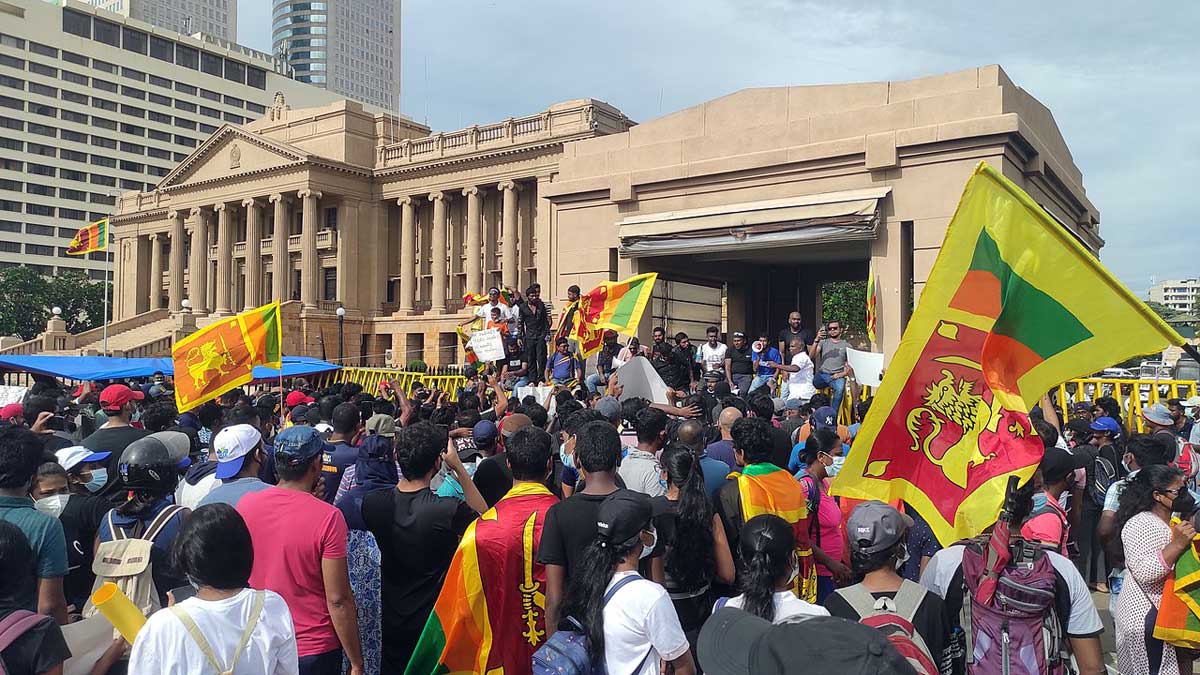
Sri Lanka’s worst economic crisis since independence has highlighted years of political and economic mismanagement and a reliance on state-sanctioned violence in response to legitimate protests. Legitimate reform and respect for human rights is required if the island nation is to act in the best interests of its people.
The crisis has resulted in the import-reliant country’s foreign currency reserves running dry, meaning that the government is unable to pay for imports of basic goods, including food and fuel. Rising inflation of 17 per cent has meant that any food available is now too expensive, with a kilogram of rice costing 500 rupees when it previously cost 80. The lack of fuel has meant that Sri Lankans are suffering through 12-hour power cuts, with the government asking people to work from home to save fuel.
Making matters worse, the government has defaulted on its foreign debts for the first time since independence. Sri Lanka’s debt is approximately $51 billion, making it now reliant on negotiations with its creditors, such as the Asian Development Bank, to pause payments so basic goods can be purchased.
As always, these issues are affecting Sri Lanka’s most vulnerable, particularly those in poorer rural areas, the elderly and people with disability. There are reports of people dying while lining up for fuel in the heat. This has the potential to worsen into a significant humanitarian crisis, with half the country sinking into poverty and food insecurity rising.
Stay ahead of the geopolitical week.
MD Briefing delivers expert analysis across five global fronts — the Indo-Pacific, energy, geoeconomics, European security, and the Middle East — every Monday morning. Free.
This is a big step back for a country that was once regarded as one of Asia’s success stories, formerly enjoying economic growth, burgeoning industries and a wealthier middle class. The was a sign of a country that was beginning to rebuild after a brutal civil war that affected all Sri Lankans.
While the government has blamed the crisis on the coronavirus pandemic and the subsequent drop in tourism, the cause is closer to home, and the government deserves significant blame.
The President, Gotabaya Rajapaksa, previously slashed taxes and focused on domestic markets rather than exports, creating an economy reliant on imports, which created unsustainable levels of debt. The government has also racked up huge debts to fund irresponsible infrastructure projects which has severely depleted the country’s foreign reserves. The banning of imports of chemical fertilisers left Sri Lanka’s large agriculture sector crippled and increased debt through the reliance on importing food.
The Rajapaksa family has ruled Sri Lanka for over two decades, with Mahinda Rajapaksa ruling as President between 2005 and 2015 and then as Prime Minister until his recent resignation. Gotabaya Rajapaksa has served as President since 2019 and several family members have long held prominent positions within the military and government. This has resulted in rampant nepotism, corruption and poor economic decisions that have turned the public away from the once popular family.
The crisis in Sri Lanka has led to nation-wide protests, which have rapidly turned violent. Protesters have stormed government buildings and government forces have been injured. Citizens are justifiably angry about years of poor economic decisions that has crippled the economy, leaving millions without the most basic of goods.
Authorities have reacted to this unrest with a heavy handed approach. The deployment of the military with orders to shoot looters on sight and the use of water cannons and tear gas had led to two deaths of the arrest of over two hundred people, including peaceful protesters. President Rajapaksa has also declared two state of emergencies, severely restricting the rights of Sri Lankans and giving authorities sweeping powers to detain legitimate protesters or those breaking curfew. This raises serious concerns about the governments respect for human rights and will do little to rebuild trust in government.
Instead of the use of violence to crush protests, the government needs to take responsibility and undertake meaningful economic and political reforms to address the crisis and quell unrest.
Human rights need to be at the forefront of any solution. The United Nations High Commissioner for Human Rights, Michelle Bachelet, has rightly called for any attacks on civilians and peace protesters to be independently and transparently investigated. State of emergency declarations and curfews should also cease, allowing Sri Lankans their right to peacefully protest about legitimate issues of concern. Any peaceful protester illegally detained needs to be released immediately.
The government should also work with international partners to find rapid solutions to critical problems, such as providing basic goods to their citizens. The decision by the World Bank to provide $600 million in assistance and ongoing negotiations with the International Monetary Fund are welcome. But more needs to be done.
The government needs to undertake meaningful economic reforms, including reversing damaging tax cuts and reducing debt, so the IMF will agree to a more substantial financial package that allows the country to recover.
The democratic process also needs to be respected. The government should maintain dialogue and consult with other political parties’, civil society and non-governmental organisations to find adequate solutions to the economic and political problems facing the country.
This includes negotiating with opposition parties to reach political solutions that lead to ongoing stability. However, while the embattled President has replaced his brother as Prime Minister in an attempt to ease political pressure, the opposition has so far refused to join an administration with the Rajapaksa family. A political solution may need to be found that finally breaks the link with the Rajapaksa’s so Sri Lanka can move forward as a nation.
Sri Lankan’s have shown that they desire legitimate change in response to this unprecedented crisis. They demand meaningful political and economic change that will allow Sri Lankans to buy basic goods and reduce poverty. The government, whether it includes the Rajapaksa’s or not, needs to listen to the people and not respond with violence by respecting their human rights and undertaking meaningful change.
