
Connect with us

World News

Burkina Faso ‘one step short of famine’

Avatar photo

Published

on

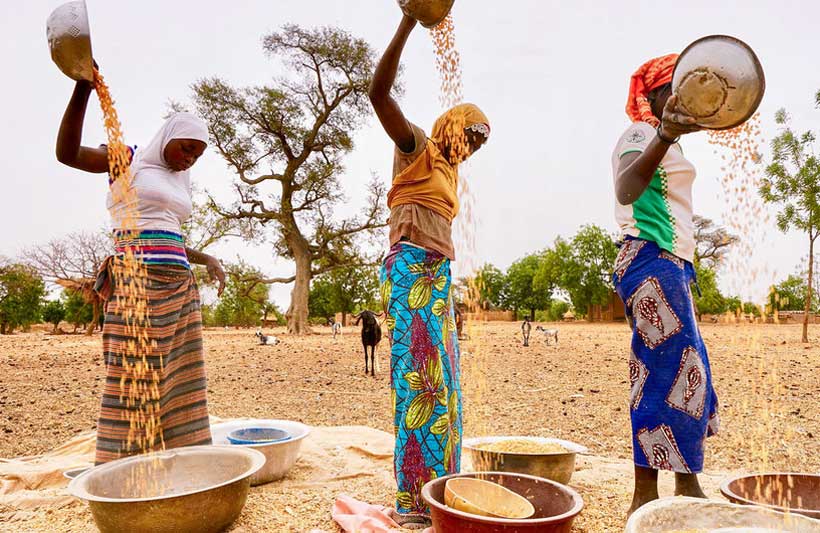
In Burkina Faso, the number of people facing a critical lack of food has increased. UNOCHA/Giles Clarke

Unless access is urgently granted to humanitarian organizations, thousands in the Central Sahel will be “pushed into further destitution”, the UN emergency food relief agency warned on Monday.  

Ahead of Tuesday’s High-Level Ministerial Conference on the Central Sahel in the Danish capital Copenhagen, the World Food Programme (WFP) sounded the alarm that catastrophic levels of hunger could hit parts of Burkina Faso, Mali and Niger.  

‘Tragic’ food insecurity spike 

Violence and insecurity have pushed 7.4 million people in the Central Sahel region of West Africa into acute hunger, according to WFP. 

Additionally, the number of internally displaced people has risen from 70,000 two years ago to nearly 1.6 million today – including over 288,000 in Mali, more than 265,000 in Niger and over one million in Burkina Faso, which is now home to the world’s fastest growing displacement crisis. 

“When we can’t get to vulnerable communities, we’re seeing tragic spikes in food insecurity”, said Chris Nikoi, WFP Regional Director for West Africa.  

He explained that “dreadful violence and conflict” in parts of northern Burkina Faso have left over ten thousand people there “one step short of famine”.  

“The world cannot wait to take action until children, women and men have died”, stressed the WFP official. 

Food deliveries on the way 

As the delivery efforts of humanitarian organizations have been jeopardized by worsening conflict and insecurity, life-saving assistance to the neediest communities has become inaccessible. 

Moreover, aid workers are increasingly targeted by non-State armed groups in Burkina Faso, Mali and Niger.  

WFP, which was recently awarded the 2020 Nobel Peace Prize, is urging conference participants to find ways for organisations to engage with communities and all actors on the ground to open safe passageways for humanitarian assistance to reach those in need.  

A worrying outlook 

Meanwhile, in response to the deepening crisis and growing needs, WFP has continued to ramp up lifesaving assistance, reaching more than 3.4 million people in August alone.  

In scaling up to meet the growing needs in Burkina Faso, WFP worried about its financial outlook.  

The UN agency has already been forced to reduce rations from July and risks, by next month, a break for emergency assistance to displaced people who – having fled their homes, farms and jobs – have no other options. 

Building resilience   

At the same time, WFP is working to strengthen resilience-building support for at-risk communities.  

Its interventions include rehabilitating community assets, improving degraded land, feeding students, and community-based nutrition activities, to prevent and treat malnutrition.  

Since 2018, more than one million people have benefitted from WFP’s integrated resilience activities in Niger, Mali and Burkina Faso. 

Humanitarian event 

The UN is co-hosting the conference in Denmark along with Germany and the European Union. 

It will feature on Tuesday, a ministerial round table that follows up on a virtual 8 September meeting, focused on forward-looking plans relating to humanitarian action, development and peace efforts, among other things.

Continue Reading
Comments

World News

Africa’s moment of truth after Russia’s mutiny

Avatar photo

Published

on

Soldiers from the Wagner Group (source: middleeastmonitor.com)

The short-lived rebellion in Russia last weekend has raised uncertainty about the future of Moscow’s military influence in Africa, where the mercenary Wagner Group has been the forward arm of President Vladimir Putin’s strategic interests. For African leaders, however, the failed mutiny prompts a different question: Does the continent’s future rely more on guns or on the civic values of democracy?, ask the Christian Science Monitor’s Editorial Board.

The answer was unequivocal for more than 50 leaders from Africa, Latin America, and Eastern Europe, who had gathered last week in Poland. Being merely pro-liberty is not enough, the group declared in a statement. “Defending democracy requires common purpose – of solidarity – among democrats inside and outside all countries.”

That consensus takes aim at a core tenet of Africa’s diplomacy – that the continent must resist choosing sides between great powers, such as the West and its global rivals. That explains how Kenya could announce its intentions for a trade deal with Russia in late May and then, three weeks later, sign another deal with the European Union. It explains why nearly half of all African governments refuse to condemn Russia for invading Ukraine.

By staying neutral, African leaders argue, they can promote equality between richer and poorer nations and help broker peace in foreign conflicts. Yet pursuing ties simultaneously with countries that uphold democratic values and with those that undermine them has instead resulted in costly entanglements, intense foreign competition over strategic natural resources, conflict, and financial dependency.

Wagner’s spread across a handful of faltering countries, mostly concentrated in the Sahel region, has undermined efforts by France and the United States to strengthen professional African militaries under civilian command. “Its effect,” the United States Institute of Peace noted recently, “is to strengthen rule by force rather than by democracy and law [and] to promote corruption over transparency.”

Mr. Putin has said that Wagner’s roughly 5,000 personnel will stay in Africa. Moscow’s interests in Africa, ranging from resource extraction to a military base on the Red Sea coast of Sudan, have not changed.

But Africa’s determination to remain nonaligned now faces a pivotal test. South Africa is due in August to host the leaders of the so-called BRICS countries – including Brazil, Russia, India, and China. In March, the International Criminal Court issued arrest warrants for Mr. Putin. That puts South Africa, as a signatory to the ICC, under an obligation to arrest the Russian president if he attends the summit.

“I’m quite sure, we can’t say to President Putin, please come to South Africa, and then arrest him,” former South African President Thabo Mbeki told the South African Broadcasting Corp. in May. “At the same time, we can’t say come to South Africa, and not arrest him – because we’re defying our own law. … We can’t behave as a lawless government.”

On the point of opposing a war of aggression, neutrality does not apply.

Continue Reading

World News

Germany’s far right scores first local victory

Avatar photo

Published

on

The FT shows how it is dissatisfied with the results of the popular vote in the local elections in Germany. ‘A danger for democracy’!  – writes:

Annette Scharfenberg, one of thousands of people who voted for the right Alternative for Germany (AfD) in a district election in eastern Germany, is angry. And she wants everyone in Berlin to know it.

Robert Sesselmann, a local lawyer, became the first AfD politician in Germany to become an elected Landrat — the equivalent of head of the county council — winning 53 per cent of the vote.

“It’s a milestone,” Alice Weidel, the AfD’s national leader, told the Financial Times. “[For the first time] we will have direct decision-making powers.”

That meant, she said, that the party would be able to decide whether Sonneberg, a county of about 56,000 people in the state of Thuringia, accepted refugees or not. “And of course we will put a stop to that, the whole nightmare.”

For others, though, the result was an unmitigated disaster. “It’s a warning signal,” Green leader Ricarda Lang said, adding that the AfD was a “danger for democracy”.

The AfD was formed in 2013 by a small group of Eurosceptic economists opposed to bailouts for southern eurozone countries. It gradually shifted its focus to immigration, adopting a stridently xenophobic and anti-Islamic tone, which won it legions of new fans, especially in former communist east Germany.

The party’s increasing radicalisation put off middle-of-the-road voters and its share of the vote slid in the last national elections in 2021. But in recent weeks, it has seen a surge in support amid widening public dissatisfaction with Chancellor Olaf Scholz’s government.

Some polls have placed the AfD as high as 20 per cent, ahead of Scholz’s Social Democrats and only a few points behind the biggest party, the opposition Christian Democratic Union.

Other polls suggest it is on course to win three critical state elections in eastern Germany next year — in Thuringia, Saxony and Brandenburg.

But discontent reached a new peak in Sonneberg — and in many other towns and cities in Germany — earlier this year when the government unveiled its plans to phase out gas- and oil-fired boilers and move instead to heat pumps powered by renewable energy.

The initiative triggered a dispute between Scholz’s coalition partners, the Greens and liberals, enhancing the perception that the government was hopelessly divided over everything from next year’s budget to how to tackle the climate crisis.

Scharfenberg said the boiler law was one of the main reasons she voted AfD on Sunday. “The cheek of it — it’s just unbelievable,” she said. “I don’t need a new boiler — mine works very well, thank you, and they can’t force me to replace it.”

Mike, a guard at Sonneberg’s main courthouse, complained about the huge nationwide refugee influx of recent months, which experts say is similar in scale to Germany’s migrant crisis of 2015-16. “How will they all be housed? There’s already not enough flats here,” he said.

He said he voted AfD in part because of its opposition to the government’s policy on Ukraine, including large-scale weapon supplies to Kyiv. “Germany profited for decades from cheap Russian gas, and now they’re the enemy?” he said.

Also the Alternative for Germany (AfD), represented in the German parliament, plans to nominate its candidate for the post of Federal Chancellor for the first time in the 2025 elections. This was announced on June 21 in a television interview by the co-chairman of this political association, 44-year-old Alis Weidel.

Should recall that the AfD was created not so long ago – in February 2013. The main principles are nationalism, right-wing populism, euroscepticism, anti-immigration. By 2023, it is represented in all Landtags of 16 federal states and has 79 seats in the Bundestag.

The AfD is extremely popular in the Eastern lands, on the territory of the former German Democratic Republic. In Thuringia, Brandenburg, Saxony and Saxony-Anhalt, the party won over 20% in local elections. In Mecklenburg-Western Pomerania, as in the listed lands, it is the second power in the Landtag. As of January 2021, 32 thousand German citizens were its permanent members.

Continue Reading

World News

Seymour Hersh: Putin fully backed the army who let Prigozhin make a fool of himself

Avatar photo

Published

on

Photo: RIA Novosti

The Biden administration had a glorious few days last weekend, notes Seymour Hersh, the famous American investigative journalist and political writer.

The ongoing disaster in Ukraine slipped from the headlines to be replaced by the “revolt,” as a New York Times headline put it, of Yevgeny Prigozhin, chief of the mercenary Wagner Group. The focus slipped from Ukraine’s failing counter-offensive to Prigozhin’s threat to Putin’s control.

Secretary of State Antony Blinken — the administration’s go-to wartime flack, who weeks ago spoke proudly of his commitment not to seek a ceasefire in Ukraine — appeared on CBS’s Face the Nation with his own version of reality: “Sixteen months ago, Russian forces were… thinking they would erase Ukraine from the map as an independent country,” Blinken said. “Now, over the weekend they’ve had to defend Moscow, Russia’s capital, against mercenaries of Putin’s own making… It was a direct challenge to Putin’s authority… It shows real cracks.”

Blinken, unchallenged by his interviewer, Margaret Brennan, as he knew he would not be — why else would he appear on the show? — went on to suggest that the defection of the crazed Wagner leader would be a boon for Ukraine’s forces, whose slaughter by Russian troops was ongoing as he spoke. “To the extent that it presents a real distraction for Putin, and for Russian authorities, that they have to look at — sort of mind their rear as they’re trying to deal with the counter offensive in Ukraine, I think that creates even greater openings for the Ukrainians to do well on the ground.”

At this point was Blinken speaking for Joe Biden? Are we to understand that this is what the man in charge believes?

We now know that the chronically unstable Prigozhin’s revolt fizzled out within a day, as he fled to Belarus, with a no-prosecution guarantee, and his mercenary army was mingled into the Russian army. There was no march on Moscow, nor was there a significant threat to Putin’s rule. 

Pity the Washington columnists and national security correspondents who seem to rely heavily on official backgrounders with White House and State Department officials. Given the published results of such briefings, those officials seem unable to look at the reality of the past few weeks, or the total disaster that has befallen the Ukraine military’s counter-offensive.

So, below is a look at what is really going that was provided to me by a knowledgeable source in the American intelligence community:

“I thought I might clear some of the smoke. First and most importantly, Putin is now in a much stronger position. We realized as early as January of 2023 that a showdown between the generals, backed by Putin, and Prigo, backed by anti-Russian extremists, was inevitable. The age-old conflict between the ‘special’ war fighters and a large, slow, clumsy, unimaginative regular army. The army always wins because they own the peripheral assets that make victory, either offensive or defensive, possible.

“The regular army welcomed the help. Prigo and Wagner, as is the wont of special forces, took the limelight and took the credit for stopping the hated Ukrainians. The press gobbled it up. Meanwhile, the big army and Putin slowly changed their strategy from offensive conquest of greater Ukraine to defense of what they already had. Prigo refused to accept the change and continued on the offensive against Bakhmut. Therein lies the rub. Rather than create a public crisis and court-martial the asshole [Prigozhin], Moscow simply withheld the resources and let Prigo use up his manpower and firepower reserves, dooming him to a stand-down. He is, after all, no matter how cunning financially, an ex-hot dog cart owner with no political or military accomplishments.

“What we never heard is three months ago Wagner was cycled out of the Bakhmut front and sent to an abandoned barracks north of Rostov-on-Don [in southern Russia] for demobilization. The heavy equipment was mostly redistributed, and the force was reduced to about 8,000, 2,000 of which left for Rostov escorted by local police.

Putin fully backed the army who let Prigo make a fool of himself and now disappear into ignominy.”

There is an enormous gap between the way the professionals in the American intelligence community assess the situation and what the White House and the supine Washington press project to the public by uncritically reproducing the statements of Blinken and his hawkish cohorts.

The current battlefield statistics that were shared with me suggest that the Biden administration’s overall foreign policy may be at risk in Ukraine. They also raise questions about the involvement of the NATO alliance, which has been providing the Ukrainian forces with training and weapons for the current lagging counter-offensive.

I learned that in the first two weeks of the operation, the Ukraine military seized only 44 square miles of territory previously held by the Russian army, much of it open land. In contrast, Russia is now in control of 40,000 square miles of Ukrainian territory.

I have been told that in the past ten days Ukrainian forces have not fought their way through the Russian defenses in any significant way. They have recovered only two more square miles of Russian-seized territory. At that pace, one informed official said, waggishly, it would take Zelensky’s military 117 years to rid the country of ‘Russian occupation’.

The Washington press in recent days seems to be slowly coming to grips with the enormity of the disaster, but there is no public evidence that President Biden and his senior aides in the White House and State Department aides understand the situation.

Putin now has within his grasp total control, or close to it, of the four Ukrainian oblasts — Donetsk, Kherson, Lubansk, Zaporizhzhia — that he publicly annexed on September 30, 2022, seven months after he began the war. The next step, assuming there is no miracle on the battlefield, will be up to Putin.

Biden’s political problems, in terms of next year’s presidential election, are acute — and obvious. On June 20 the ‘Washington Post’ published an article based on a Gallup poll under the headline “Biden Shouldn’t Be as Unpopular as Trump — but He Is.” The article accompanying the poll by Perry Bacon, Jr., said that Biden has “almost universal support within his own party, virtually none from the opposition party and terrible numbers among independents.” Biden, like previous Democratic presidents, Bacon wrote, struggles “to connect with younger and less engaged voters.” Bacon had nothing to say about Biden’s support for the Ukraine war because the poll apparently asked no questions about the administration’s foreign policy.

The looming disaster in Ukraine, and its political implications, should be a wake-up call for those Democratic members of Congress who support the president but disagree with his willingness to throw many billions of good money after bad in Ukraine in the hope of a miracle that will not arrive.

It may be prudent for Joe Biden to talk straight about the war, and its various problems for America — and to explain why the estimated more than $150 billion that his administration has put up thus far turned out to be a very bad investment, concludes Seymour Hersh.

Continue Reading

Publications

Latest

Economy12 mins ago

China insight: growth, resilience, greenness

Editor’s note: Mara Warwick, now the World Bank country director for China, was the World Bank’s Wenchuan Earthquake Recovery Project...

Science & Technology4 hours ago

Despite the Hype, Artificial Intelligence Remains Inferior to the Human Brain

The global infoscape is currently abuzz with alarmist predictions over the dangers posed by artificial intelligence (AI). Billionaire entrepreneurs and...

Economy8 hours ago

Corruption is a Global Problem for Development. To Fight It, We All Have a Role to Play

Authors: Ousmane Diagana and Mouhamadou Diagne* Every day, we hear about the onslaught of crises facing the world—from climate change...

Europe9 hours ago

Is Poor Greece a NATO Charity?

Greece is one of the poorest members of the European Union, having been battered by the IMF, Brussels and the...

Economy12 hours ago

BRICS at a Historical Turning Point: Unexpected Challenges

The BRICS group (Brazil, Russia, India, China, South Africa) was created in conditions where the universal power of the West...

Finance13 hours ago

China: 5-year plan for double-digit expansion of transport networks

China has put together a five-year transportation infrastructure investment plan that would continue heavy spending on highways, high-speed rail and...

Defense15 hours ago

Rethinking of the Wagner’s crisis from a historical perspective

Although the Wagner crisis ended in less than 40 hours in Russia, the world was shocked and divided politically and...

Trending